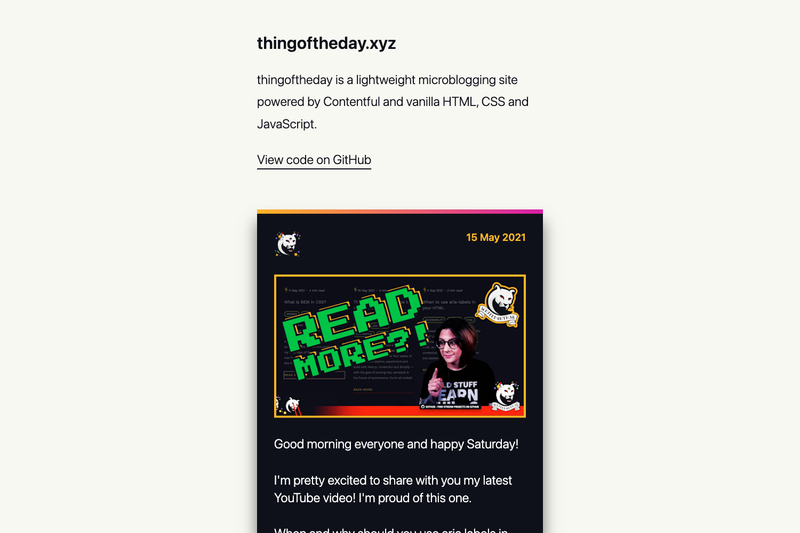
thingoftheday is a lightweight microblogging site template that uses Contentful as a headless CMS and vanilla HTML, CSS, and JavaScript to serve a fast, dependency-free microblog.
What is thingoftheday?
thingoftheday is a lightweight microblogging site template built with vanilla HTML, CSS, and JavaScript, using Contentful as its content management system. The repository includes a ready-to-import content model and example post, and the front end fetches entries through the Contentful Content Delivery API. The project also ships a Netlify function that generates an RSS feed, and it is accompanied by a detailed tutorial on the Contentful blog.
What makes thingoftheday stand out?
- No framework — The site uses only vanilla HTML, CSS, and JavaScript, with no build step or framework dependencies; content is loaded via ES modules and requires a local HTTP server for development.
- Contentful integration — A
contentful-export.jsonfile lets you import the entire content model and an example post using the Contentful CLI commandcontentful space import --space-id SPACE_ID --content-file contentful-export.json. - RSS generation — A serverless function located at
/.netlify/functions/rssoutputs an RSS feed of all posts; the live feed for thingoftheday.xyz is available at https://thingoftheday.xyz/.netlify/functions/rss. - Seven-step setup — The README walks through forking the repo, creating a Contentful space, adding credentials to
./setup/credentials.js, installing the Contentful CLI, importing content, and runningnpx http-serverto view the site locally. - Educational value — The repository links to a Contentful blog tutorial by the author, whitep4nth3r, explaining how the lightweight blog was built.
- Credential configuration — Space ID and Content Delivery API access token are stored in a single
./setup/credentials.jsfile that the front end reads to query Contentful.
Who should use thingoftheday?
Developers who want to learn how a headless CMS works in practice will find a minimal codebase that clearly shows how to fetch and render Contentful entries without a framework. Content creators who prefer a fast, bare-bones microblog can manage posts in Contentful while the front end stays light and quick. Netlify users can deploy the site and its RSS function with minimal extra configuration because the project is structured around Netlify Functions.
Use cases for thingoftheday
- Personal microblogging: Publish short daily updates or "thing of the day" posts using the imported Contentful content model and example post.
- CMS experimentation: Use the included content model as a starting point for testing Contentful's Content Delivery API and GraphQL playground.
- Learning vanilla JavaScript: Study how ES modules, fetch requests, and serverless functions work together in a real-world site with no bundler or transpiler.
How does thingoftheday work?
The setup follows a clear sequence: fork and clone the repository, create a Contentful space, copy your Space ID and Delivery API token into ./setup/credentials.js, install the Contentful CLI, import contentful-export.json to load the content model, and then start npx http-server in the repo root. The front end reads the credentials to request entries from Contentful, and the included Netlify function exposes an RSS feed at /.netlify/functions/rss.
FAQ
Is thingoftheday free to use?
Yes, the template itself is open source and uses only free tools: Contentful has a free tier, and the site can be hosted on Netlify's free tier. The repository does not mention any licensing costs, and the setup guide links to Contentful's free sign-up page.
Does thingoftheday use a framework?
No, it is built with vanilla HTML, CSS, and JavaScript. The only external service is Contentful, which provides the content API; there is no React, Vue, or other front-end framework involved.
What credentials do I need?
You need a Contentful Space ID and a Content Delivery API access token. These are generated in your Contentful dashboard under Settings and are stored in the ./setup/credentials.js file in the repository.
Can I generate an RSS feed?
Yes, the project includes a serverless function that produces an RSS feed. After deployment, visit /.netlify/functions/rss on your hostname to retrieve the feed, as demonstrated by the live feed at https://thingoftheday.xyz/.netlify/functions/rss.