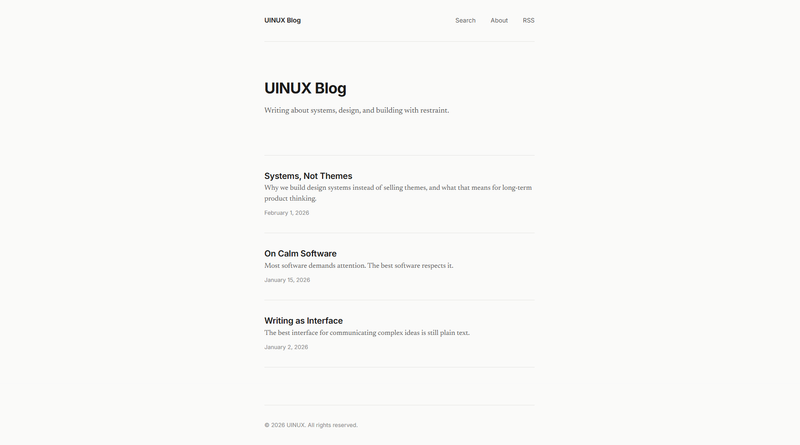
UINUX Blog is an Astro-based static blog template for long-form writing, designed around typography, whitespace, and readability rather than visual features or integrations.
What is UINUX Blog?
UINUX Blog is a static blog system built with Astro that turns Markdown or MDX files into a production-ready blog website. It accepts posts with frontmatter fields (title, description, date, tags) and outputs a static site with paginated post listings, tag pages, a client-side search page, an RSS feed, and JSON-LD structured data. It runs entirely on Node.js 18+ and requires no database, admin panel, or third-party services.
Key Features
- Astro framework — Built on Astro, generating static HTML and CSS with no client-side JavaScript except for search.
- Markdown/MDX content — Write posts as
.mdor.mdxfiles insrc/content/posts/, with content collection schema defined insrc/content/config.ts. - Client-side search — A static JSON search index is built at build time; the
/searchpage provides debounced instant results across title, description, tags, and full post body, with optional?q=linking. - Tag system — Posts support zero or more tags; browse all tags at
/tagsand filter by tag at/tags/[tag-name]. - Pagination — The home page shows 10 posts per page, with subsequent pages at
/page/2,/page/3, and so on. - SEO built in — Canonical URLs, Open Graph and Twitter Card meta, JSON-LD for WebSite, BlogPosting, and AboutPage, plus an RSS feed at
/rss.xml— all with zero third-party SEO libraries. - Minimal design — Serif body text (Newsreader), sans-serif headings (Inter), 640px content width, and no dark mode or component library; the entire UI is six Astro components.
- Google Search Console verification — Optional verification code via the
PUBLIC_GOOGLE_SITE_VERIFICATIONenvironment variable.
Who is it for?
UINUX Blog is for writers who want a quiet, focused publishing platform without dashboards or analytics. It also suits developers who prefer writing in Markdown and deploying a static site to any static host, and anyone who wants a blog with no tracking, no newsletter popups, and no growth-hack tooling.
What can you do with UINUX Blog?
- Long-form writers: publish essays and articles with clean typography and a 640px measure optimized for sustained reading.
- Independent bloggers: organize posts with tags, paginate the home listing automatically, and let readers search the full post body instantly.
- Astro developers: use the template as a starting point for a custom blog, with source files for all components, pages, and styles visible in the repository structure.
How does UINUX Blog work?
After clicking "Use this template," clone the repository, run npm install, delete the example posts in src/content/posts/, and update astro.config.mjs with your site URL. Then create Markdown or MDX files in src/content/posts/ with frontmatter for title, description, date, and optional tags, and run npm run dev for local writing or npm run build to output a static dist/ directory.
FAQ
Is UINUX Blog a CMS?
No. It has no admin panel, database, or integration layer. You write Markdown or MDX files locally and build the site with Astro; updates require rebuilding and redeploying the static output.
Does UINUX Blog have dark mode?
No. The template explicitly ships one light mode, no color presets, and no visual variants. This keeps the maintenance surface small and the reading experience consistent.
How do I add a new post?
Create a new .md or .mdx file in src/content/posts/, add frontmatter with title, description, date, and optional tags, then run the dev server to preview.
What search dependencies does it use?
The search feature has no dependencies and no external services. It uses a static JSON index generated at build time from the full post body, so search works entirely client-side at /search.
Can I deploy it anywhere?
Yes. npm run build produces a static dist/ directory that can be served by any static hosting service; the site also includes an RSS feed and SEO meta out of the box.