Yehez-NextTailwind-Starter is a boilerplate template that combines Next.js with TypeScript and Tailwind CSS, preconfigured with linting, formatting, testing, SEO, and changelog tooling so developers can skip setup and start building.
What is Yehez-NextTailwind-Starter?
Yehez-NextTailwind-Starter is a starter template created by Yehezkiel Gunawan for his own use, as stated in the repository description. It accepts a GitHub repository template or a degit/create-next-app command as input and produces a fully configured Next.js project with TypeScript, Tailwind CSS, ESLint, Prettier, Husky, lint-staged, standard-version, and next-seo already wired up. The template runs on Next.js 12 with Rust Compiler Minification enabled by default, which can be disabled in next.config.js.
Key Features
- Next.js 12 with Rust Compiler Minification — The template runs on Next.js 12 and enables Rust-based minification by default for faster builds; it can be turned off via
next.config.js. - TypeScript and Tailwind CSS — Written in TypeScript with Tailwind CSS for styling, and it includes a basic responsive layout configuration using Chakra UI media queries.
- Linting and formatting tooling — ESLint, Prettier, Husky, and lint-staged are preconfigured; the ESLint config is published as the
eslint-config-yehezgunnpm package. - SEO optimization — next-seo is integrated for managing meta tags and search engine optimization.
- Changelog generation — Standard-version is included to generate changelogs; run
npx standard-version --skip.bump --skip.commit --skip.tagto create one. - Testing setup — Unit and integration tests are included; use
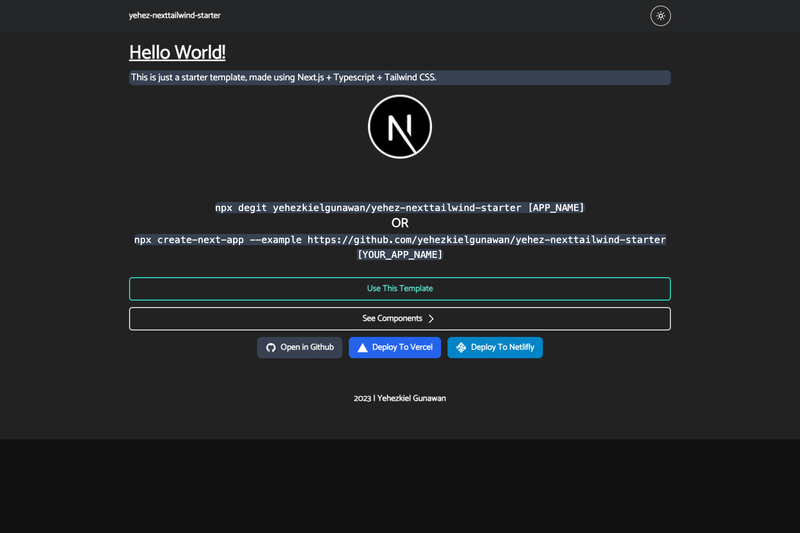
yarn testoryarn test:cito run them and view coverage. - One-click deployment — The template provides deploy buttons for Vercel and Netlify that import the repository directly.
Who should use Yehez-NextTailwind-Starter?
Developers who want to start a new Next.js project without configuring tooling from scratch will find this template useful. It is specifically suited for solo developers and hobbyists who want a minimal but opinionated setup, as well as for teams that want consistent linting and formatting conventions via the shared ESLint config. React developers who prefer TypeScript and Tailwind CSS can also use it to scaffold a project quickly.
What can you do with Yehez-NextTailwind-Starter?
- Solo developers: Scaffold a personal project with
npx degit yehezkielgunawan/yehez-nexttailwind-starter your-app-nameand get a working Next.js + TypeScript + Tailwind app with linting and tests. - Teams: Adopt the shared ESLint configuration
eslint-config-yehezgunacross projects to enforce code style consistency. - Product teams: Deploy directly to Vercel or Netlify via the provided buttons and use next-seo to manage page metadata.
How does Yehez-NextTailwind-Starter work?
After cloning the template with degit, create-next-app, or the GitHub 'Use this template' button, install dependencies with npm install or yarn. Then run yarn dev or npm run dev to start the local development server; run yarn test or yarn test:ci to run the included unit and integration tests and inspect coverage.
Alternatives
- Theodorus Clarence's ts-nextjs-tailwind-starter — a similar Next.js + Tailwind starter that is cited as the main reference for this template.
- Vercel's create-next-app — the official Next.js scaffold, which is less opinionated and doesn't include the same linting and testing setup.
FAQ
Is the template free to use?
Yes, the repository is open source and can be copied, forked, or cloned without any cost; you can also create a new GitHub repository using the "Use this template" button.
How do I deploy this template?
The README includes deploy buttons for Vercel and Netlify that import the repository directly. You can also deploy manually by connecting the repository to either platform.
What testing setup is included?
The template comes with unit and integration tests; running yarn test or yarn test:ci executes the test suite and provides coverage output, which helps you understand the testing patterns before modifying them.
Can I customize the template's configuration?
Yes, the Next.js configuration is in next.config.js, where you can disable Rust Compiler Minification; ESLint and Prettier settings are also open to modification.