Newsletter
Join the Community
Subscribe to our newsletter for the latest news and updates

Open-source, self-hostable AI chat interface supporting OpenAI, Claude, Gemini, Mistral, and local Ollama models.
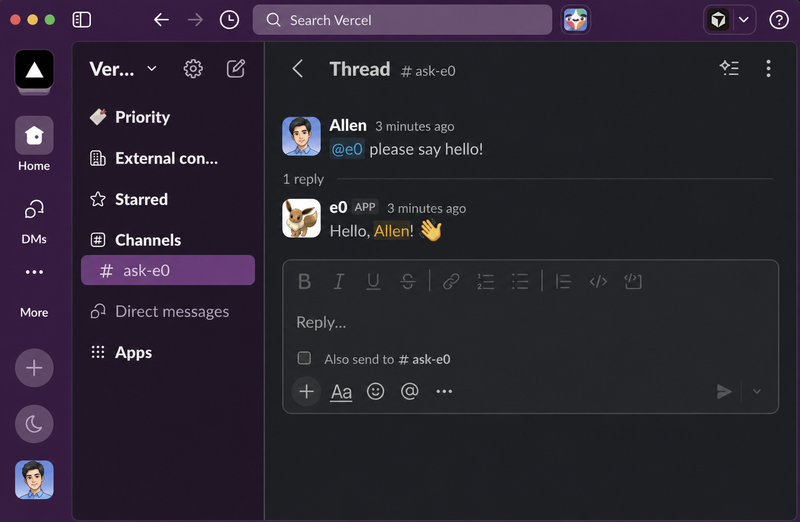
An eve template for Slack agents with webhook handling, Vercel Connect credential management, a starter agent, and an example tool.
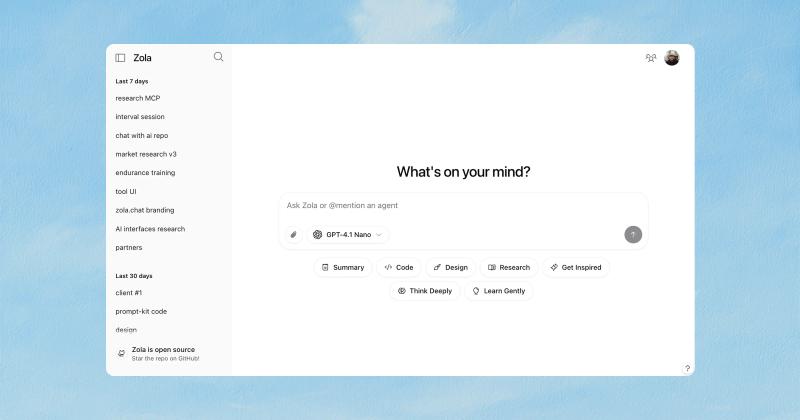
Zola is an open-source, self-hostable AI chat interface that connects to OpenAI, Mistral, Claude, Gemini, and local Ollama models from a single Next.js web app. Published on GitHub as ibelick/zola under the Apache License 2.0, it lets you clone the repo, set a provider API key, and run a multi-model chat UI locally, in Docker, or on Vercel.
Zola is a chat front end rather than a model of its own: it accepts text prompts and uploaded files as input and returns responses from whichever AI provider you configure. It is distributed as Next.js and TypeScript source code on GitHub (ibelick/zola), and the page states it is currently a beta release whose codebase is still evolving. You can run it on your own machine, in Docker alongside Ollama, or deploy it to Vercel with a one-click clone button.
The stack behind it is Next.js with TypeScript, Tailwind CSS and shadcn/ui for core components, prompt-kit for AI components, motion-primitives for animation, the Vercel AI SDK for model integration, and Supabase for auth and storage.
Getting started is a clone-and-run flow: clone github.com/ibelick/zola, run npm install, write your provider key into .env.local, then npm run dev. For local models you install Ollama and pull a model first, and Zola detects the available models automatically. Docker users can bring up the Ollama compose file instead of installing Node dependencies manually.
Zola is free and open source under the Apache License 2.0. There is no paid Zola tier on the page; any cost comes from the model provider you connect (for example OpenAI) or from your own hardware when running Ollama locally.
Yes. Zola is released as open-source software under the Apache License 2.0, so it can be self-hosted at no cost. Any spending comes from the AI provider you connect, or from your own hardware if you run local Ollama models.
Zola supports OpenAI, Mistral, Claude, and Gemini as cloud providers, plus Ollama for local models. It also supports bringing your own API key through OpenRouter, which can route requests to additional models.
Yes. Install Ollama, pull a model such as llama3.2, then start Zola and it automatically detects your local Ollama models. A docker-compose.ollama.yml file launches Zola and Ollama together in containers.
Auth and file uploads are gated behind additional configuration described in INSTALL.md rather than working out of the box. MCP support is listed as work in progress, and the project is a beta release whose codebase may change.
Zola is a Next.js and TypeScript application styled with Tailwind CSS, using shadcn/ui for core components, prompt-kit for AI components, motion-primitives for animated components, the Vercel AI SDK for model integration, and Supabase for auth and storage.