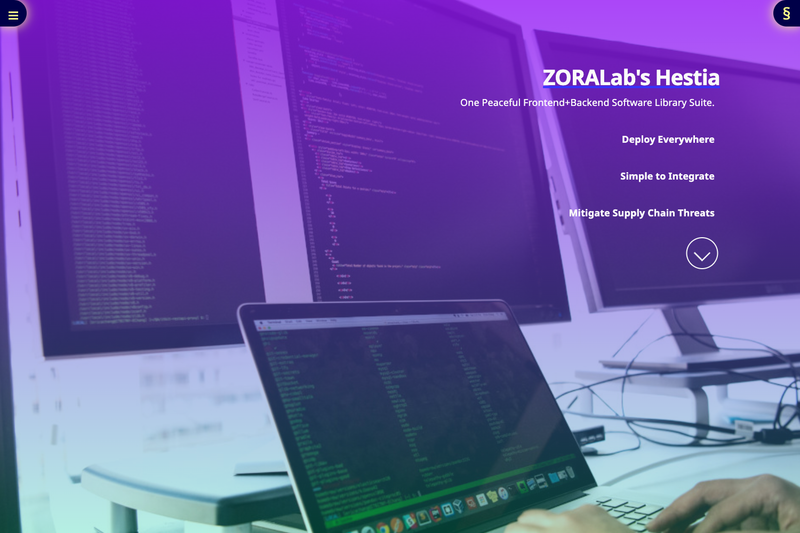
ZORALab's Hestia is an open-source frontend and backend software library suite that unifies common libraries and data structures into a single repository for reuse across Hugo, Go, TinyGo, and Nim targets.
What is ZORALab's Hestia?
ZORALab's Hestia is a unified library suite developed by ZORALab, consolidating common libraries and data structures to improve reusability, smooth learning curves, and tool alignment. It takes source code and content as input and produces static PWA websites, WASM binaries, and embedded microcontroller binaries. The suite runs on anything that can compute, from servers to microcontrollers, and is built around interoperability with Hugo, Go, TinyGo, and Nim.
Key Features
- Unified repository — One repository combines libraries and data structures for consistent reuse across projects.
- Multi-language interop — Code is interoperable between Hugo, Go, TinyGo, and Nim, covering backend, frontend UI, PWA, WASM, and embedded targets.
- PWA+WASM content servers — Phase 1 (completed February 9, 2023) natively builds PWA static websites with Hugo, with features like precise content compilation, portable offline HTML, CSS variables compilation, favicon generation, and JS compilation.
- WASM frontend takeover — Phase 2 (working, v2.X.X) lets you build entire frontend UIs using Go, TinyGo, or Nim compiled to WASM binaries, backward-compatible for non-WASM users.
- Microcontroller support — Phase 3 (planned, v3.X.X) will make libraries usable on 8/16/32-bit microcontrollers ELF and binaries natively via TinyGo and Nim, optimized for small footprints.
- Supply chain security — Distribution uses a simple zip archive with a GPG cryptography signature for integrity checking, reducing risks from geo-political or supply chain threats.
- Offline documentation — The official website is offline-capable by default; install it as a PWA app and visit pages while online to cache them for later.
Who is it for?
ZORALab's Hestia is for developers and teams who want a consistent library suite across web and embedded environments.
- Web developers using Hugo — Build static PWA websites with built-in offline support, CSS variables, favicon generation, and JS compilation.
- Go, TinyGo, and Nim developers — Write frontend UI code in backend languages and compile to WASM binaries that run natively in the browser.
- Embedded systems engineers — Use the same libraries on 8/16/32-bit microcontrollers with TinyGo and Nim, planned for small-footprint optimized builds.
What can you do with ZORALab's Hestia?
- Create offline-capable PWA sites — Use Hugo to generate static websites with offline capabilities and precise content compilation.
- Build WASM frontend apps — Compile Go, TinyGo, or Nim code into WASM binaries for reactive or SPA-style rendering.
- Reuse code across platforms — Write logic once and deploy it to servers, browsers, and microcontrollers using the same library suite.
- Integrate securely — Distribute or consume the library as a zip file with GPG signature verification.
FAQ
Is ZORALab's Hestia free?
The code is licensed under the OSI-compliant Apache 2.0 license, so the code is free to use. Media assets such as images and audio are under a restricted license, and you should contact the artists directly for those.
Does Hestia work with Hugo?
Yes. Hugo is one of the key technologies, and Phase 1 (completed February 9, 2023) delivers a Hugo-based PWA content server. Hestia is designed to interoperate with Hugo, Go, TinyGo, and Nim.
Can I use Hestia offline?
The official documentation website is offline-capable by default. You can install it as a PWA app and visit the pages you need while online; they will be available offline later.
Is Hestia complete?
Phase 1 (PWA+WASM content servers) is completed, Phase 2 (pure WASM frontend takeover) is working, while Phases 3 (microcontrollers) and 4 (wrap-up) are planned. So the library is actively developed but not fully finished.