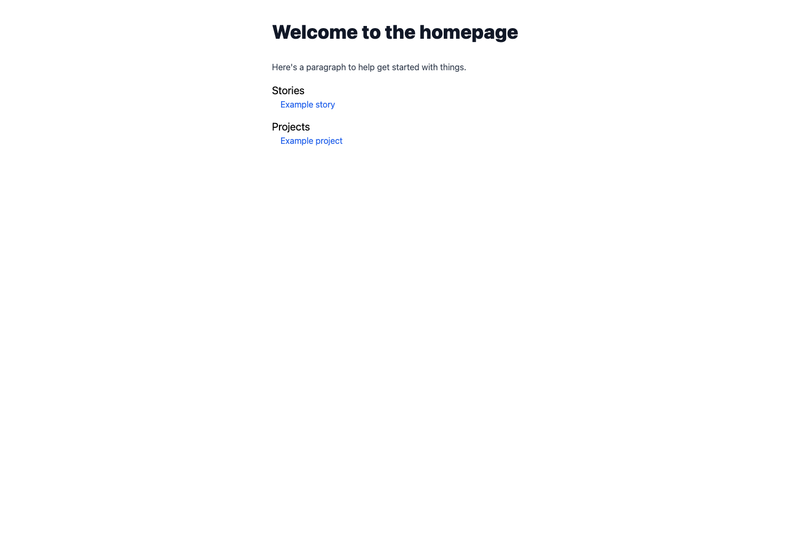
The Minimal 11ty + Tailwind starter kit is a boilerplate for building static websites with the Eleventy static site generator and the Tailwind CSS utility-first framework.
What is the 11ty Tailwind Starter?
This starter kit is a minimal starting point for an Eleventy + Tailwind project. It combines the Eleventy static site generator with TailwindCSS utility-first CSS to produce static websites with minimal overhead. The project is designed to be cloned and then used productively without spending time learning the setup, cleaning out example files, or reconfiguring the technology.
Key Features
- Eleventy static site generator — Uses 11ty for building static sites from Markdown content and templates.
- TailwindCSS utility-first CSS — Styles components with Tailwind's utility classes; production builds prune and minify CSS using the Tailwind CLI.
- Simple npm scripts — Provides
npm run build,npm run build:production,npm run watch, andnpm run deployfor development, production builds, live reload, and GitHub Pages deployment. - GitHub Pages deployment — The
deploytask runs a production build and pushes the_sitedirectory to thegh-pagesbranch. - No module bundler — Purposely leaves out client-side JavaScript bundling so the end-developer can choose their own packaging approach.
- Path prefix support — The
build:productiontask references apathprefixvalue inpackage.json, useful for hosting on GitHub Pages subpaths.
Who is it for?
- Developers starting a new static site — who want a minimal Eleventy + Tailwind setup without extra configuration files or starter-specific boilerplate to delete.
- Developers deploying to GitHub Pages — who need a predefined deploy task that compiles production assets and publishes the
_siteoutput to thegh-pagesbranch. - Developers who prefer a plain build toolchain — who want no module bundler by default and plan to add their own JavaScript packaging later.
What can you do with it?
- Create a content-driven marketing site — use Eleventy's Markdown-based collections to generate pages and Tailwind utilities for styling.
- Set up a blog or documentation site — write content in Markdown, build with 11ty, and deploy via the included GitHub Pages workflow.
- Prototype a static page quickly — run
npm run watchto get live reload during development andnpm run buildto produce a dev build.
How does it work?
The project defines four primary npm tasks. npm run build outputs a development build. npm run build:production creates a production-ready build in the _site directory, pruning and minifying the CSS via the Tailwind CLI, and requires updating or removing the pathprefix value in package.json for GitHub Pages. npm run deploy runs the production build then pushes _site to the gh-pages branch. npm run watch starts the 11ty dev server in watch mode while also watching the Tailwind style directory.
Pros and cons
- Pros: Minimal scaffold to start quickly; built-in GitHub Pages deployment; no forced JavaScript bundler; relies on two widely used open-source projects.
- Cons: No JavaScript module bundler included, so client-side JS packaging is left to the developer; no built-in HTML minification during production builds (listed under considerations).
FAQ
Does this starter kit include a JavaScript bundler?
No. The README explicitly states there is currently no module bundler for packaging client-side JavaScript, leaving that decision to the end-developer.
How do I deploy this to GitHub Pages?
Use npm run deploy. This command runs a production build and pushes the resulting _site directory to the gh-pages branch. You also need to update or remove the pathprefix value in package.json for the production build to work correctly with GitHub Pages.
What is the pathprefix for?
The build:production task relies on a pathprefix value in package.json. This is the base path your site will be served from, which is necessary when deploying to GitHub Pages on a subpath like username.github.io/repo.
Can I use this starter for a blog?
Yes. Eleventy natively processes Markdown files, so you can structure content as blog posts. The template itself does not include example blog post layouts — the source page shows only the basic setup, not a full blog scaffold.
Is this starter kit free?
The repository does not mention any licensing or pricing, and it is a public README for a starter kit, so it is effectively free to use.