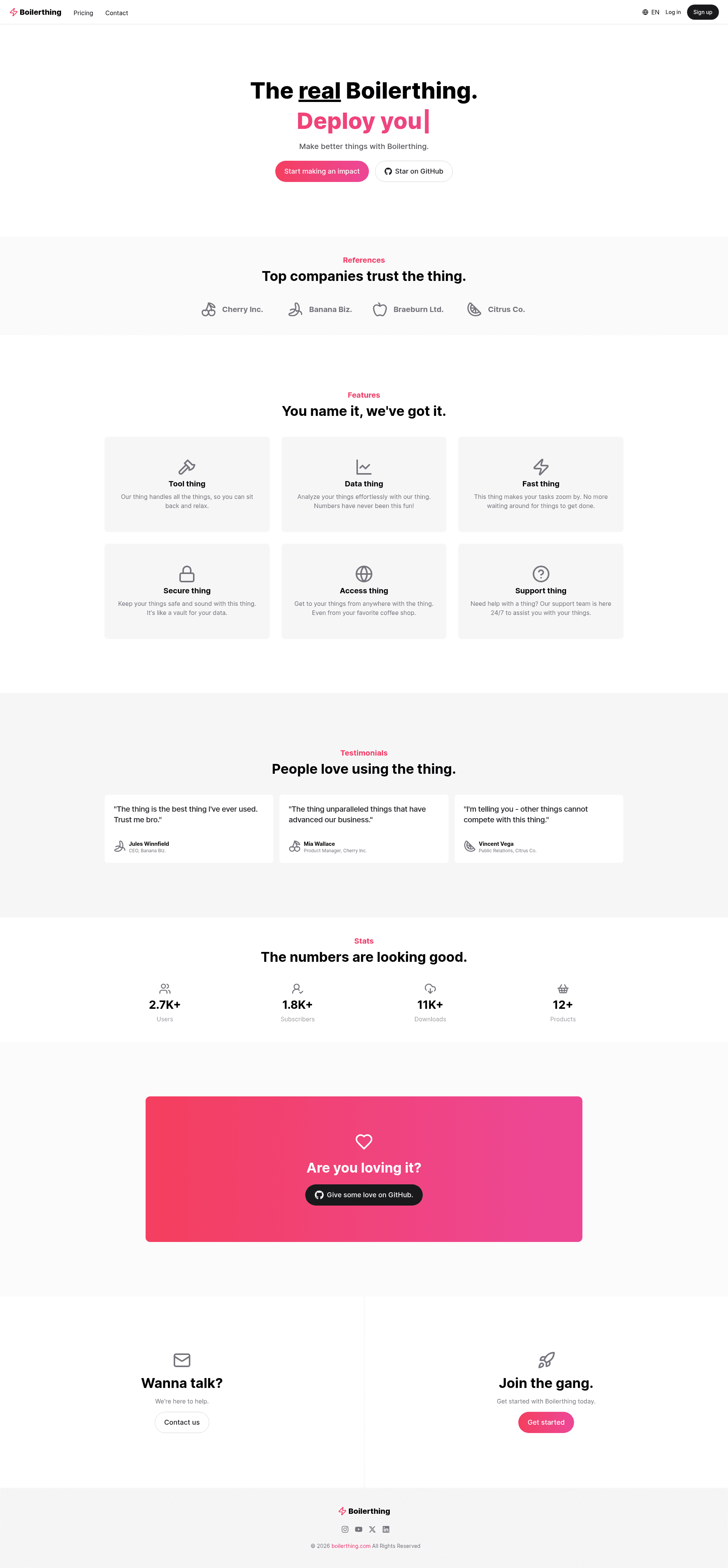
Boilerthing is a free, open-source Next.js 14 boilerplate built with the App Router, bundling authentication, internationalized routes, Prisma ORM, email delivery, and a Tailwind-plus-shadcn/ui interface so developers can skip configuration and move straight to building a SaaS or web application.
What is Boilerthing?
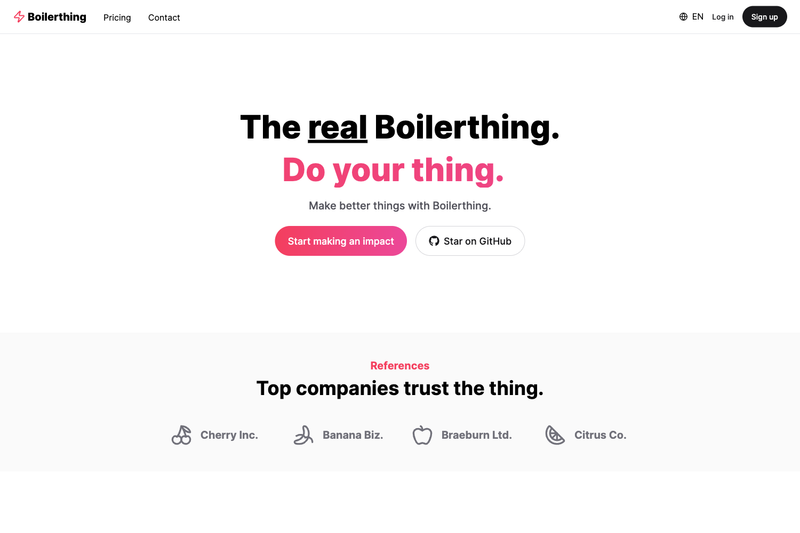
Boilerthing is a starter template for Next.js 14 projects, created by Egor Kirpichev (GitHub: eeegor) and released under the MIT License in 2024. It takes a developer's app requirements and returns a pre-configured codebase with Next-auth v5 for authentication, Next-intl for translated routes, Prisma ORM for database access, Resend for sending emails, and a UI layer built from Tailwind CSS 3.4, shadcn/ui, and Radix UI. A live demo runs at boilerthing.vercel.app.
Key Features
- Next.js 14 with App Router — The project uses the modern file-based routing system, with a centralized app config file that keeps global settings in one place for easy modification.
- Next-auth v5 — Flexible authentication supporting multiple strategies; the project includes the required configuration to drop in credentials or OAuth providers.
- Next-intl internationalization — Translates not only UI strings but also routes, so each locale has its own URL structure; ideal for multilingual sites.
- Prisma ORM with Docker Compose — Database schema management through Prisma Migrate/DB push, plus a Docker command to launch a local PostgreSQL instance for development.
- Tailwind CSS 3.4 with mobile-first design — Utility classes with a responsive-first approach, paired with shadcn/ui and Radix UI accessible components.
- Form handling stack — React Hook Form combined with Zod validation and ReCaptcha protection; Resend handles email sendings such as verification or notifications.
- Type-safe environment variables — T3 Env validates configuration at build time, failing fast on missing variables.
- Developer tooling — ESLint for linting, Prettier with import sorting, Sentry for error monitoring, and absolute imports using the @ prefix.
Who is it for?
- SaaS developers — Quickly bootstrap a multi-tenant app with authentication, a database layer, and email notifications already wired together.
- International product teams — Start with a working i18n setup including translated routes, which is time-consuming to add later.
- Developers learning the modern Next.js stack — Use the repository as a reference implementation combining App Router, server components, auth, and a shadcn/ui design system.
- Startup founders — Ship a marketing landing page and core app shell faster by customizing the included hero section with a typewriter effect instead of building it from scratch.
What can you do with Boilerthing?
- Launch an MVP — Replace placeholder content and add your own features to get a working product with auth, database, forms, and email in one deployment.
- Build a multilingual site — Manage several locales via Next-intl with translated routes and switch languages without rearchitecting routing.
- Set up a monitored production app — Use the included Sentry integration to track errors and T3 Env to keep configuration safe.
How does Boilerthing work?
The starter flows through a simple setup: run a PostgreSQL container using Docker Compose, initialize the Prisma client and database schema, copy .env.example to .env and fill in values, then start the development server with npm run dev. The roadmap lists planned additions such as Jest tests, Posthog analytics, Stripe payments, AWS integration, and an admin dashboard.
FAQ
Is Boilerthing free?
Yes, Boilerthing is free and open source under the MIT License. You can use it for personal and commercial projects and modify it without restriction, as long as the copyright notice is preserved.
What framework does Boilerthing use?
It is built on Next.js 14 with the App Router, TypeScript for type checking, and Tailwind CSS 3.4 for styling. Authentication uses Next-auth v5, the database layer uses Prisma ORM, and UI components come from shadcn/ui and Radix UI.
Does Boilerthing include a database?
It integrates Prisma ORM and provides a Docker Compose command to run a local PostgreSQL instance. Development setup requires running the database, then running prisma generate and prisma db push to sync the schema.
Can I use Boilerthing for a commercial product?
Yes, the MIT license allows commercial use. The author, Egor Kirpichev, explicitly welcomes contributions and feedback via GitHub issues.