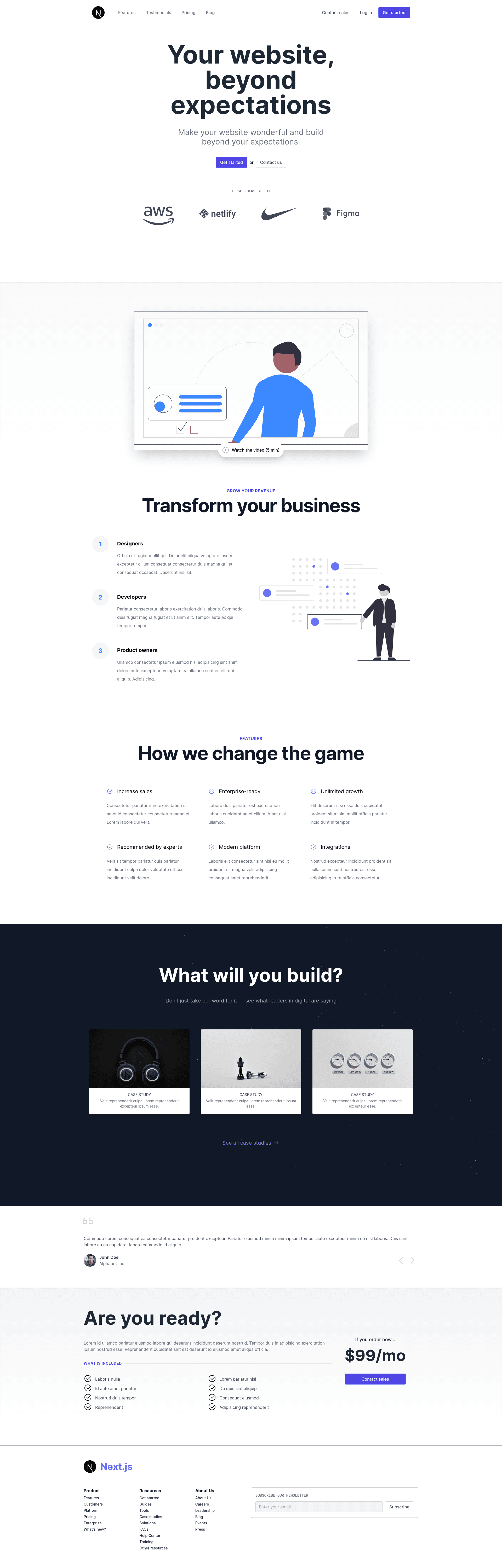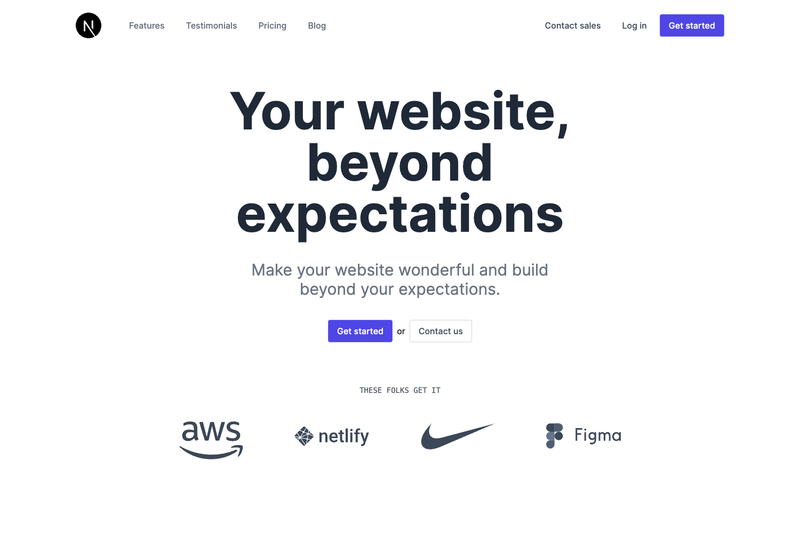
Next.js Template1 is a free, MIT-licensed landing page template built with Next.js and TypeScript, designed to give SaaS products and online services a ready-to-run marketing page with a live demo hosted at nextjs-template1.vercel.app.
What is Next.js Template1?
Next.js Template1 is a landing page template for SaaS products, online services, and similar web projects. It takes the source code from a GitHub repository as its input and produces a deployable Next.js website, using TypeScript for type safety and Twind for styling. The template is free to use and released under the MIT License, with a live demo available at nextjs-template1.vercel.app.
Key Features
- Next.js framework — Built on the React-based Next.js framework, which provides server-side rendering, static site generation, and file-based routing out of the box.
- TypeScript support — The entire template is written in TypeScript, giving you static typing and better editor autocompletion from the start.
- Twind styling — Uses Twind, a Tailwind-in-JS solution that compiles Tailwind-like utility classes at runtime, keeping the bundle small and configuration in TypeScript.
- next-seo integration — Includes next-seo to manage page metadata and structured data, making on-page SEO easier to handle.
- ESLint + Prettier — Pre-configured with ESLint for linting and Prettier for opinionated code formatting, with lint-staged to run linters on staged files.
- Husky git hooks — Uses Husky to run commit hooks, plus Commitizen and Commitlint to enforce conventional commit message formats.
- Renovate dependency updates — Includes Renovate configuration to automate dependency update pull requests.
- Absolute imports — Configured to import files and folders using the @ prefix, avoiding fragile relative paths.
Who is it for?
- SaaS founders — who need a clean landing page to present their product before launching, and want to customize the copy and colors.
- Next.js developers — who want a ready-made starter with TypeScript, styling, and code-quality tools already wired up, so they can skip boilerplate setup.
- Open-source contributors — who want to use a free, MIT-licensed template that accepts pull requests and has a live demo to preview changes.
What can you do with Next.js Template1?
- Launch a marketing site fast — Clone or generate the template from GitHub, run
yarnandyarn dev, and edit the components to create a landing page for your product. - Set up SEO from the start — Use the built-in next-seo integration to update page titles, descriptions, and Open Graph tags without writing custom head code.
- Maintain code quality — Rely on the included ESLint, Prettier, Husky, Commitizen, and Commitlint setup to keep the codebase consistent and conventional commits enforced.
How does Next.js Template1 work?
Getting started is straightforward: after generating or cloning the repository, install dependencies with yarn, start the development server with yarn dev, and open http://localhost:3000 to view the site. The template includes a live demo link to nextjs-template1.vercel.app for quick previewing before cloning.
Pricing
Next.js Template1 is free and open source, released under the MIT License, meaning you can use it for personal and commercial projects without paying a fee.
FAQ
Is Next.js Template1 free?
Yes, the template is completely free to use and is licensed under the MIT License, which allows you to modify and use it in commercial projects as long as you retain the copyright notice.
What styling solution does Next.js Template1 use?
It uses Twind, a Tailwind-in-JS library. Instead of a separate Tailwind CSS build step, Twind generates utility classes at runtime, which keeps the setup lightweight and configuration in TypeScript.
How do I run Next.js Template1 locally?
Clone or generate the repository, run yarn to install dependencies, then run yarn dev and open http://localhost:3000 in your browser. The development server will hot-reload changes.
Does Next.js Template1 include SEO tools?
Yes, it includes next-seo, a React plugin that simplifies managing page metadata, Open Graph tags, and JSON-LD structured data for better search engine visibility.