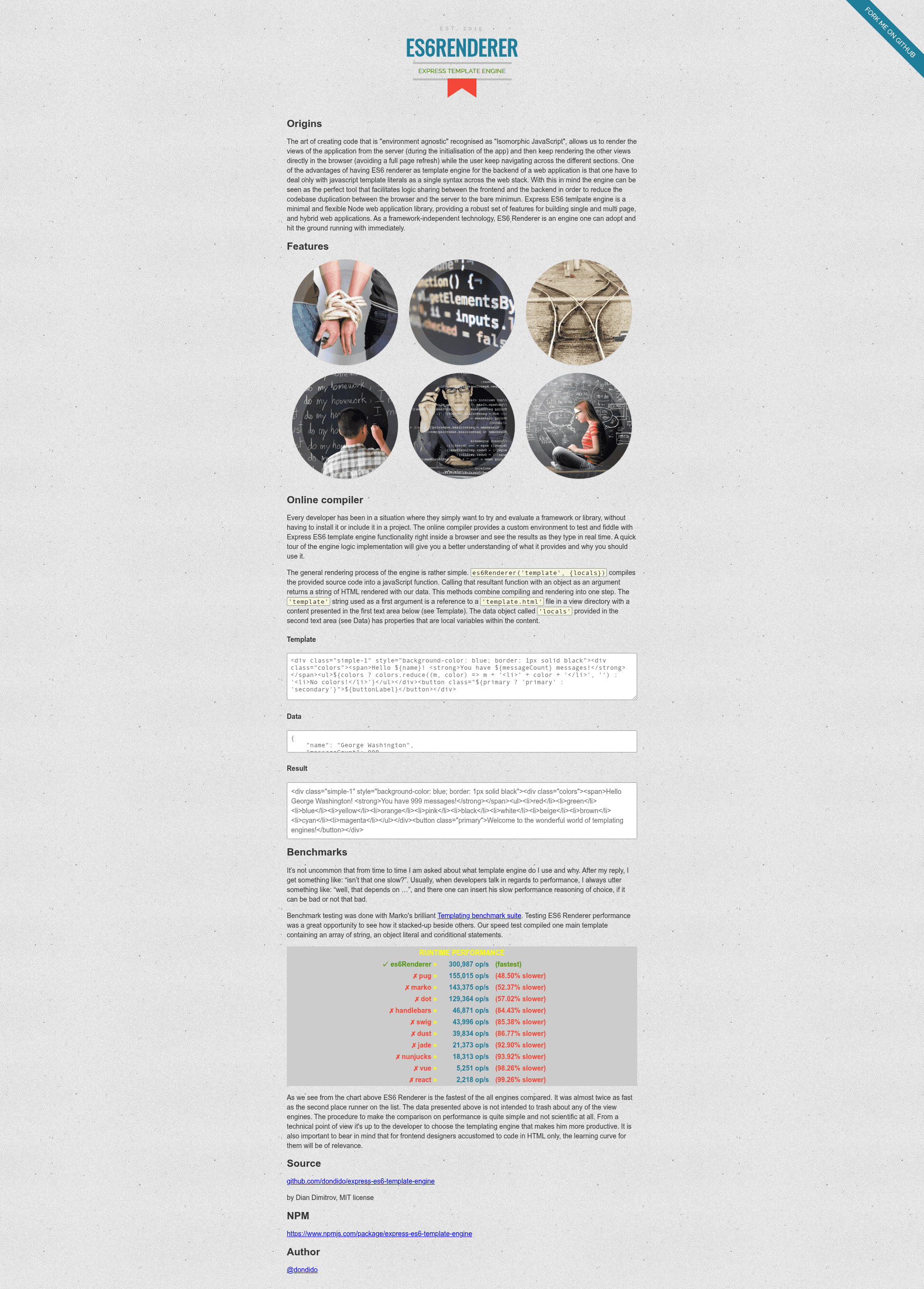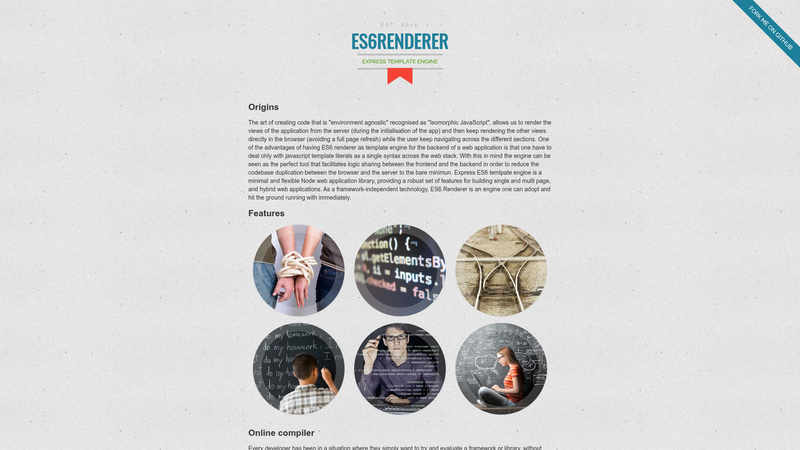
express-es6-template-engine is an Express-compatible template engine that renders HTML views from ES6 template literal syntax, letting developers use native JavaScript expressions inside backtick-delimited templates without learning a custom template language.
What is express-es6-template-engine?
A template engine for Node.js and Express applications that uses pure ES6 JavaScript template strings as its syntax. It scans files in a working directory, reads their contents, converts plain strings to ES6 template strings, and compiles them to text using the V8 engine. The package is under 1kb, has zero dependencies, and requires Node.js version 4.0.0 or higher. It is developed by Dian Dimitrov and released under the MIT License.
What makes express-es6-template-engine stand out?
The engine requires no new syntax beyond standard ES6 template literals, so any JavaScript developer can start using it immediately.
- No dependencies — The package has zero runtime dependencies, keeping your project lightweight.
- V8-compiled performance — Templates are compiled and interpreted directly by the V8 engine, adding negligible overhead to an Express app.
- Partials support — You can inject one template into another by passing a
partialsobject tores.render, exactly as shown in the partial examples. - Conditional and iteration support — Use native JavaScript
ifexpressions and.map()calls inside template literals to render conditionals and loops. - Precompilation — Templates can be compiled once into a function and invoked later, which is faster than rendering each time.
- Synchronous and asynchronous invocation — The engine supports both a synchronous compiled-function call and an async callback/promise-based mode.
- Built-in error handling — Errors from synchronous code are caught automatically, and async errors can be handled via callbacks or promise rejection.
Who should use express-es6-template-engine?
Any Express developer who wants to render views without introducing a separate template language will find this engine useful.
- Express back-end developers — Set the engine with
app.engine('html', es6Renderer)and render.htmlfiles containing${...}expressions. - Teams standardizing on ES6 — Developers already comfortable with template literals can apply the same syntax in server-side views.
- Performance-conscious projects — Because templates are precompiled to JavaScript functions, the runtime rendering cost is minimal.
What can you do with express-es6-template-engine?
- Render dynamic HTML pages — Pass a
localsobject with variables liketitleand inject them into templates using${title}placeholders. - Compose pages from partials — Break a page into reusable partial files and inject them into a parent template with the
partialsoption. - Precompile templates for speed — Compile a string once into a function and call it multiple times with different variable values, avoiding repeated file reads.
- Render templates without Express — Call the exported function directly with a file path, an options object, and a callback to get rendered output in any Node.js script.
How does express-es6-template-engine work?
The engine first scans the template files in the configured views directory and reads their contents. It then converts the file content into ES6 template literal strings, which are compiled by the V8 engine into executable JavaScript functions. When rendering, it passes the locals object into the function, evaluates any embedded expressions, and returns the final HTML string through a callback or promise.
Pros and cons
- Fast — Compilation is handled by V8, and the engine itself is less than 1kb.
- No learning curve — Uses standard ES6 template literals instead of a proprietary syntax.
- Flexible partials — Partials are just other template files, and they can be passed per render call.
- Nesting not supported — Template nesting is currently not supported; the recommended workaround is to perform multiple compilations manually.
FAQ
Do I need to learn a new template syntax?
No. express-es6-template-engine uses native ES6 template literals, so if you already know JavaScript template strings, you can start rendering views immediately.
How do I use partials with this engine?
Pass a partials object to res.render with keys matching the placeholders in your template and values pointing to the partial file names. The engine injects the rendered partial at render time.
Can I precompile templates?
Yes. You can call the engine with a string and a list of variable names to get a compiled function. For example, es6Renderer(text, 'engineName, place') returns a function that you can call with the variable values.
Is express-es6-template-engine free?
Yes, it is released under the MIT License and can be used freely in commercial and personal projects.
Does it support template nesting?
No, template nesting is not currently supported. The documentation suggests performing multiple template compilations and passing the result as a local variable to work around this limitation.