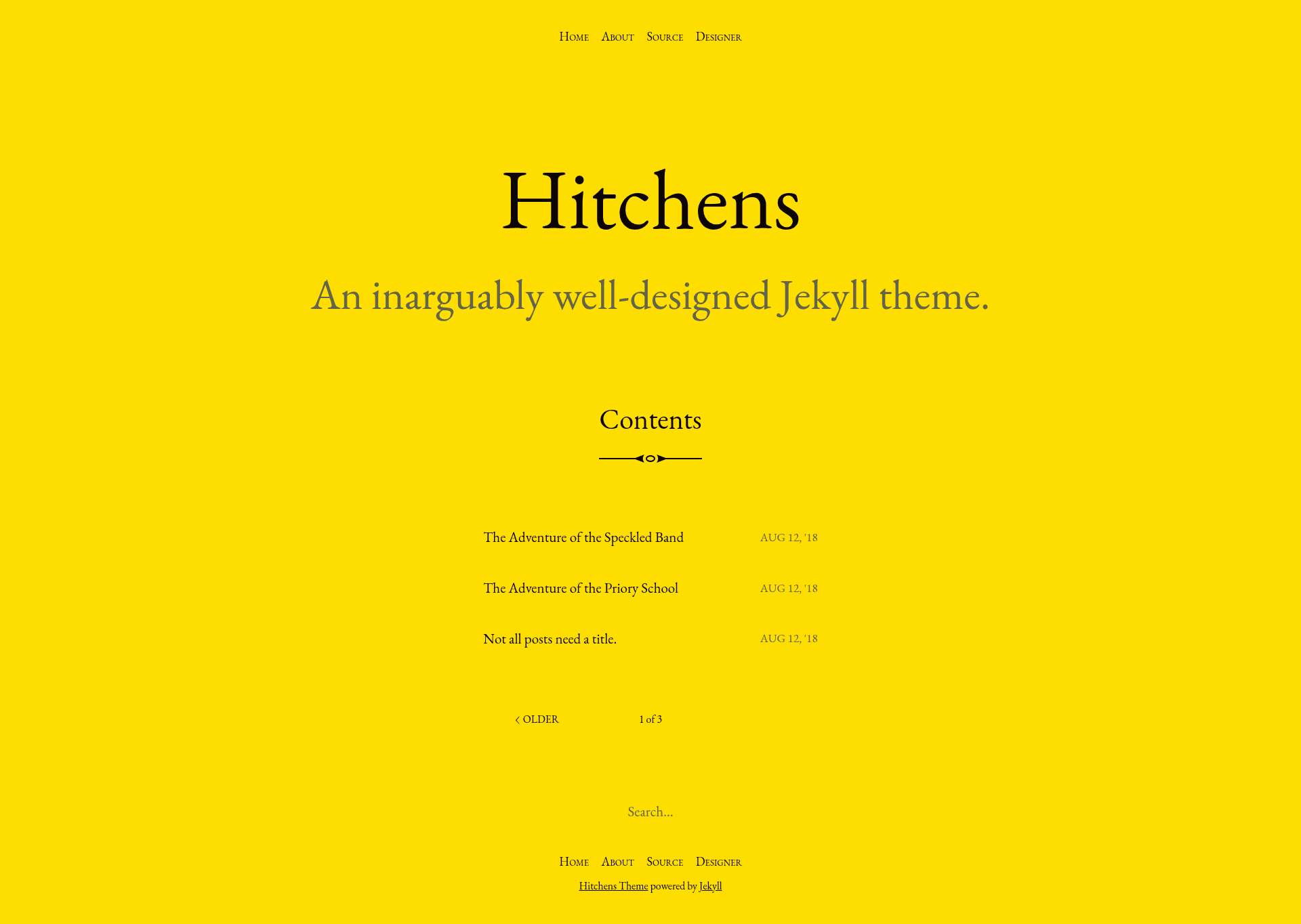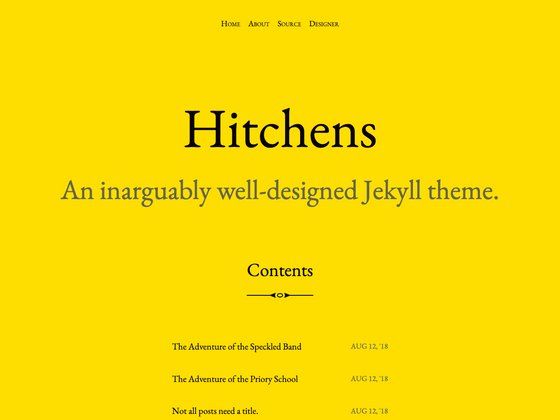
Hitchens is a Jekyll blog theme created by Pat Dryburgh that turns a standard Jekyll site into a text-first, long-form blog, inspired by the trade paperback design of Christopher Hitchens's Arguably.
What is Hitchens?
Hitchens is a Jekyll theme designed for long-form writing. It runs on Jekyll and ships with a home layout that lists articles chronologically, a sparse post layout for reading, and configurable features like excerpts, pagination, and a DuckDuckGo search form. The theme was created by Pat Dryburgh and is open source under the MIT License. It is also available as ports for Hugo and Eleventy.
Key Features
- Jekyll-based theme — The theme is itself a Jekyll blog; you can fork it and run it on GitHub Pages with minimal configuration.
- Home layout with pagination — Posts are listed chronologically; pagination is enabled via the
jekyll-paginateplugin with configurablepaginateandpaginate_pathsettings. - Excerpt control — Set
show_excerpts: trueto display post excerpts;excerpt_lengthcontrols truncation (default 20 words,0disables truncation). - Navigation menu — Define menu items in
_data/menu.ymlto show links in the masthead and footer. - Title-less posts — Publish posts with an empty
titlein front matter; the home page shows a truncated first paragraph instead. - Search form — Includes a custom DuckDuckGo search form that can be turned off with
hide_search: true. - Bundled font — Ships EB Garamond (SIL OFL licensed) as the closest open alternative to the Arguably cover font.
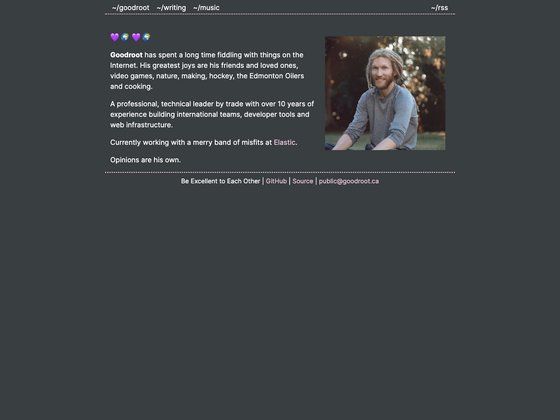
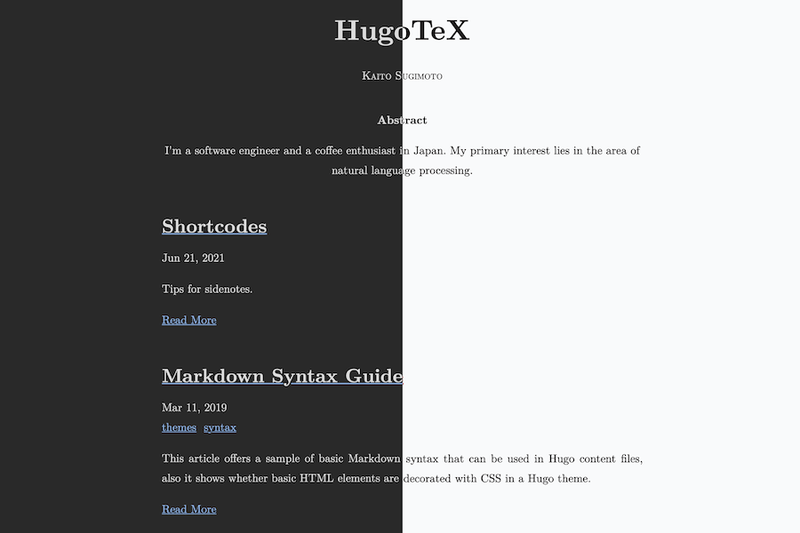
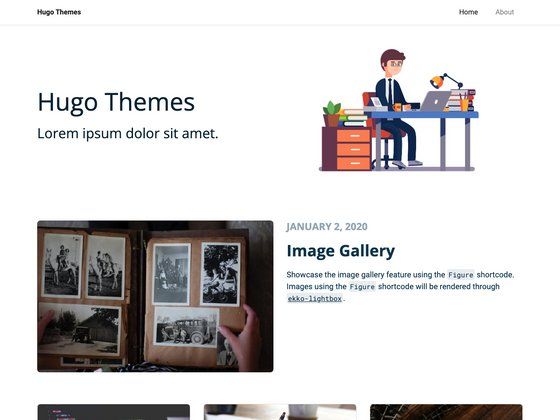
- Cross-platform ports — Hitchens for Hugo and Hitchens for Eleventy are maintained by separate authors.
Who should use Hitchens?
- Writers and bloggers who want a clean, text-focused design for essays and long-form articles.
- Jekyll users who want a ready-to-run blog theme with built-in pagination, excerpts, and search.
- Publishers on GitHub Pages who want to launch a blog by simply forking the repository and setting the Pages source.
- Developers who prefer a minimalist theme with source code they can modify under the MIT License.
What can you do with Hitchens?
- Publish a personal blog: Fork the repo, enable GitHub Pages, and start writing posts with the
postlayout. - Microblog without titles: Use title-less posts to publish short updates that appear as excerpts on the home page.
- Customize navigation and search: Add menu items via
_data/menu.ymland toggle the DuckDuckGo search form in_config.yml. - Switch platforms: If you migrate to Hugo or Eleventy, use the community ports to keep the same design.
How does Hitchens work?
To get started, fork the repository and set the GitHub Pages source to the Master branch. For an existing Jekyll site, add gem "hitchens-theme" to your Gemfile and set theme: hitchens-theme in _config.yml. Run bundle to install dependencies, then bundle exec jekyll serve to preview locally at http://localhost:4000.
Pricing
Hitchens is free and open source under the MIT License. The bundled EB Garamond font is licensed under the SIL Open Font License 1.1, and graphics are released to the public domain.
FAQ
Is Hitchens free to use?
Yes. The theme code is open source under the MIT License, meaning you can use, modify, and distribute it freely.
Can I remove the theme credits?
Yes. Add hide_credits: true to your _config.yml file to hide the credits that appear at the bottom of each page.
Does Hitchens support pagination?
Yes. The theme uses Jekyll's built-in pagination. Add gem "jekyll-paginate" to your Gemfile and configure paginate and paginate_path in _config.yml.
Can I use Hitchens with Hugo or Eleventy?
Yes. Pete Moore maintains a Hugo port and Jason Shellen maintains an Eleventy port, both linked from the theme's repository.
What font does Hitchens use?
The theme includes EB Garamond, designed by Georg Duffner and Octavio Pardo, which is the closest open-licensed alternative to the font on the cover of Arguably.