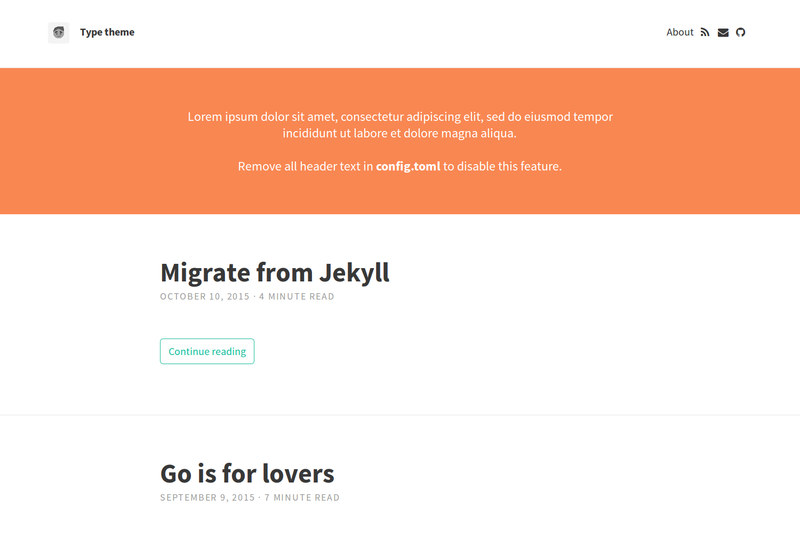
Hugo Type is a free, open-source Hugo theme for blogs, ported from Rohan Chandra's Type theme by digitalcraftsman, that bundles Disqus comments, Google Analytics, and localization support into a clean, typography-focused layout.
What is Hugo Type?
Hugo Type is a Hugo theme designed for personal blogs and content-focused sites, built as a port of the Jekyll-based Type theme originally created by Rohan Chandra. It takes standard Hugo content files written in Markdown, along with a config.toml configuration file, and generates a static website with a minimal, readable design. The theme is released under the MIT license and is hosted on GitHub under the digitalcraftsman/hugo-type-theme repository. The project page explicitly states the theme is no longer maintained.
Key Features
- Disqus integration — A comment system powered by Disqus; enable it by entering your shortname in the disqusShortname field of config.toml, and disable it per page with the disableComments frontmatter parameter.
- Google Analytics — Add your tracking code to the googleAnalytics setting in config.toml to enable site-wide visitor analytics.
- Localization (l10n) — All user-facing strings are collected in data/l10n.toml, allowing full translation of the theme interface into any language without touching template files.
- Navigation menu — Menu entries are declared in frontmatter by setting menu = "nav" on any post or page, which automatically adds them to the site's navigation.
- Feature images — Posts can display a thumbnail by specifying a relative path in the featureimage frontmatter parameter, with images stored next to content or in the static folder.
- About page — Create content/about.md to produce an author biography page linked from the site's navigation.
- Example site — The repository ships with an exampleSite folder containing a config.toml and sample content, configured with themesDir = "../.." so you can preview the theme by running hugo server inside that folder.
Who is it for?
- Hugo bloggers — Writers who want a lightweight, readable blog theme with built-in commenting and analytics, without pulling in a large framework or component library.
- Hugo learners — Developers studying how to structure a Hugo theme, including layouts, data-driven translation files, and frontmatter-driven configuration.
- Non-English content creators — Bloggers who need a theme they can localize quickly by editing a single data file rather than editing template code.
What can you do with Hugo Type?
- Personal bloggers: publish Markdown posts with optional feature images and navigation entries, and enable Disqus comments to engage readers.
- Site owners: measure audience growth by adding a Google Analytics tracking code to the theme's configuration.
- Translators: convert the theme to a new language by replacing the strings in data/l10n.toml, enabling a fully localized blog in minutes.
How does Hugo Type work?
First, clone the repository into your Hugo site's themes directory with git clone https://github.com/digitalcraftsman/hugo-type-theme.git. Then copy config.toml and the relevant subfolders from themes/hugo-type-theme/exampleSite/ into your site's root. Because the exampleSite's config sets themesDir to "../.." for standalone preview, you must comment out that property when using the theme on a regular Hugo site. Finally, run hugo server to preview the site locally at localhost:1313.
Maintenance and license
The theme is no longer maintained, so it may lag behind Hugo's evolving template APIs. It is released under the MIT license, and its development was supported by Rohan Chandra for the original theme, Steve Francia for Hugo, and Andy Grunwald for contributions.