HugoBlox is an open-source framework for building professional static websites from structured Markdown, combining AI page generation with a Hugo and Tailwind CSS stack.
What is HugoBlox?
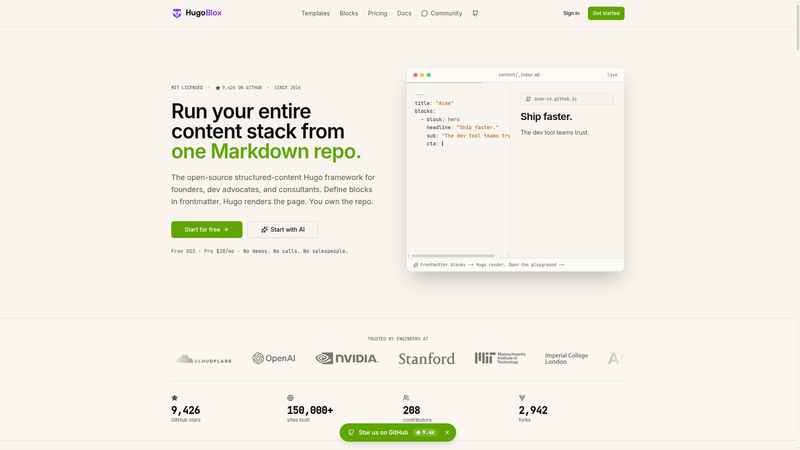
HugoBlox is an open-source website framework that turns plain-English descriptions and chosen templates into static sites built on Hugo and Tailwind CSS. As input it takes either a template selection or a natural-language request to Hugo Chat AI; as output it produces plain Markdown files that compile to static HTML ready for deployment. The project is maintained by Lore Labs, has been in development since 2016, and is released under the MIT License.
Key Features
- Hugo Chat AI generation — Describe a page in plain English, such as "Create a landing page with hero, pricing, and testimonials," and it returns structured Hugo pages with the correct front matter, shortcodes, and blocks.
- 20+ structured content types — Includes landing pages, blogs, portfolios, publication pages with BibTeX/DOI workflows, documentation with sidebar navigation, team and author profiles, event/talk pages, slide decks, resumes/CVs, and native rendering of Jupyter notebooks and LaTeX.
- Ownable CMS for VS Code — Offers drag-and-drop block editing, live preview, and YAML validation inside Visual Studio Code, turning the editor into a visual website builder.
- Plain Markdown ownership — Every file is a human-readable Markdown document; no database and no proprietary format locks your content.
- Free static hosting — Builds to pure static HTML with no runtime server, so sites run for free on Netlify, Vercel, Cloudflare Pages, GitHub Pages, or any static host.
- CLI scaffolding — Install with
npm install -g hugobloxand runhugoblox create siteto scaffold a new project that needs Hugo Extended and Node.js.
Who is HugoBlox for?
- Researchers and academics — Publish publication lists with BibTeX metadata, team profiles, and news sections, and render Jupyter notebooks or LaTeX math pages directly.
- Founders and consultants — Assemble landing pages with hero, pricing, testimonials, and contact sections through AI-generated blocks, then deploy without a backend.
- Developers and developer advocates — Create documentation portals, personal portfolios, and reveal.js slide decks from Markdown, keeping everything in a Git repository.
What can you do with HugoBlox?
- Launch a consulting landing page — Ask Hugo Chat for a page with services, testimonials, and a contact form, and receive a set of Markdown blocks you can edit and ship the same day.
- Generate research publication pages — Describe your research areas and get 30 publication pages with correct BibTeX metadata, team profiles, and a news section for your lab.
- Build searchable documentation — Use HugoBlox's documentation content type to produce a docs site with sidebar navigation and versioning, hosted for free.
How does HugoBlox work?
Pick a template from the HugoBlox gallery or scaffold with the CLI, then customize via Hugo Chat AI or Ownable CMS visual editing. The result is a Markdown-based project you push to GitHub and deploy to any static host. No database, no runtime server, no vendor lock-in.
Pricing
HugoBlox is free and open source under an MIT license, and Hugo Chat includes free messages every day. A paid Pro tier adds visual editing, AI automations, BibTeX import, and priority support; pricing details are listed on the official pricing page.
Alternatives
- Lovable — an AI site builder that generates React code rather than portable Markdown.
- v0 — Vercel's AI builder, which also outputs code that is harder to hand-edit than Markdown.
- WordPress — a CMS that stores content in a database and requires a runtime server, unlike HugoBlox's static output.
- Webflow — a visual CMS that locks content into its proprietary platform.
FAQ
Is HugoBlox free?
Yes. The framework is MIT licensed and open source; Hugo Chat offers free messages every day, and sites can be hosted for free on static hosting platforms like Netlify, Vercel, Cloudflare Pages, or GitHub Pages. A paid Pro tier exists for extra features.
Do I own my content?
Yes. All content is stored as plain Markdown files in your repository, not in a database or proprietary format. You can export or migrate your content to any other platform at any time without lock-in.
What can HugoBlox build?
HugoBlox includes over 20 structured content types, including landing pages, blogs, portfolios, documentation, publication pages, team profiles, event pages, slide decks, resumes, and Jupyter notebooks.
What technologies does HugoBlox use?
HugoBlox is built on Hugo, a static site generator, and Tailwind CSS for styling. It supports reveal.js for slide decks and can render Jupyter notebooks and LaTeX natively.