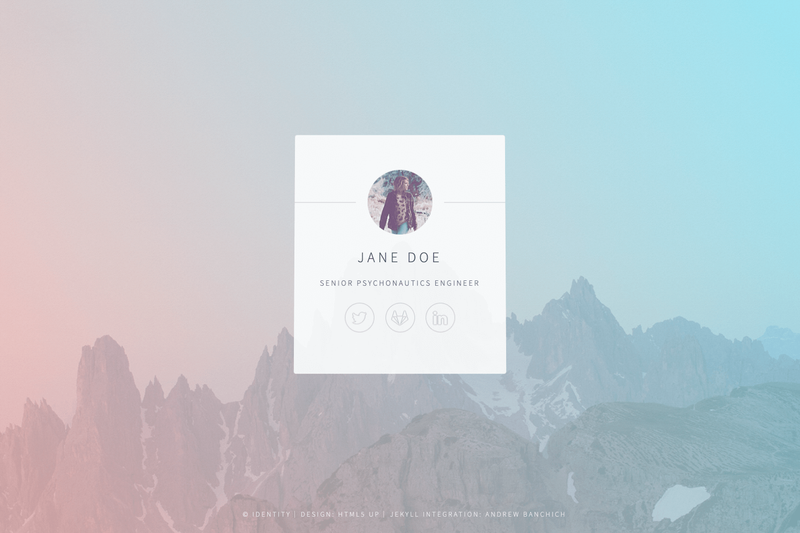
Identity Jekyll Theme is a Jekyll port of HTML5 UP's "Identity" profile/card template that generates a single-page personal landing page from a _config.yml file. The theme is maintained by Andrew Banchich, with the source hosted on GitLab and mirrored on GitHub.
What is Identity Jekyll Theme?
Identity Jekyll Theme is a Jekyll version of the "Identity" theme by HTML5 UP, designed as a minimal, responsive profile/card-style page. It takes configuration data from the _config.yml file — specifically your name, title, and social media URLs — and outputs a static HTML page that displays a personal identity card with links to your profiles. The original HTML5 UP design uses Skel and Sass, and this port maintains that structure within a Jekyll site.
Key Features
- Social profile integration — Add up to ten social URLs (500px, Facebook, GitHub, GitLab, Google+, Instagram, LinkedIn, Pinterest, Slack, Twitter) directly in
_config.yml; the theme renders them as icons. - Custom identity fields — Set your name and title through the
your-nameandyour-titleparameters in_config.yml; the page displays them prominently on the card. - Responsive design — Built with Skel and Sass, the original HTML5 UP theme is mobile-friendly and adapts to different screen sizes.
- Free to use — Released under the Creative Commons Attribution 3.0 (CCA 3.0) license, free for personal and commercial use.
- Simple deployment — Fork the repository and edit
_config.yml; on GitHub, create agh-pagesbranch to publish via GitHub Pages; on GitLab, just fork and edit. - Static site output — Jekyll generates plain HTML/CSS with no server-side dependencies, so the resulting site is fast and can be hosted anywhere.
- Minimal footprint — A single-page profile card with a small footprint, using Font Awesome icons from the original theme.
Who is it for?
This template suits developers, designers, freelancers, and professionals who need a quick, clean personal landing page. For example, a web developer can fork the repository, set their name and GitHub URL, and deploy to GitHub Pages in minutes. A freelancer can use it as a simple online business card with links to their portfolio and social profiles. A designer can customize the Sass styles to match their personal brand.
What can you do with it?
- Personal branding: Create a one-page card that displays your name, title, and links to your LinkedIn, Twitter, and GitHub profiles.
- Portfolio entry point: Use the theme as a minimal landing page that directs visitors to your main portfolio site or social channels.
- Rapid prototyping: Set up a personal page in under five minutes by editing only the
_config.ymlfile.
How does it work?
- Fork the repository (on GitLab directly, or on GitHub by creating a
gh-pagesbranch). - Edit
_config.ymlto add your name, title, and social URLs. - Push changes; Jekyll builds the static page and GitHub Pages or GitLab Pages serves it.
Alternatively, run Jekyll locally to preview.
FAQ
Is Identity Jekyll Theme free?
Yes, the theme is free for personal and commercial use under the Creative Commons Attribution 3.0 license, as stated in the original HTML5 UP readme.
How do I add my social media links?
Social links are configured in the _config.yml file using parameters like facebook_url, twitter_url, github_url, and others. Simply add your profile URLs and the theme will display social icons.
Can I use it on GitHub Pages?
Yes, fork the repository, create a branch named gh-pages, and edit _config.yml. GitHub Pages will build and serve the site automatically.
What do I need to know to use this theme?
Basic familiarity with Jekyll is helpful; the readme links to Jekyll's documentation on front matter, posts, and pages. Editing only requires changing _config.yml.
Does the theme include demo images?
The original HTML5 UP theme mentions demo images from Unsplash, but they are not included in the Jekyll version. You'll need to supply your own images if you want them.