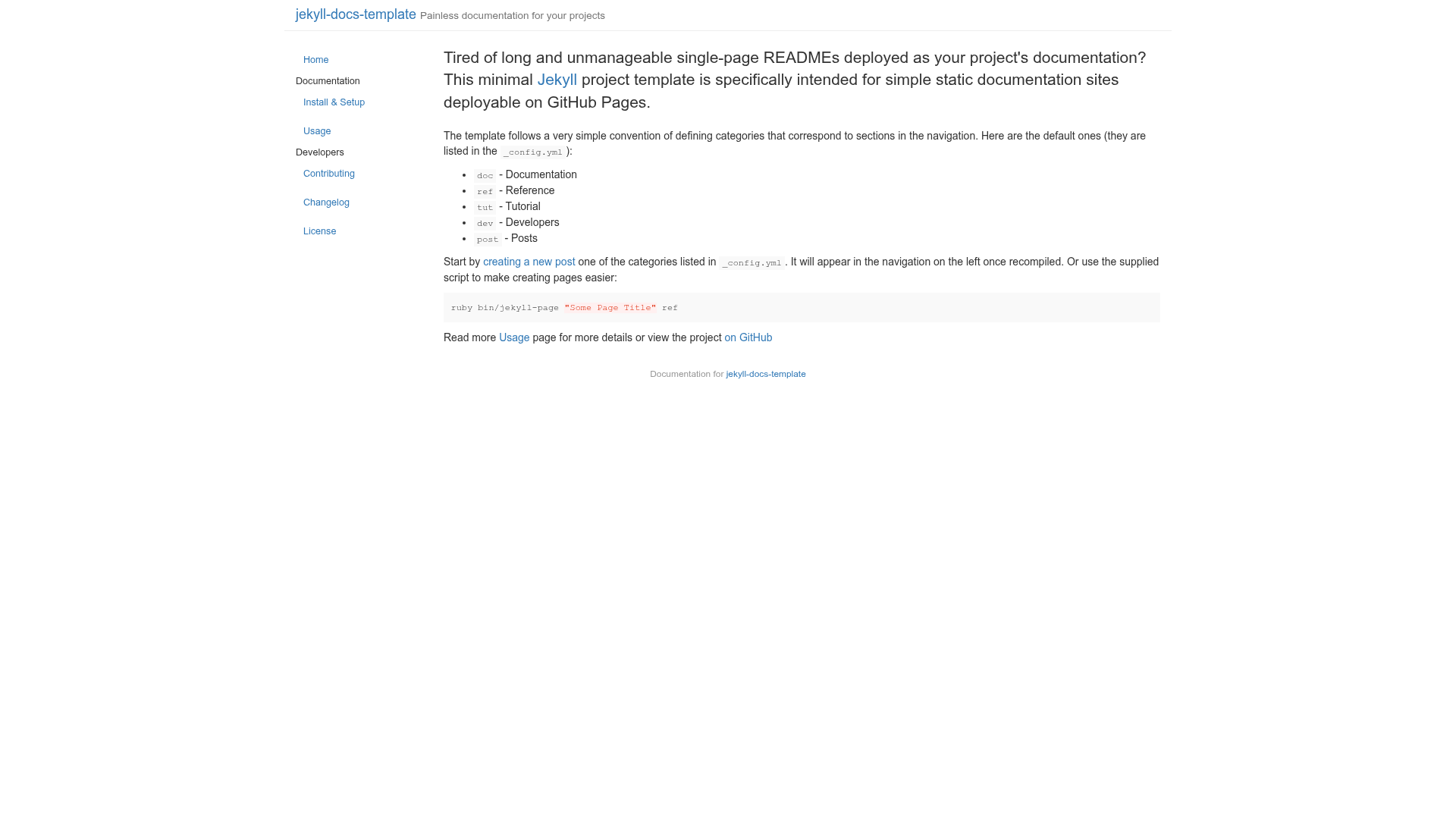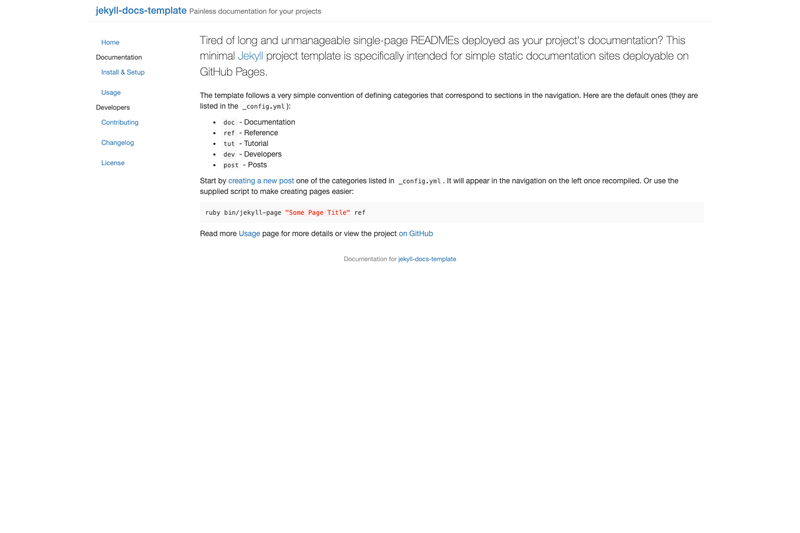
Jekyll Docs Template is an open-source Jekyll template created by bruth for building documentation-based websites. It provides a pre-configured structure that transforms Markdown and HTML content into a static site via Jekyll, the Ruby-based static site generator. The template is available on GitHub under the repository bruth/jekyll-docs-template and has accumulated 195 stars, signaling community interest. A live instance of the template is hosted at http://bruth.github.io/jekyll-docs-template, which also serves as the official documentation for customizing the template.
What is Jekyll Docs Template?
Jekyll Docs Template is a starting point for publishing technical documentation as a static website. It leverages Jekyll's ability to convert Markdown files and Liquid templates into plain HTML, which can be deployed to any web server or to GitHub Pages for free hosting. The template's structure is tailored specifically for documentation content, making it straightforward to organize guides, tutorials, and API references. Since it is built on Jekyll, users benefit from features like front matter for metadata, automatic code highlighting, and the extensive ecosystem of Jekyll plugins and themes.
Key Features
The following features are directly attributable to the template based on its description and the public repository:
- Jekyll framework — The template uses Jekyll, a static site generator that processes Markdown and Liquid templates to output a fast, dependency-free website.
- Documentation-oriented design — The template is explicitly described as a "Jekyll template for documentation-based sites," meaning its layout and organization are intended for article-like content with navigation.
- GitHub Pages deployment — The live demo at bruth.github.io shows that the template runs on GitHub Pages, the free static hosting service that natively supports Jekyll.
- Source code access — The complete source code is publicly available on GitHub, allowing anyone to view or adapt the template for their own projects.
- Community adoption — With 195 stars on GitHub, the template has been watched or starred by nearly 200 users, indicating it meets a common need for documentation sites.
Who is it for?
This template suits technical writers and developers who need to create and maintain documentation for software projects. It is also a good fit for open-source maintainers who want to host their project's documentation on GitHub Pages alongside their code. Teams that prefer static sites over heavy content management systems can use this template to publish internal wikis or product manuals without a database.
Use cases
- Open-source project documentation: Maintain documentation in the same repository as code, using Jekyll to generate a hosted docs site on GitHub Pages.
- API reference guides: Structure endpoint descriptions and code samples using Markdown, with Jekyll's syntax highlighting for code blocks.
- Team knowledge base: Create an internal documentation hub that is version-controlled and simple to deploy.
Pricing
The template is publicly accessible for free on GitHub, so there is no cost to download the source code or deploy the resulting site. No subscription or licensing fees are mentioned on the repository page.
FAQ
Is Jekyll Docs Template free?
Yes, the template is freely available on GitHub. You can clone the repository and publish your documentation without paying any fees.
How do I use Jekyll Docs Template?
The template requires Jekyll to be installed on your computer. After cloning the repository, you can edit the Markdown files in the content directory and run jekyll serve to preview the site locally, then build and deploy it to your hosting provider.
Where can I see a live demo?
A live demonstration of the template is available at http://bruth.github.io/jekyll-docs-template. This site also serves as the documentation for the template itself.
What is Jekyll?
Jekyll is a static site generator written in Ruby that turns Markdown and Liquid templates into a static HTML website. It is the engine behind GitHub Pages, allowing users to host Jekyll sites directly from their repositories.