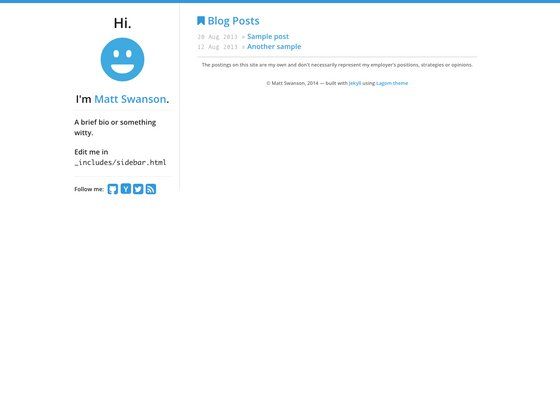
Jekyll FullIt Theme is a free, MIT-licensed Jekyll theme for publishing static websites and blogs on GitHub Pages, combining Bootstrap 4 for responsive design with fullpage.js to create full-screen scrolling sections.
What is Jekyll FullIt Theme?
Jekyll FullIt Theme is a static site template built on Jekyll, Bootstrap 4, and fullpage.js. It takes Jekyll content (posts and pages written in Markdown or HTML) and renders it into a complete website that can be hosted on GitHub Pages for free. The repository lives under the fullit GitHub organization and is released under the MIT license.
What makes Jekyll FullIt Theme stand out?
- fullpage.js integration — Creates full-screen scrolling sections, ideal for one-page portfolios and landing pages.
- Bootstrap 4 framework — Provides responsive grid, components, and utility classes for mobile-first design.
- GitHub Pages ready — Setup instructions target hosting under a USERNAME.github.io repository without extra build steps.
- Jekyll native — Uses Jekyll's standard _includes, _layouts, and _config structure for content management.
- MIT License — Free to use, modify, and redistribute, including for commercial purposes.
- Minimal setup — Clone a repository, change remote URL, and push to go live; GitHub's built-in Jekyll build handles the rest.
Who is Jekyll FullIt Theme for?
- Developers who want a quick personal website or blog with full-screen section transitions and no backend.
- Designers who need a portfolio that presents projects in full-viewport panels using fullpage.js.
- Writers who prefer Jekyll's Markdown workflow and want a stylish, responsive blog hosted on GitHub Pages.
- GitHub users who want a free static site with no server costs and an easy deployment flow.
What can you do with Jekyll FullIt Theme?
- Personal website — Set up a one-page resume with full-screen sections for about, experience, and contact.
- Project portfolio — Present each project as a full-screen slide that visitors scroll through vertically.
- Blog — Publish Markdown posts with Jekyll's built-in blog features and Bootstrap-styled typography.
- Landing page — Create a scrolling promotional site for a product or event using the fullpage.js effect.
How does Jekyll FullIt Theme work?
The README describes three steps: create a repository named USERNAME.github.io, clone the theme's repository and reset the remote URL, then edit the configuration in _includes/themes/bootstrap/ to customize site information. After pushing to GitHub, the site becomes available in about 10 minutes.
FAQ
Is Jekyll FullIt Theme free?
Yes. The theme is released under the MIT License, so it is free to use, modify, and redistribute, including in commercial projects.
Does it require a local Jekyll installation?
No. Because it is designed for GitHub Pages, GitHub's own Jekyll build processes the site when you push. You can also run it locally, but it is not required for basic hosting.
What static site generator does it use?
It uses Jekyll, the Ruby-based static site generator that GitHub Pages supports natively. The theme relies on Jekyll's template engine to generate HTML pages from Markdown content.
How long does it take to go live after pushing?
The README states that GitHub takes about 10 minutes to build and publish the site after the initial push.