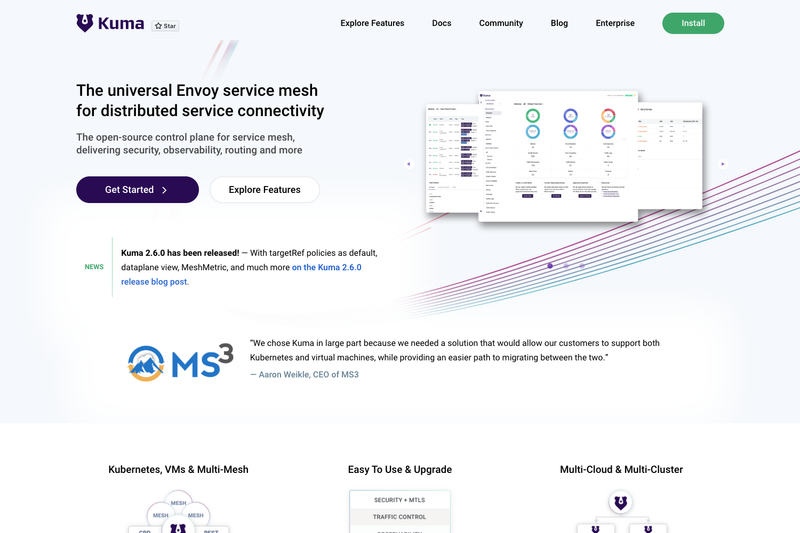
The Kuma Website is an open-source repository for the official website of Kuma, a control plane for service mesh that supports both Kubernetes and VM environments. The site is built with Jekyll, a static site generator, and is published using Netlify, as detailed in the repository's README.
What is the Kuma Website?
The Kuma Website is the official online presence for Kuma, a service mesh control plane, and it is developed openly on GitHub. The repository contains the source content and tooling for the site, including Markdown pages, SCSS styling, and the Jekyll configuration that generates static HTML. The site is published on Netlify, with a deployment status badge visible in the repository, and is licensed under Apache 2.0 according to the license badge.
What makes the Kuma Website stand out?
- Built with Jekyll — The website uses Jekyll, a static site generator that converts Markdown and SCSS source files into fast, static HTML pages, making the site easy to host and maintain.
- Published on Netlify — Deployment is handled by Netlify, and the repository's Netlify Status badge indicates the health of the latest deployment.
- Open-source contribution model — The repository is public and includes CONTRIBUTING.md and WRITING-DOCUMENTATION.md files that guide new contributors through code and documentation changes.
- Service mesh documentation focus — The site documents Kuma's role as a control plane for service mesh, covering support for both Kubernetes clusters and VM-based workloads.
- Community channels — The repository displays badges for a Slack community and a Twitter feed, providing ways for users to engage with the Kuma team.
Who should use the Kuma Website?
- Kuma users and operators — They can browse the site for documentation and updates about Kuma's features, including its support for Kubernetes and VM environments.
- Contributors to open-source documentation — They can use the WRITING-DOCUMENTATION.md guide to understand how to edit and publish content on the site.
- Developers learning static site building — They can study the repository to see how a production website is structured with Jekyll, styled with SCSS, and deployed through Netlify.
What can you do with the Kuma Website?
- Access official Kuma information — Visit the live site to learn about Kuma's service mesh capabilities, platform support, and community resources.
- Contribute documentation changes — Fork the repository, edit Markdown files, and submit pull requests to improve the site's content following the contributing guide.
- Deploy a similar static site — Use the project as a reference for setting up a Jekyll site with Netlify deployment and a community contribution workflow.