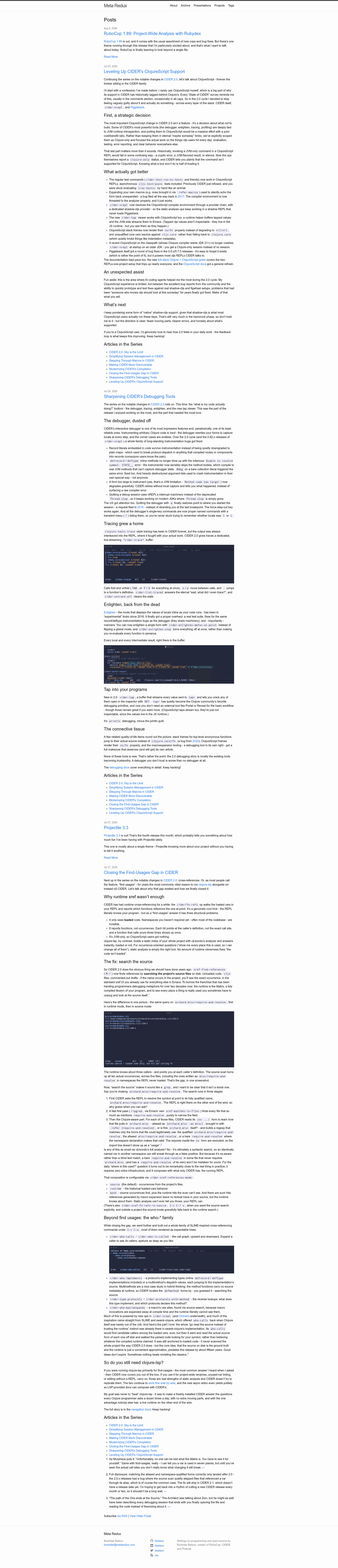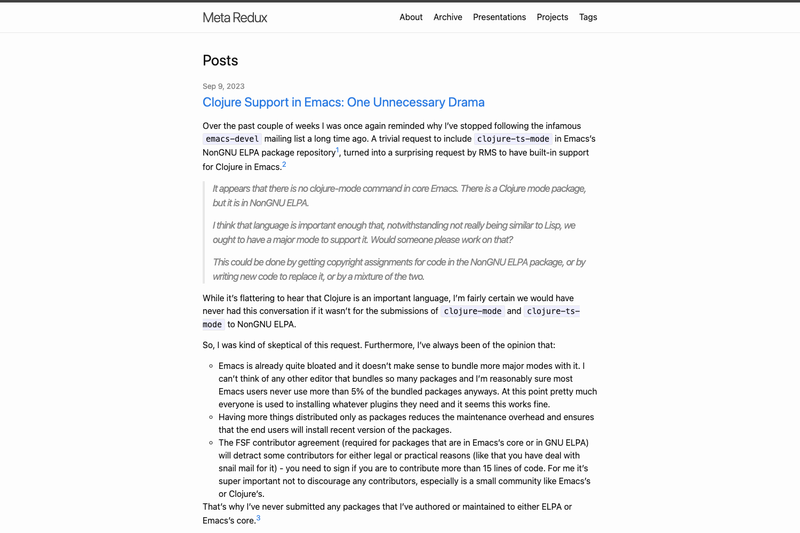
Meta Redux is a Jekyll-powered personal tech blog template whose source code is published on GitHub and deployed to https://metaredux.com through GitHub Pages. It is a simple, static-site implementation of a blog, with the full repository open to the public for anyone to study, fork, or contribute to.
What is Meta Redux?
Meta Redux is the complete source code behind the tech blog at https://metaredux.com. The site is built with Jekyll, a static site generator that compiles Markdown content and Liquid templates into plain HTML files, and it is hosted on GitHub Pages, so there is no dynamic server or database involved. The repository is publicly accessible on GitHub, currently has 9 stars, and the author explicitly invites pull requests that fix typos, bad grammar, or visual glitches. This makes it both a live blog and a working example of a Jekyll deployment pipeline.
Key Features
- Jekyll static generation — Content is authored in Markdown and rendered through Jekyll's Liquid template engine, producing a fast, static site with no server-side requirements.
- GitHub Pages hosting — The site is deployed automatically from the GitHub repository to GitHub Pages, offering free hosting and simple version-controlled updates.
- Open contribution model — The source is open for pull requests, with the author specifically welcoming fixes for typos, grammar, and visual glitches.
- Personal tech blog structure — The site focuses on a single author's tech posts, with the standard Jekyll folder layout for posts and pages.
Who should use Meta Redux?
- Jekyll beginners who want to see a real-world, minimal Jekyll site that is already live and deployed on GitHub Pages.
- Tech writers who prefer writing in Markdown and publishing through a git-based workflow, and who want a simple starting point for their own blog.
- Open-source contributors looking for a small, low-risk project where they can practice submitting pull requests for straightforward fixes.
What can you do with Meta Redux?
- Fork and customize — Copy the repository to create your own Jekyll blog on GitHub Pages by editing the Markdown posts and configuration files.
- Learn Jekyll and GitHub Pages — Study the repository structure to understand how a Jekyll site is configured, built, and deployed to GitHub Pages.
- Contribute improvements — Submit pull requests to fix typos, correct grammar, or address visual glitches, directly improving the live blog.
How does Meta Redux work?
As a Jekyll site, it uses the standard structure with a _posts folder for Markdown posts and a _config.yml for site settings. When changes are pushed to the GitHub repository, GitHub Pages automatically rebuilds the Jekyll site and serves the generated static files at metaredux.com.
FAQ
Is Meta Redux free to use?
Yes, the source code is publicly available on GitHub, so anyone can view, fork, or use it. The repository shows 9 stars and is open for contributions via pull requests.
What technology does Meta Redux use?
Meta Redux uses Jekyll, a Ruby-based static site generator, and is deployed on GitHub Pages. Jekyll converts Markdown and Liquid templates into static HTML, making the site fast and easy to host.
Can I contribute to Meta Redux?
Yes, the author explicitly invites pull requests that address typos, bad grammar, or visual glitches. Contributions are made through the standard GitHub fork-and-pull-request workflow.
Is Meta Redux a good starting point for my own blog?
Because it is a live, minimal Jekyll site, it can serve as a pragmatic starting point. You can fork the repository, replace the posts with your own content, and deploy the result to GitHub Pages.