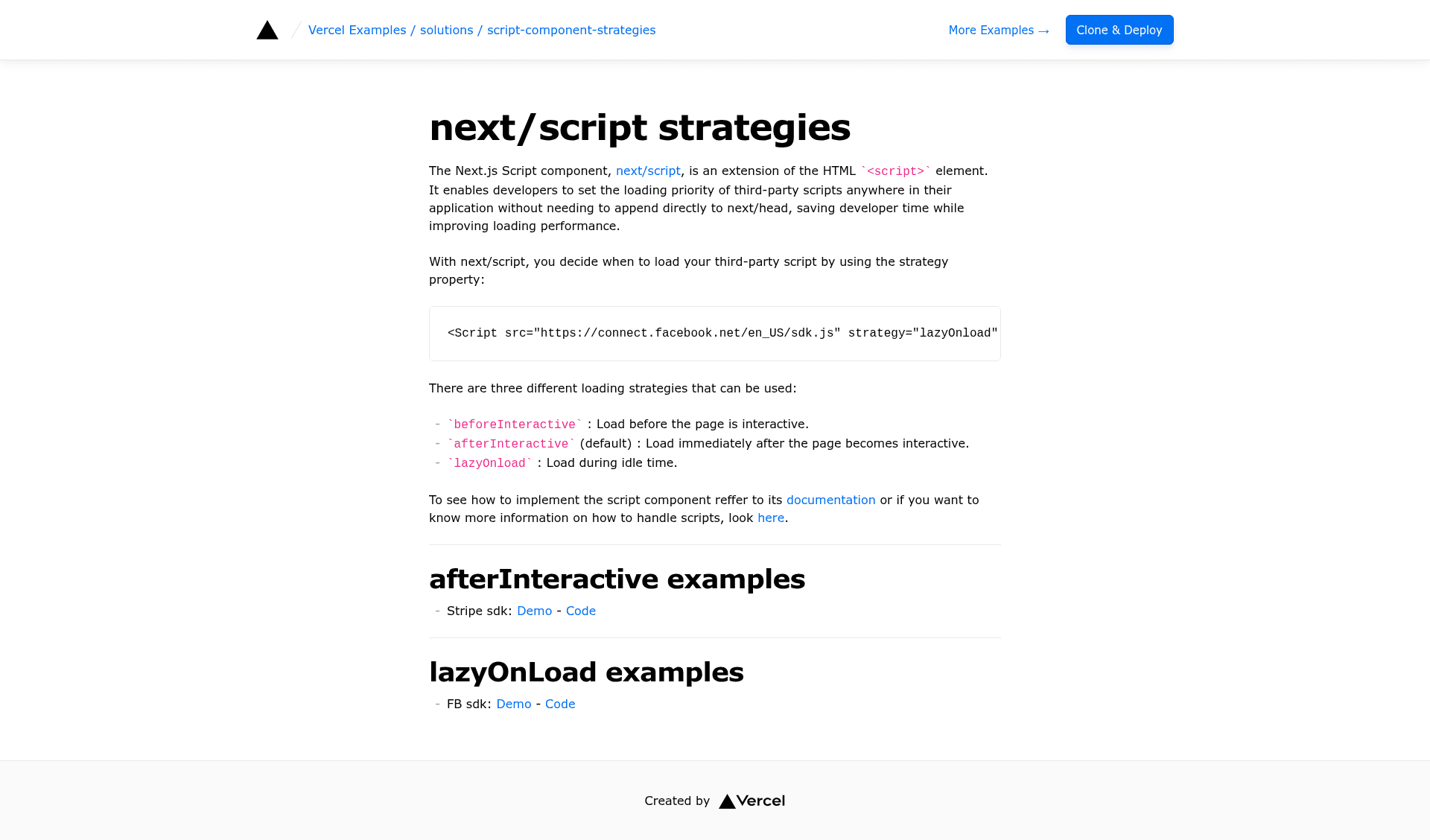
The next/script strategies example is a Next.js documentation template from Vercel that demonstrates how to load third-party scripts with different loading strategies using the next/script component. The project is part of the official vercel/examples repository, a curated collection of examples and solutions for building scalable applications, and it is intended as a learning resource for developers working with the Next.js Script component.
What is the next/script strategies example?
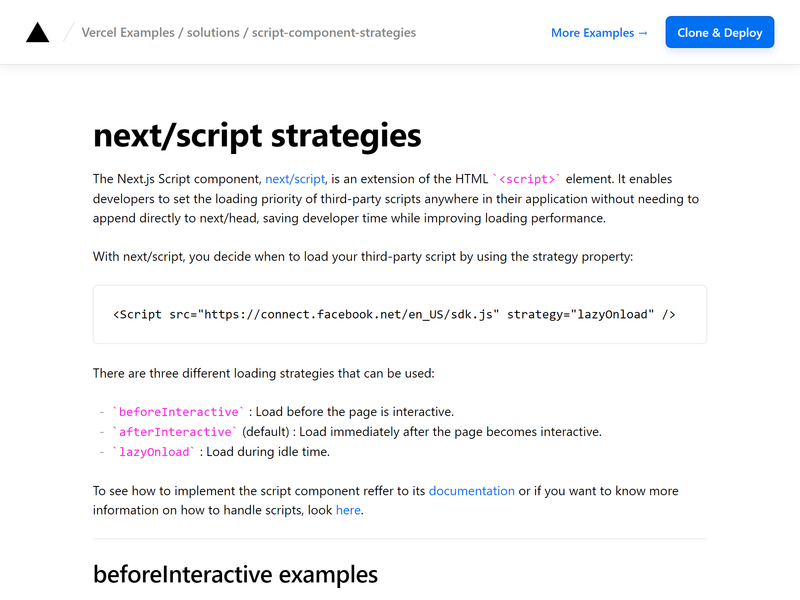
The next/script strategies example is a minimal Next.js application that demonstrates how to use the next/script component for loading external JavaScript with configurable timing strategies. It is published by Vercel, hosted in the vercel/examples repository, and runs on the Next.js framework. The template takes a basic Next.js app and shows how to configure script loading strategies that control when a script is fetched and executed, covering the different timing options available for the next/script component. A live demo is available at https://solutions-script-component-strategies.vercel.app, and the project can be deployed to Vercel or run locally.
Key features
The example includes a specific set of technical features that are evident from its repository metadata and README.
- Next.js framework — The example is built on Next.js, a React-based framework that provides server-side rendering, static site generation, and API routes out of the box.
- Tailwind CSS — Repository metadata lists Tailwind CSS as the styling system, giving utility-first CSS classes for layout and design.
- One-click Vercel deployment — The README includes a deploy button that clones the repository into a new Vercel project without manual configuration.
- Local setup with create-next-app — Developers can bootstrap the project by running
pnpm create next-app --example <repository-url>and then start it withpnpm dev. - Production demo — A hosted demo at the provided URL lets you inspect the script loading behavior in a live environment.
- Documentation-oriented use case — The project is flagged as a documentation example, so the code is kept intentionally small to highlight the
next/scriptstrategies. - Curated Vercel examples collection — It lives in the
vercel/examplesrepository, which is described as a curated collection of patterns for robust and scalable applications.
Who is it for?
This example is built for developers who work with Next.js and need to load third-party scripts efficiently.
- Next.js developers who need to integrate third-party scripts such as analytics, tag managers, or chat widgets and want to choose the right loading strategy.
- Performance-focused frontend engineers who are optimizing page load times and need to defer non-essential scripts until the page is usable.
- Technical writers and educators who want a concise, working code example to reference when documenting or teaching the
next/scriptcomponent.
What can you do with the next/script strategies example?
With this template, you can quickly spin up a working demo of script-loading strategies and use it as a learning or reference tool.
- Study realistic behaviors — Deploy the demo or run the app locally to observe how each strategy affects the timing of script fetch and execution in a real Next.js app.
- Use as a scaffold — Clone the repository with
create-next-appto quickly spin up a Next.js and Tailwind CSS project with the script-loading setup already demonstrated. - Cross-reference with official docs — Pair the example with the Next.js documentation on
next/scriptto deepen your understanding of strategy trade-offs.
How does the next/script strategies example work?
The README gives two ways to run the example: a one-click Vercel deploy and a local create-next-app bootstrap. To deploy, click the Vercel button in the README, which creates a new project from the GitHub repository URL. To run locally, execute pnpm create next-app --example <repository-url> and then pnpm dev to start the development server. Both approaches produce a working Next.js app that exercises the different script loading strategies.