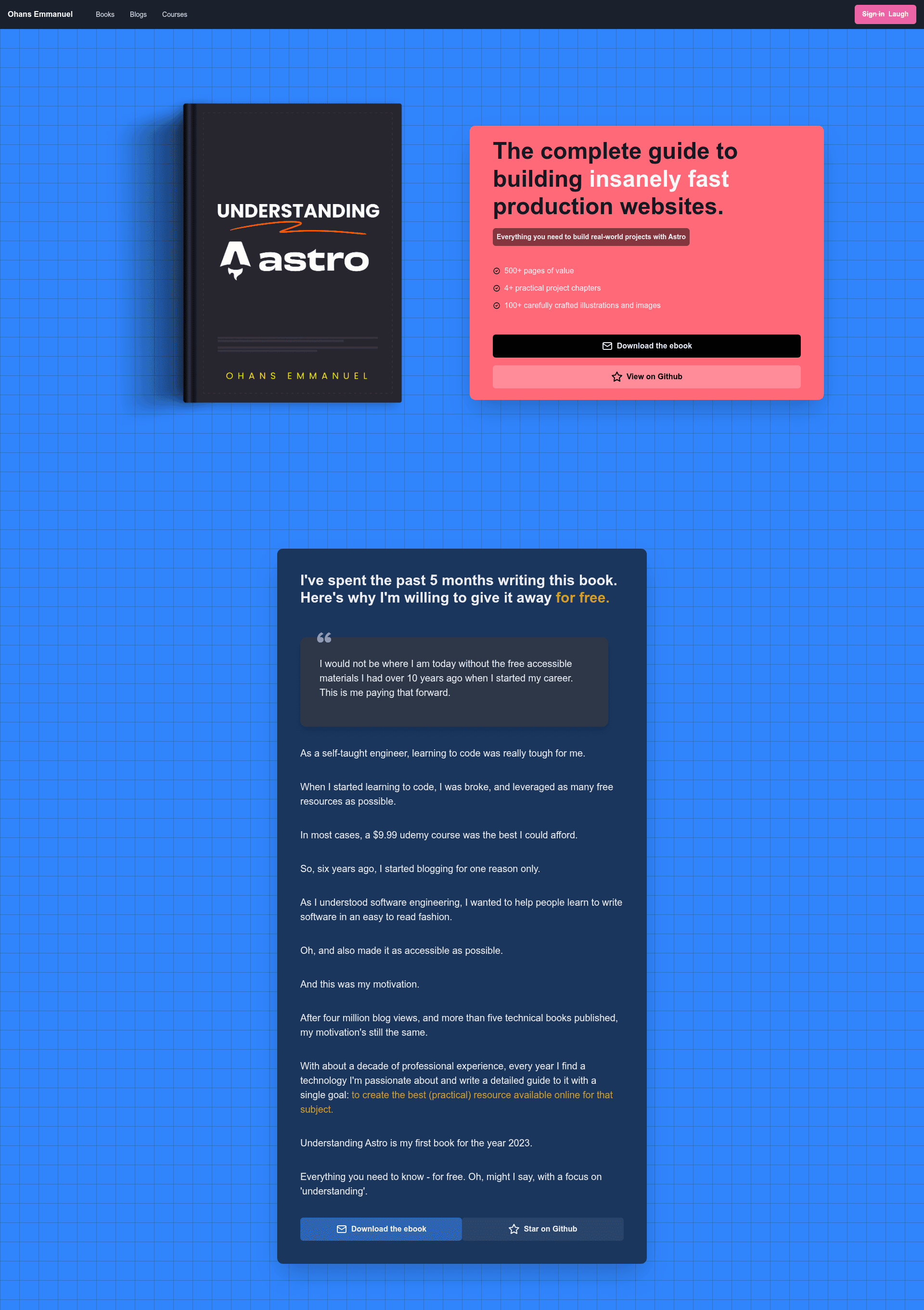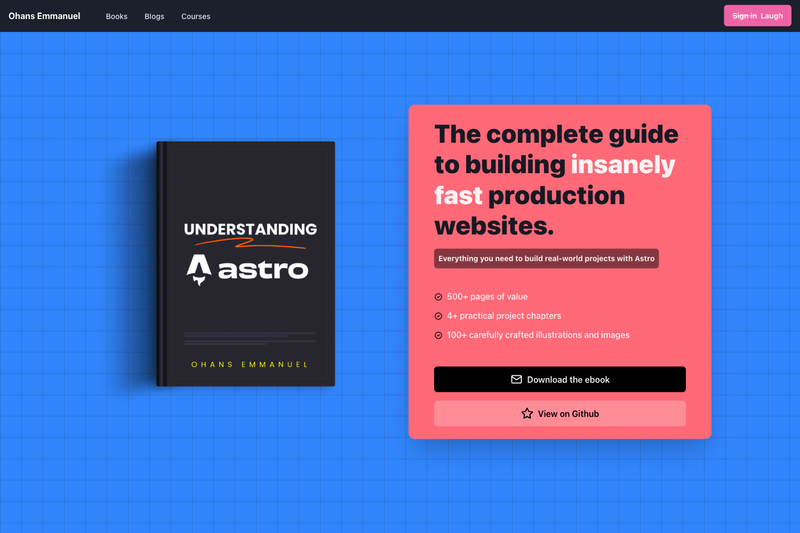
Understanding Astro is a free, in-depth ebook by Ohans Emmanuel that teaches developers to build fast, static-first websites with the Astro web framework, from a first component to custom integrations.
What is Understanding Astro?
Understanding Astro is a practical guide to the Astro framework, hosted on GitHub under a Creative Commons Attribution-NonCommercial-NoDerivatives 4.0 license. It takes a developer through Astro's core ideas — static site generation, Astro components, the islands architecture, partial hydration, server-side rendering (SSR), server endpoints, and custom integrations — using explanations and build-along projects. The book's eight chapters plus introduction and conclusion are written in a practical, easy-to-understand style, and the full text is available in Markdown files in the repository.
Key Features
- Chapter-based progression — Eight chapters and a conclusion move from building a first Astro page to writing custom Astro integrations.
- Hands-on projects — Includes a React documentation site clone, a full-stack audio recording app built with Firebase, and a custom "default prerender" integration.
- Islands architecture coverage — Dedicated chapters explain component islands, the
client:directives for responsible hydration (load, only, visible, media, idle), and sharing state between islands with Nano Stores. - Modern Astro stack — Shows styling with Tailwind, authoring content collections with MDX and Zod schemas, dynamic routing, and TypeScript import aliases.
- SSR and full-stack topics — Covers enabling SSR, choosing adapters, working with Request and Response objects, cookies, environment variables, API endpoints, and streaming.
- Free to read on GitHub — The complete Markdown source is in the repository, which has 920 stars at the time of writing.
- Downloadable ebooks — A separate landing page at ohans.me/understanding-astro offers ebook downloads.
Who is it for?
- Web developers new to Astro — They'll start with chapter 1, which walks through installing Node.js, setting up a code editor, and building and deploying a static site.
- Frontend developers curious about islands architecture — Chapters 3 and 4 explain the tradeoffs of client-side rendering, SSR, and partial hydration, then show how to implement and use component islands in Astro.
- Developers building content-heavy sites — Chapter 5 demonstrates a React docs clone with content collections, MDX, dynamic routes, syntax highlighting, and a custom 404 page.
- Full-stack developers — Chapters 6 and 7 cover SSR, server endpoints, streaming, Firebase authentication, cloud storage, and HTML form handling.
What can you do with Understanding Astro?
- Learn Astro systematically: Follow the chapters in order to build a static Astro site, add interactive islands, and deploy it with automated workflows.
- Build a documentation or blog site: Chapter 5 clones a documentation site using Tailwind, content collections, MDX, and dynamic routing.
- Create a full-stack app: Chapter 7 builds "Be Audible", an audio recording app with Firebase auth, cloud storage, and protected routes.
- Extend Astro with integrations: Chapter 8 teaches you to write Vite plugins, use Astro's hook lifecycle, and build renderer integrations.
FAQ
Is Understanding Astro free?
Yes, the full text is available on GitHub under a Creative Commons Attribution-NonCommercial-NoDerivatives 4.0 license, so you can read it online without paying. Ebook downloads are offered through the author's landing page at ohans.me/understanding-astro.
What are the prerequisites for reading the book?
The preface lists prerequisites, including basic web development knowledge and a working Node.js installation. The first chapter also includes instructions for installing Node.js and setting up a code editor.
What Astro features does the book cover?
It covers static site generation, Astro components, slots and props, Markdown pages, component islands with client hydration directives, content collections, MDX, dynamic routing, SSR, server endpoints, streaming, and building custom integrations.
Which frontend frameworks appear in the examples?
The book includes examples using Vue, Petite-vue, Preact, and React for framework components, and uses Tailwind CSS for styling in later chapters. A full-stack project uses Firebase for authentication and storage.