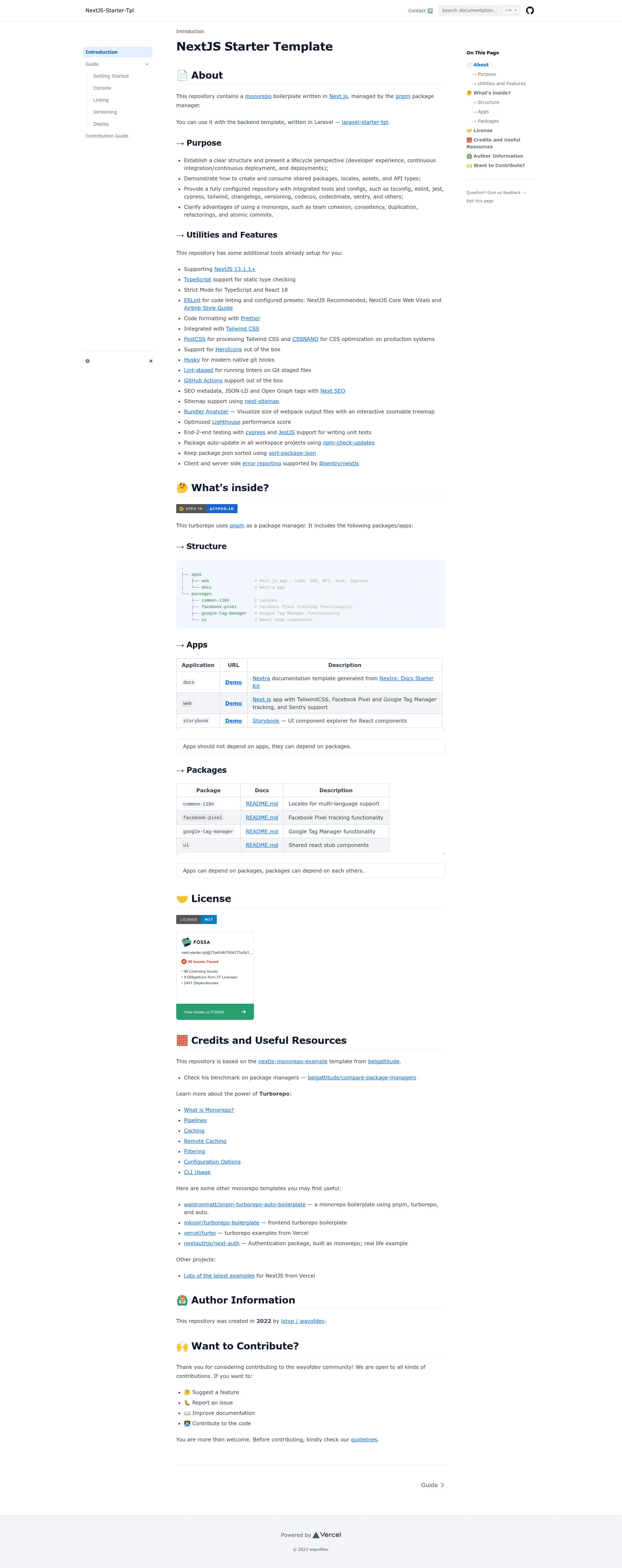
Next.js Starter Template is a microservices-ready monorepo boilerplate from Wayofdev that scaffolds production-ready Next.js applications with Turborepo, pnpm workspaces, and preconfigured tooling for testing, linting, CI/CD, and observability.
What is Next.js Starter Template?
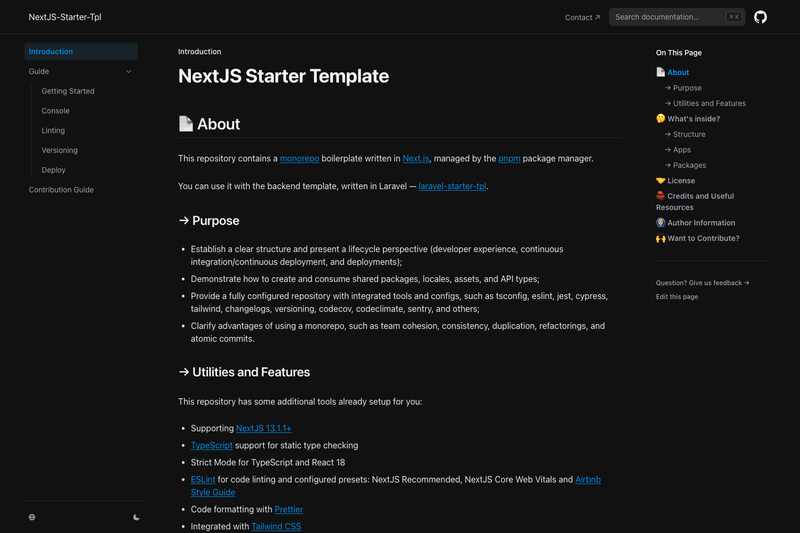
Next.js Starter Template is a monorepo boilerplate written in Next.js and managed by the pnpm package manager. It takes a new project's source code structure and produces a fully configured application with shared packages for locales, UI components, and tracking utilities, plus a separate Nextra documentation site. The repository is maintained by Wayofdev (created by lotyp), supports Next.js 13.1.1 and newer, and comes with TypeScript and React 18 strict mode enabled.
Key Features
- Monorepo structure with Turborepo — Organizes code into apps/web, apps/docs, and apps/storybook, plus packages for ui, common-i18n, facebook-pixel, and google-tag-manager.
- Preconfigured linting and formatting — Includes ESLint with Airbnb style guide and Next.js presets, Prettier, Husky git hooks, and lint-staged.
- Tailwind CSS and PostCSS — Integrated styling with CSSNANO optimization for production builds, plus HeroIcons support.
- Testing setup — Jest for unit tests and Cypress for end-to-end testing.
- SEO and metadata — Uses Next SEO for metadata, JSON-LD, Open Graph tags, and next-sitemap for sitemaps.
- Error reporting — Sentry integration for client and server-side error reporting via @sentry/nextjs.
- CI/CD ready — GitHub Actions support out of the box, with Codecov and Code Climate maintainability badges.
- Automated maintenance — npm-check-updates for package updates and sort-package-json to keep package.json sorted.
Who is it for?
- Next.js developers building full-stack applications who want a monorepo foundation with shared packages.
- Teams standardizing workflows that need consistent ESLint, Prettier, Jest, and Cypress configurations across multiple apps.
- Product teams shipping docs and web apps — the included Nextra documentation app lets you publish guides alongside the main Next.js application.
- DevOps engineers who want a Docker-based local development environment with TLS and DNS routing via Traefik and dnsmasq.
What can you do with it?
- Frontend teams: Bootstrap a Next.js web app with i18n, SSR, API routes, and built-in tracking (Facebook Pixel and Google Tag Manager) from one repository.
- Documentation maintainers: Run the Nextra-powered docs app to write and deploy technical documentation with a starter kit.
- UI developers: Use the Storybook app to develop and showcase React components in isolation before integrating them into the web app.
- Microservice builders: Set up a microservices-ready architecture with Docker and docker-compose, relying on shared packages for common functionality.
Requirements and how to use it
The template assumes a macOS or Linux environment with Docker 20.10 or newer, a running dnsmasq service, and the docker-shared-services repository for system-wide DNS, routing, and TLS via Traefik. After cloning, you follow the getting-started guide in the documentation to install dependencies with pnpm and run the dev servers. The repository also supports Gitpod for instant cloud-based development.