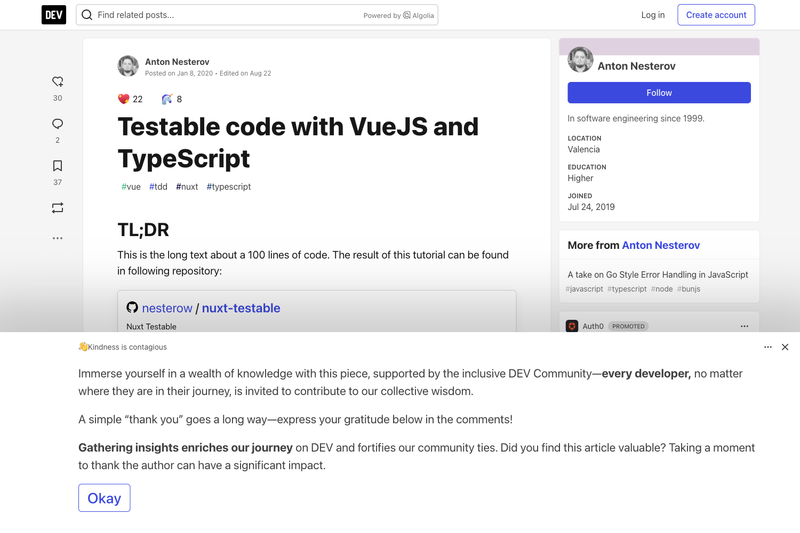
Nuxt Testable is a GitHub repository and tutorial that demonstrates how to write testable Nuxt.js applications using TypeScript, class-based Vue components, and Jest as the test runner. It walks through building a modular todo application step by step, with tests written before implementation, so you can see a realistic TDD workflow for a Nuxt + Vuex project.
What is Nuxt Testable?
Nuxt Testable is a community-written guide and starter project (author: nesterow) based on the Nuxt Community typescript-template. Its core function is to show concrete patterns for unit-testing Vuex stores and Vue components in a Nuxt app. The project takes a fresh Nuxt TypeScript skeleton as input and produces a modular application structure with Jest configuration, dependency injection, and mocked API calls as output.
Key Features
- Class-based Vue and Vuex components — Uses
nuxt-property-decoratorandvuex-module-decoratorsto write components and store modules as TypeScript classes, enabling inheritance and OOP patterns. - Complete Jest setup configuration — Includes
package.jsonJest settings forvue-jest,ts-jest, andbabel-jesttransforms, plustestRegexforspecfiles andtestURL: http://localhost/. - Babel dynamic-import plugin — Recommended setup for universal Nuxt apps to load libraries only on the client side, avoiding server-side
window/documentreferences. - Modular directory structure — Replaces boilerplate
componentsandmiddlewaredirectories with amodulesfolder, where each module groups its own components, store, types, tests, andindex.vue. - Dependency injection with
provide-consume-decorator— Provides@provideVuex/@consumedecorators to inject an axios instance (or any dependency) into Vuex modules and components, making them configurable and abstracted from concrete implementations. - State factory option — Uses
stateFactory: trueinvuex-module-decoratorsto avoid module caching issues that cause shared state across test instances and SSR clients. - Axios mock adapter for tests — Uses
axios-mock-adapterto create a fake REST API (/todosendpoints) so actions can be tested without a real server. - Reusable test factory functions — A
__factory.tshelper mounts Vue components with a configured Vuex store and injected dependencies, so the same setup can be reused across component specs.
Who is it for?
- Nuxt developers new to testing — They can follow the step-by-step setup to configure Jest with TypeScript and Vue single-file components in a Nuxt project.
- Vuex store developers — They get a pattern for testing mutations and asynchronous actions using
getModule()fromvuex-module-decoratorsand a mocked axios adapter. - Vue component authors — They learn to test components with
@vue/test-utils, using factory functions and provided/injected store instances. - Team leads and architects — They can adopt the modular directory structure and dependency injection approach to make large Vue applications more maintainable and portable between projects.
What can you do with Nuxt Testable?
- Set up a testable Nuxt boilerplate — Generate a project with
vue init nuxt-community/typescript-template, then follow the instructions to add Jest, Babel plugins, and the required dependencies. - Write TDD specs for a Vuex store — Start with a failing test that expects a store instance, implement the Vuex module with
@Moduleand@Mutation/@Actiondecorators, and iterate until tests pass. - Mock a backend API in tests — Use
axios-mock-adapterto stubGET/POST/PUT/DELETE /todosroutes, so actions can be tested against realistic responses. - Test Vue components in isolation — Mount
AddTodo.vueandTodoList.vuewith a factory that injects a mocked Vuex store, then assert that component state and store state update correctly after calling methods.
How does Nuxt Testable work?
The tutorial is organized as a sequence of steps: first, generate the Nuxt TypeScript skeleton and install dependencies (vuex-module-decorators, provide-consume-decorator, axios-mock-adapter, and Jest-related packages). Next, add Jest and Babel configuration to package.json and tsconfig.json. Then define a TypeScript interface for the store, write a failing spec, and implement the Vuex module using class decorators. Component testing follows the same pattern: write a spec, run it, and make it pass by adding component logic. Finally, connect the module to the Nuxt app via ~/store/index.ts and mount the parent component on a page.
FAQ
What is Nuxt Testable?
Nuxt Testable is a public GitHub repository (17 stars) that contains a tutorial and example code for building Nuxt applications with testable TypeScript code. It focuses on unit-testing Vuex stores and Vue components using Jest, class-based components, and dependency injection.
Which testing libraries does it use?
The project uses Jest as the test runner with vue-jest, ts-jest, and babel-jest for transformation. It also uses @vue/test-utils for mounting components, vuex-module-decorators for store classes, and axios-mock-adapter for mocking HTTP requests.
Does it use class-based components?
Yes. Both Vue components and Vuex modules are written as TypeScript classes using nuxt-property-decorator and vuex-module-decorators. This allows the author to apply inheritance, decorators, and OOP patterns instead of the options-object style.
Is the repository free to use?
The repository is publicly available on GitHub without any stated license restrictions, and the tutorial code can be freely used as a reference or starter. The setup commands use standard npm install steps that are common to open-source projects.