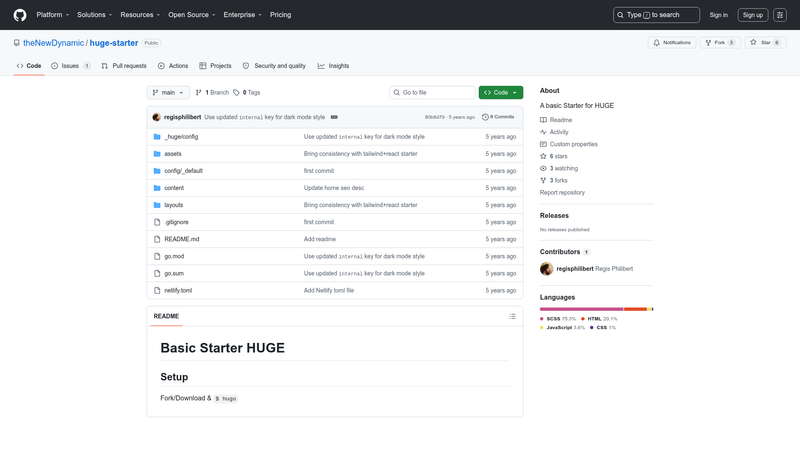
Basic Starter HUGE is a minimal Hugo boilerplate that you fork or download and then build by running $ hugo, making it a bare-bones starting point for static site projects.
What is Basic Starter HUGE?
Basic Starter HUGE is a repository that provides a basic starter template for the Hugo static site generator. It takes a standard Hugo project structure as its input and produces a compiled static website as its output when you run the hugo command in the project root. The repository description labels it "a basic Starter for HUGE," and the only setup instruction given is to fork or download the repo and execute $ hugo. The project is hosted on GitHub and currently has 6 stars, indicating a small but existing user base.
Key Features
Because the repository documentation is intentionally thin, the features listed here are limited to what is directly visible or structurally implied by a Hugo starter.
- Hugo framework — Built on Hugo, a static site generator, so the output is pre-rendered HTML that needs no server-side runtime.
- Single-command build — The documented workflow uses the single
$ hugocommand, suggesting a build process with default Hugo settings. - Fork-based workflow — The starter is designed for GitHub fork, letting you immediately create a new project from the repository without copying files manually.
- Basic structure — The repository description calls it a "basic" starter, so it is not a full-featured theme with many pre-built sections; instead it focuses on the essential Hugo directories needed to run the generator.
- Public access — Since it is a public GitHub repository, anyone can clone or fork it at no cost.
Who is it for?
Basic Starter HUGE is aimed at people who want a no-frills entry point into Hugo rather than a ready-made themed site.
- Hugo beginners can fork this starter to see how a minimal Hugo project is laid out and run their first successful
hugobuild. - Developers building custom sites can use it as a clean slate, adding their own content and layouts without first having to strip away an existing theme's assumptions.
- Theme authors can use this basic structure as a starting point when constructing a new Hugo theme from zero.
What can you do with Basic Starter HUGE?
- Quickly bootstrap a Hugo site: Fork the repo, clone it locally, run
$ hugo, and you have a static site ready to deploy to any hosting service. - Experiment with Hugo internals: The minimal file set makes it easy to inspect how Hugo maps content to templates and to test small changes without distraction.
- Create a personal project base: Use it as the foundation for a blog, portfolio, or documentation site, though the starter itself does not pre-configure those content types.
How does Basic Starter HUGE work?
The workflow is described in the repository setup section: you first fork or download the repository, then open a terminal in the project directory and run $ hugo. Hugo reads the project's configuration files and content, processes them through the available templates, and writes the resulting static HTML files. The resulting files can then be hosted anywhere that serves static content.