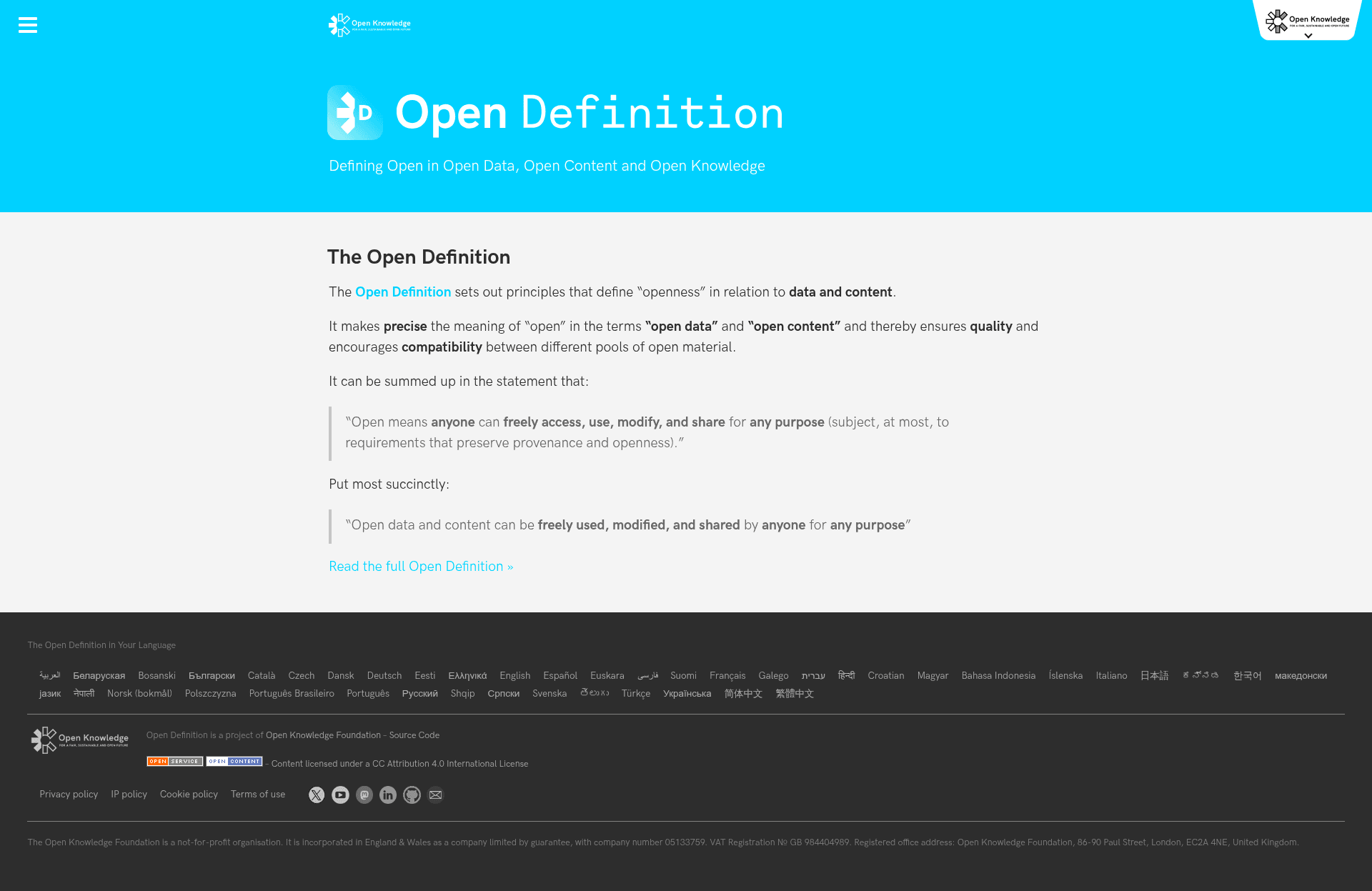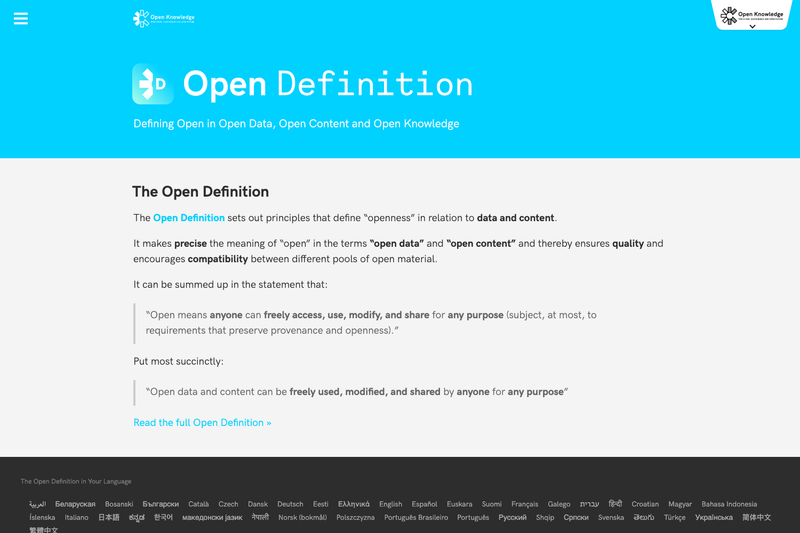
This is the GitHub source repository for the opendefinition.org website, a Jekyll-built static site that publishes the Open Definition version 2.1 and its translations.
What is the Open Definition website source?
The repository contains the Jekyll source files used to generate opendefinition.org, which hosts the Open Definition, a standard that explains what makes data and content "open" in terms of access, redistribution, and reuse. Content is authored as Markdown files, and Jekyll generates a static HTML site. The project lives under the Open Knowledge Foundation's GitHub organization, and community discussions happen on the Open Knowledge Foundation forum at discuss.okfn.org.
Key Features
- Jekyll static site generator — The site runs on Jekyll, so all content is written in Markdown and compiled into plain static HTML with no server-side dependencies.
- Multi-language translation support — The current version 2.1 is available in numerous translations, each added as a Markdown file in the path
od/2.1/{language code}/index.markdown. The preferred way to submit a new translation is to add that file and send a pull request on thegh-pagesbranch. - Versioned definition content — The repository is structured around Open Definition version 2.1, with a clear directory layout that separates the core definition from translations and related pages.
- Community contribution workflow — Contributors are encouraged to file issues, submit pull requests, and discuss changes on the forum; translation guidance is provided at opendefinition.org/participate/#translation.
- Related definitions and guides — Beyond the main navigation, the site includes many pages of related definitions and domain-specific guides, which are listed on the participate page. These pages exist but need review and updating.
- Open licensing topics — The GitHub topics for the repository include licenses, licensing, open-data, opendata, openness, reflecting the site's focus on open licensing standards.
- Integration with license list — The site links to the related licenses.opendefinition.org and its source repository; the two are planned to be merged eventually, as tracked in issue #7 of the repository.
Who is it for?
- Open data advocates maintain or update the Open Definition website content, ensuring the definition and guides stay current.
- Translators localize the Open Definition into other languages by creating a Markdown file for their language code and submitting a pull request.
- License maintainers check whether their licenses conform to the Open Definition by reading the definition and related licensing guides on the site.
- Web developers interested in Jekyll multi-language static sites can use this repository as a real-world example.
What can you do with it?
- Translators: Add a new language to the Open Definition site by dropping an
od/2.1/{language code}/index.markdownfile into the repo and opening a pull request ongh-pages. - Open data project maintainers: Align project licenses with the Open Definition by consulting the current version and the domain-specific guides.
- Community reviewers: Help revive the related definitions and guides by filing issues or submitting pull requests for outdated pages listed on the participate page.
How does it work?
The site is built with Jekyll: content files are written in Markdown, and Jekyll generates static HTML for hosting on GitHub Pages. To add a translation, a contributor clones the repo, adds a Markdown file in the appropriate language directory, and opens a pull request targeting the gh-pages branch. Discussion and issue tracking run through the GitHub repository and the Open Knowledge Foundation forum.
Pros and cons
- Pros: Static site hosting is fast and lightweight; the Markdown-based workflow makes contributions accessible to non-developers; versioned content keeps the Open Definition stable.
- Cons: The related definitions and guides are currently in need of review and updating, so some pages may be stale until community contributors step in.
FAQ
How do I add a new translation to the Open Definition website?
Create a Markdown file at od/2.1/{language code}/index.markdown with the translated text, then submit a pull request to the gh-pages branch. Detailed guidance is available at opendefinition.org/participate/#translation.
What is the current version of the Open Definition?
The current version is 2.1. The website hosts this version and its numerous translations.
Can I contribute to the Open Definition website?
Yes. You can file issues, submit pull requests, and discuss changes on the Open Knowledge Foundation forum at discuss.okfn.org/c/projects/OpenDefinition.
What is the relationship to licenses.opendefinition.org?
The licenses site is a related project with its own repository. The two websites and repositories will likely be merged at some point, as tracked in issue #7.