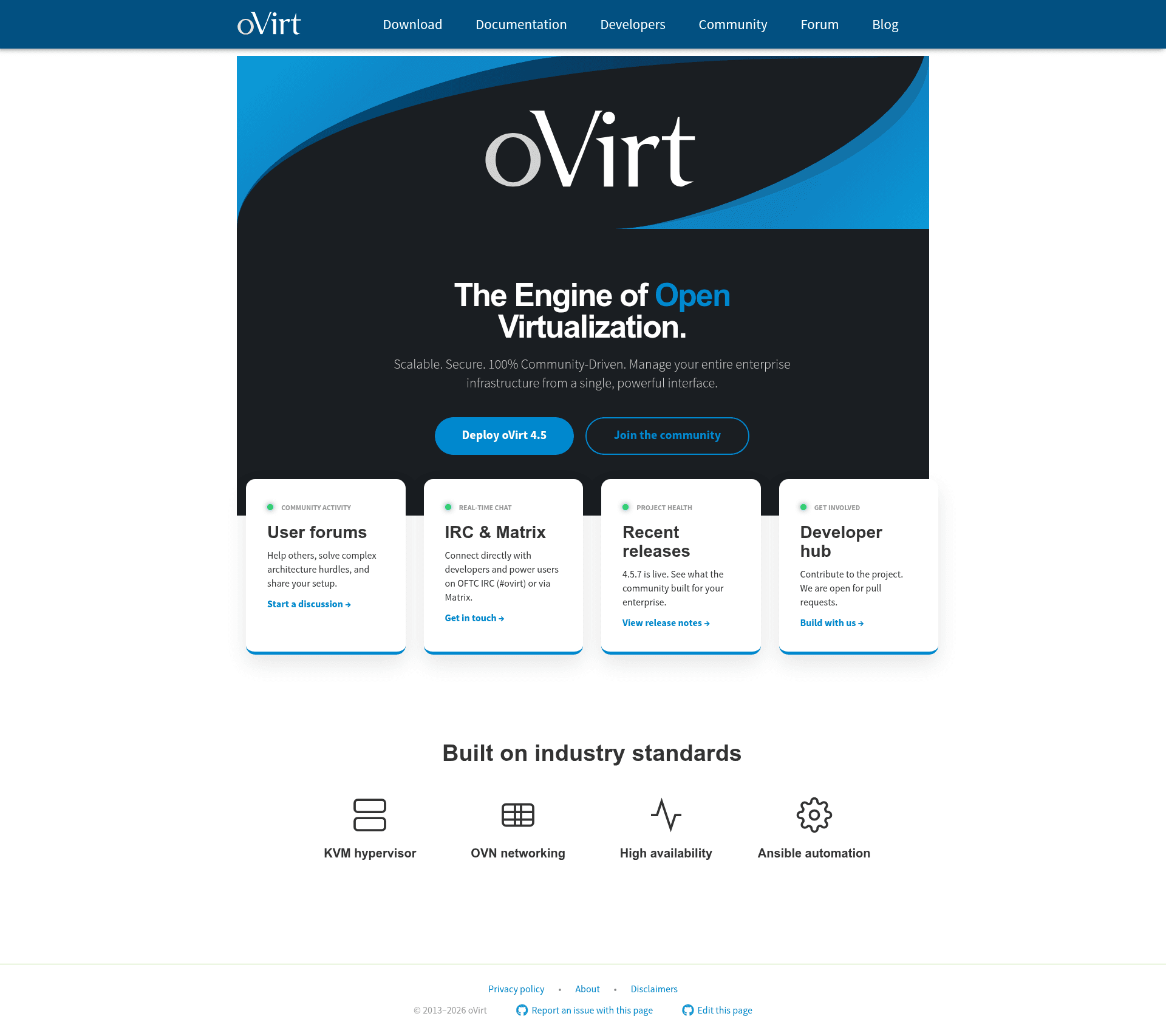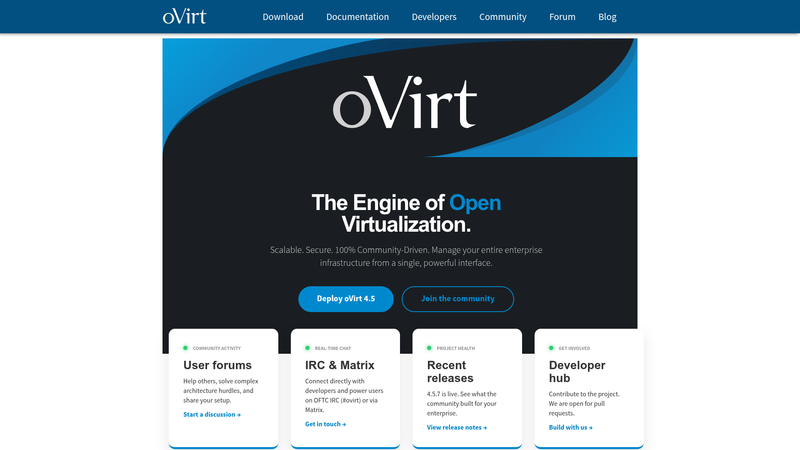
ovirt-site is the Jekyll-based source repository for the oVirt.org website, a community-driven documentation and web design project that turns Markdown content into a static site. The repository lives on GitHub and is maintained by the oVirt open-source community.
What is ovirt-site?
The ovirt-site repository contains all code, templates, stylesheets, and documentation for the oVirt.org website. Built on Jekyll, it uses Ruby and Sass for the site's structure and design, and stores the majority of content as Markdown files with a .md extension. The project runs entirely through GitHub; every published page includes "Edit this page on GitHub" and "Report an issue on GitHub" footer links, and contributions arrive as pull requests. It is a community-driven project, so all content is open for anyone to improve.
Key Features
- Jekyll static site engine — Generates fast, static HTML pages using Jekyll's templating system and a Ruby-based build pipeline.
- Markdown-based content — Almost all documentation and web page copy is written in Markdown, using a simple name.md naming convention for new files.
- GitHub-native contribution flow — Footer buttons on each page create pull requests or issues in the ovirt-site GitHub repository, lowering the barrier for contributors.
- Automated build verification — Pull requests are checked by automation; a green "All checks have passed" confirms a valid build, and a site-without-markdown.zip artifact is available under the Checks > Website Tests tab for review.
- Local preview with simple web servers — The built site can be served locally with
python3 -m http.serverfrom the extracted directory; running Apache in /var/www/html also replicates .htaccess redirects. - Clear project organization — README_ORGANIZATION.md explains how the source tree is structured, and CONTRIBUTING.md details local building and testing steps.
Who is it for?
- oVirt contributors — Anyone who wants to fix a typo or add new documentation can edit pages via the GitHub footer links and submit a pull request.
- Website maintainers — The maintainer group listed in MAINTAINING.md manages the site's layout, Sass styling, and structural changes.
- Jekyll developers — Developers seeking a production Jekyll example with Haml/HTML templates, Sass stylesheets, and a large Markdown content collection can use this repository as reference.
What can you do with it?
- Documentation editors: Create or update Markdown pages either by cloning the repo, creating a name.md file, or using the GitHub "New File" button, then proposing the change as a pull request.
- Issue reporters: Report documentation bugs or feature requests by clicking "Report an issue on GitHub" on the relevant page, or by opening an issue directly at the repository.
- Site designers: Modify the site's Sass and HTML sources to change its design, then preview locally with Python or Apache before submitting changes.
How does it work?
The contribution workflow is GitHub-centric: after forking or using the footer links, a pull request triggers automated checks that validate the Jekyll build. If all checks pass, the generated website is downloadable as a zip archive. For local development, contributors build the site following CONTRIBUTING.md and serve the output folder with a web server.
FAQ
How do I contribute to the oVirt website?
Click "Edit this page on GitHub" on any page to open a pull request, or clone the repository, add a Markdown file, and submit your change. CONTRIBUTING.md gives full set-up instructions for building and testing the site locally.
What file formats does the site use?
Most content is authored in Markdown, while site templates use Jekyll's preferred HTML and Haml formats with Sass for styling. The repository stores these source files under a structured directory layout.
How can I preview the site locally after building?
Extract the downloaded site-without-markdown.zip artifact and run python3 -m http.server from that directory. For .htaccess redirect support, place the directory in /var/www/html and serve it with an Apache server.