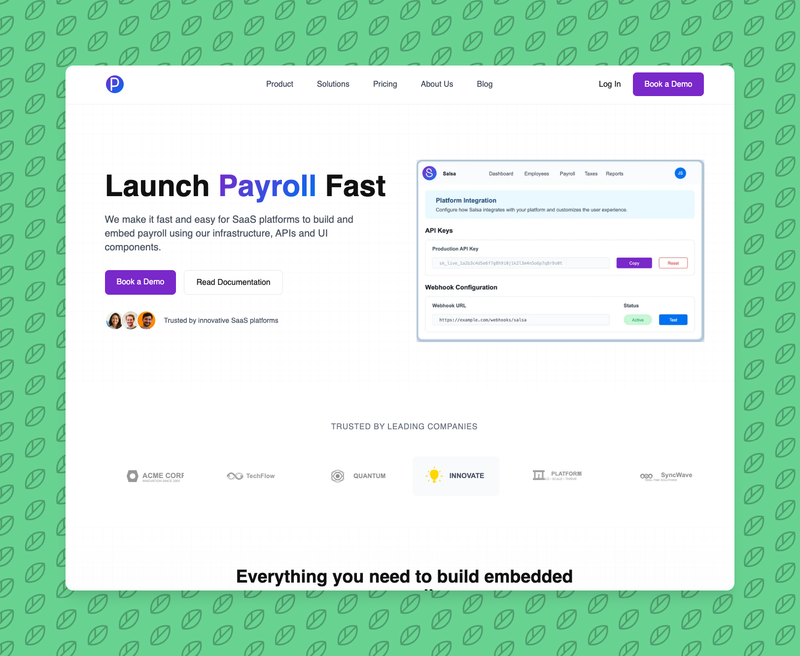
Payflo is an open-source Astro 5.7 starter theme that reimplements the salsa.dev website as a SaaS landing template for a fictional payroll provider, published on GitHub by ctrimm under the MIT License.
What is Payflo?
Payflo is a website template that takes the design of salsa.dev and rebuilds it as a modern Astro 5.7 project. It produces a static marketing site for a fictional payroll company, with routing determined by .astro files in the src/pages directory and a build output to dist/. The template is authored by ctrimm, distributed under the MIT License, and uses TypeScript configuration via tsconfig.json.
Key Features
- Astro 5.7 framework — Built on Astro 5.7, using its built-in image optimization for assets stored in src/assets, and supporting static site generation to dist/.
- Tailwind CSS styling — Responsive utility-first styling configured in tailwind.config.mjs and global styles in src/styles/global.css.
- View Transitions API — Fast page transitions are implemented with Astro's View Transitions support, so navigation between routes feels native.
- Scroll-triggered animations — Micro-interactions fire via an Intersection Observer in src/scripts/animations.js, paired with CSS animations defined in global.css.
- Accessibility and SEO — Components in src/components are accessibility-friendly, and the template includes modern SEO practices out of the box.
- Flexible page creation — Adding a page means creating a .astro file in src/pages; dynamic routes use bracket syntax such as src/pages/blog/[slug].astro.
Who is it for?
- SaaS founders — Launch a professional payroll or fintech marketing site quickly by cloning the repository and replacing the fictional Payflo content with their own branding.
- Astro developers — Learn Astro 5.7 best practices by reading the project structure, including the View Transitions API, image optimization, and TypeScript setup.
- Designers — Customize the Tailwind theme and global CSS to match a brand, with no back-end required because the site compiles to static files.
What can you do with Payflo?
- Payroll startups: Stand up a landing page and supporting routes by editing the existing Astro components and page files under src/pages.
- Hobbyist developers: Experiment with View Transitions and scroll animations by running the dev server and tweaking the animation script.
- Open-source contributors: Fork the MIT-licensed repository, add new pages or components, and submit changes upstream.
How does Payflo work?
Clone the repository from GitHub, install dependencies with npm, yarn, or pnpm, then run the dev server. The site is served locally at localhost:4321 during development, and "npm run build" generates the production output in dist/. Use "npm run preview" to test the production build locally.
Pricing
Payflo is free and open source under the MIT License, with no paid tiers or subscription requirements.
FAQ
Is Payflo free to use?
Yes. The repository is released under the MIT License, so you can use, modify, and distribute it freely, including in commercial projects.
What Node.js version do I need?
The README lists Node.js v18.14.1 or higher as a prerequisite, along with npm, yarn, or pnpm as package managers.
How do I add a new page to Payflo?
Create a new .astro file in the src/pages directory; the file path becomes the route. For example, src/pages/blog.astro serves at /blog, and src/pages/blog/[slug].astro creates dynamic blog post routes.
Where can I deploy Payflo?
Since the build output is static HTML in dist/, it can be hosted on Netlify, Vercel, GitHub Pages, Cloudflare Pages, or AWS S3 with CloudFront.


![Image for Start UI [web] on template0.com](https://cdn.sanity.io/images/asuw607r/production/82416b588b6dbb99eaa1c693646962928c22b67e-1920x1080.png?w=800&auto=format "Image for Start UI [web] on template0.com")