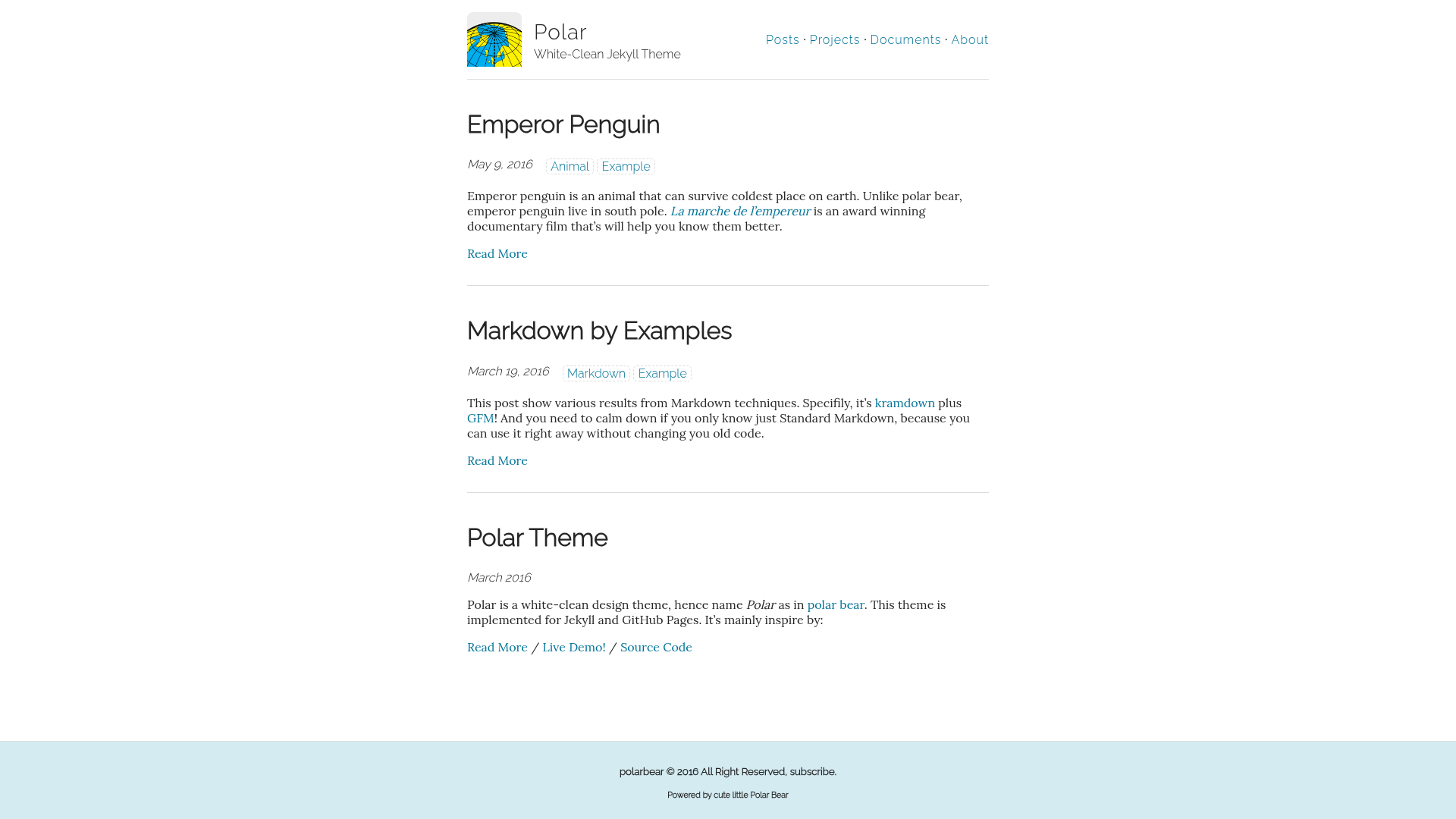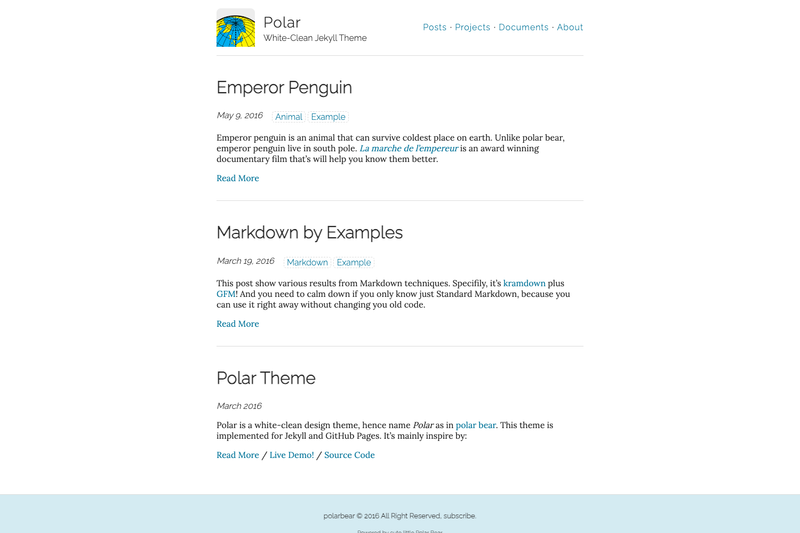
Polar is a Jekyll theme that builds white, clean, static websites without any JavaScript, aimed at content-focused blogs and personal pages. It is a free open-source theme hosted on GitHub by neizod, with a live preview available at https://neizod.dev/polar/. The theme relies on CSS flexbox for layout and integrates MathJax to render LaTeX-style equations directly in your Markdown posts.
What is Polar?
Polar is a Jekyll theme focused on minimalism and performance. It takes Markdown content and page configuration, and Jekyll generates a fully static HTML website with no client-side scripts. The theme is maintained in a public GitHub repository, attracting contributions through Hacktoberfest, and has earned 21 stars from the community. Its defining traits—white background, clean typography, zero JavaScript—make it straightforward to install and customize for content-focused sites.
Key Features
- No JavaScript — The theme ships zero custom client-side JavaScript, which means pages load faster and depend only on HTML and CSS.
- White clean design — The color palette is dominated by white space and clean typography, keeping readability high.
- Flexbox layout — The layout system is built with CSS flexbox, allowing responsive arrangements without external grid frameworks.
- MathJax support — Math equations written in LaTeX within Markdown render via MathJax, making it suitable for scientific notation and formulas.
- Open-source and free — The source code is publicly available on GitHub; you can fork it, submit issues, and propose changes through the Hacktoberfest program.
- Live demo — A working example of the theme can be visited at https://neizod.dev/polar/, useful for evaluating the theme before adopting it.
Who is it for?
Polar suits writers and developers who value speed and simplicity. Bloggers can use it to publish a lightweight personal blog with minimal configuration. Academics and instructors can publish lecture notes or research posts containing complex math formulas that render cleanly. Developers building project documentation or README-style sites can reuse the theme to present technical content without front-end build tooling.
What can you do with Polar?
- Academics: Write technical blog posts that include LaTeX math equations, and have them rendered automatically via MathJax.
- Bloggers: Launch a fast, minimal blog with straightforward Jekyll workflows—write Markdown posts and push to GitHub Pages.
- Open-source maintainers: Create clean project documentation pages that load quickly and are easy to navigate for users.
- Hacktoberfest contributors: Improve the theme itself by submitting pull requests to add features, fix bugs, or improve documentation.
How does Polar work?
Polar is installed as a standard Jekyll theme. You add the theme to your Jekyll site configuration, write your content in Markdown, and run the Jekyll build process. The theme's templates and styles transform the content into static HTML files you can host anywhere, including GitHub Pages.
FAQ
Is Polar free to use?
Yes, Polar's source code is published publicly on GitHub, so you can clone, use, and modify it without paying a license fee. Because it is a Jekyll theme, you only need a Ruby environment or GitHub Pages to build your site.
Does Polar include JavaScript?
Polar itself ships zero JavaScript files. However, if you use math equations, it loads MathJax from an external source, which is a JavaScript library, to render LaTeX in the browser. The core theme remains JavaScript-free.
Can I use Polar for a project documentation site?
Yes, Polar works for documentation sites because Jekyll can organize pages and posts into a clean, lightweight site. Its focus on white space and no custom JavaScript keeps documentation fast to load and easy to scan.
Where can I see a live preview of Polar?
A live preview of the Polar theme is hosted at https://neizod.dev/polar/. You can explore the demo pages to evaluate the theme's look and behavior before installing it yourself.
Does Polar support math equations?
Yes, Polar integrates MathJax, a JavaScript library that renders LaTeX math markup. Even though the theme ships no custom JavaScript, MathJax is loaded when needed to handle equations in your Markdown content.