
Template details
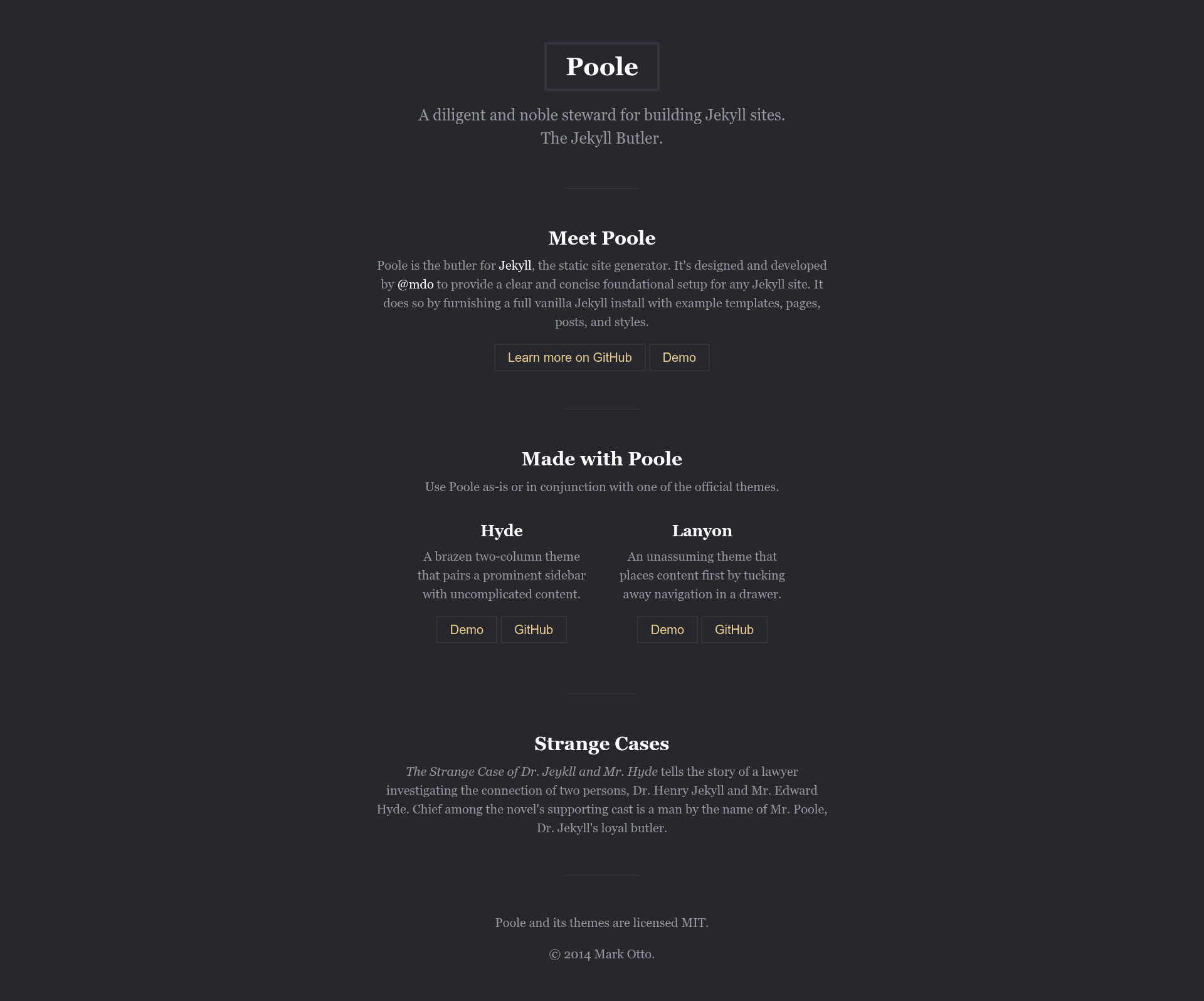
Poole
A no-frills responsive Jekyll blog theme by Mark Otto, with example templates, pages, posts, and Sass styles.
About this template
Poole is a no-frills responsive Jekyll blog theme created by Mark Otto (@mdo) that gives you a complete vanilla Jekyll installation with example templates, pages, posts, and styles so you can publish a blog without starting from scratch.
What is Poole?
Poole is a foundational Jekyll theme that provides the base structure for a static blog. It takes a standard Jekyll project and adds example layouts, pages, an RSS feed, and Sass-based styling, then compiles everything into static HTML via Jekyll's built-in compiler. The theme is authored by Mark Otto, a designer and developer known for his work on Bootstrap, and is released under the MIT license. It also serves as the parent theme for two official variants, Hyde and Lanyon.
Key Features
- Complete Jekyll starter — Includes example templates, pages, posts, an
atom.xmlRSS feed, and assets for CSS and JS, giving you a working blog out of the box. - Built-in SCSS pipeline — Source Sass files are stored in
_sass/, imported intostyles.scss, and compiled tostyles.cssby Jekyll's native Sass compiler. - Syntax highlighting support — Works with either Pygments or Rouge; install the gem you prefer and the theme's built-in styling applies automatically.
- Responsive layout — Described as "no frills" and responsive, the theme adapts to different screen sizes without extra frameworks.
- GitHub Pages ready — Fork the repository, switch to the
gh-pagesbranch, and setbaseurlorCNAMEto host the site on GitHub Pages or a custom domain. - Companion themes — Hyde and Lanyon are two official themes built on Poole, each with its own demo site and repository for feedback.
Who is it for?
Poole is designed for Jekyll users who want a clean, minimal starting point for a blog. Bloggers can download the theme, run jekyll serve, and start writing posts using the provided templates. Developers who already have a Jekyll site can copy only the needed parts — like _layouts/, HTML files, atom.xml, and assets/ — into their project. Those interested in Hyde or Lanyon can use Poole as a reference to understand how those themes are structured.
What can you do with Poole?
- Launch a personal blog quickly: Set up a responsive Jekyll blog with example content, RSS, and syntax highlighting by running
jekyll serveafter downloading. - Learn Jekyll structure: The example templates and pages demonstrate how Jekyll layouts, includes, and Sass compile together.
- Host on GitHub Pages: Fork the repo, switch to the
gh-pagesbranch, adjustbaseurlorCNAME, and publish a site at a GitHub Pages URL or custom domain.
How does Poole work?
Download the files, install Jekyll plus the jekyll-gist, jekyll-sitemap, and jekyll-seo-tag gems, then run jekyll serve to preview at http://localhost:4000. The theme compiles Sass to CSS on the fly, and when hosting on GitHub Pages you point the baseurl or a CNAME file at your domain. The repository has two branches: master is for development and pull requests, while gh-pages hosts the demo site with analytics tracking.
Pros and cons
- Pros: Free under the MIT license, responsive, includes example content, and easily deployable to GitHub Pages.
- Cons: Misconfiguring the
baseurlorCNAMEsettings can break styles, and the theme requires Jekyll to be installed locally before serving.
FAQ
Is Poole free?
Yes, Poole is open sourced under the MIT license, so you can use, modify, and distribute it freely.
What does Poole include?
It includes example templates, pages, posts, an RSS feed, Sass source files, and assets for CSS and JS. It also supports syntax highlighting via Pygments or Rouge.
Can I use Poole with my own domain?
Yes, on GitHub Pages you can modify the CNAME file to point to a custom domain, or set the baseurl in _config.yml for a project page.
What are Hyde and Lanyon?
Hyde and Lanyon are two official themes built on Poole. They are hosted at their own demo sites and have separate repositories for bug reports and feedback.