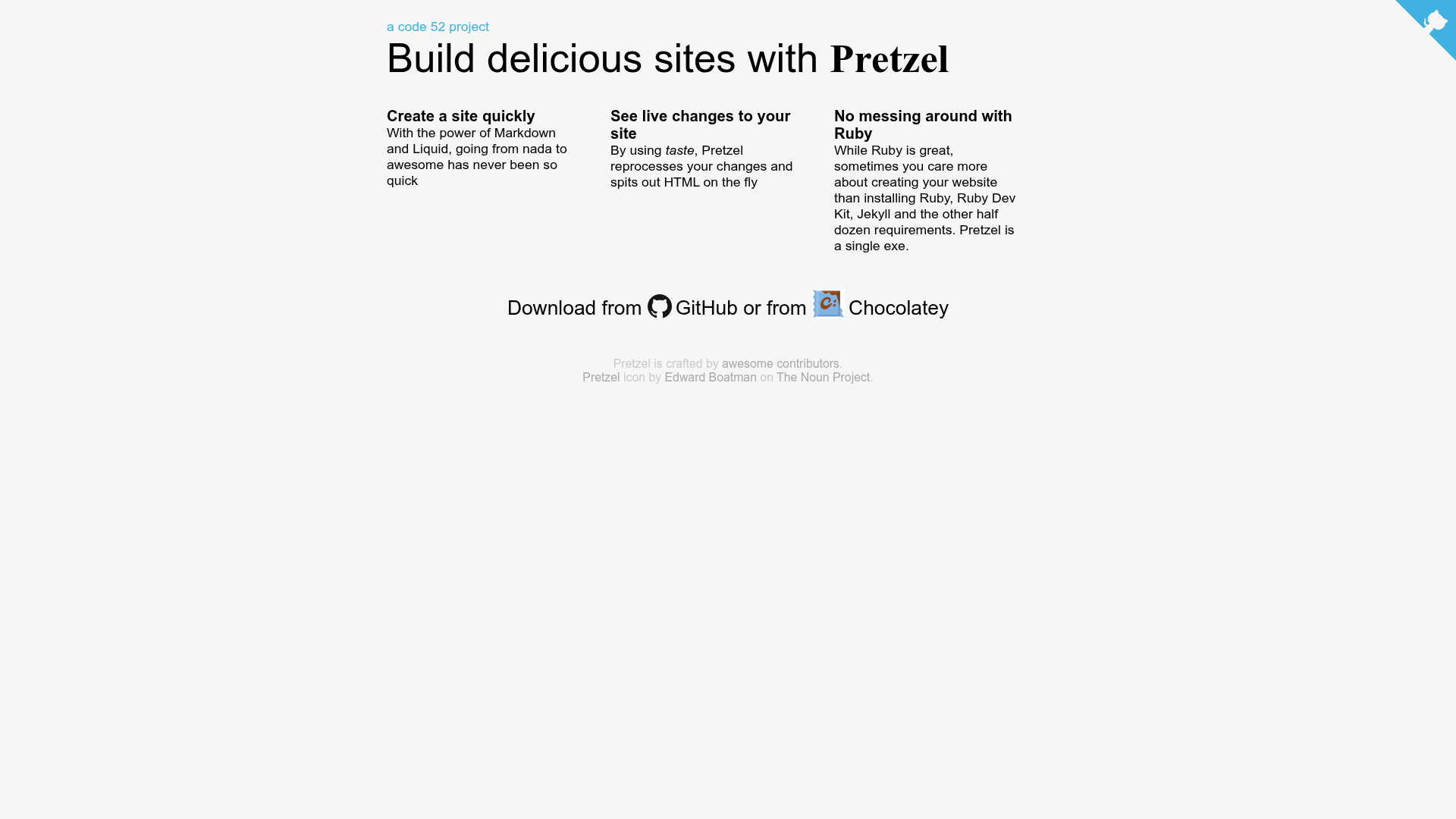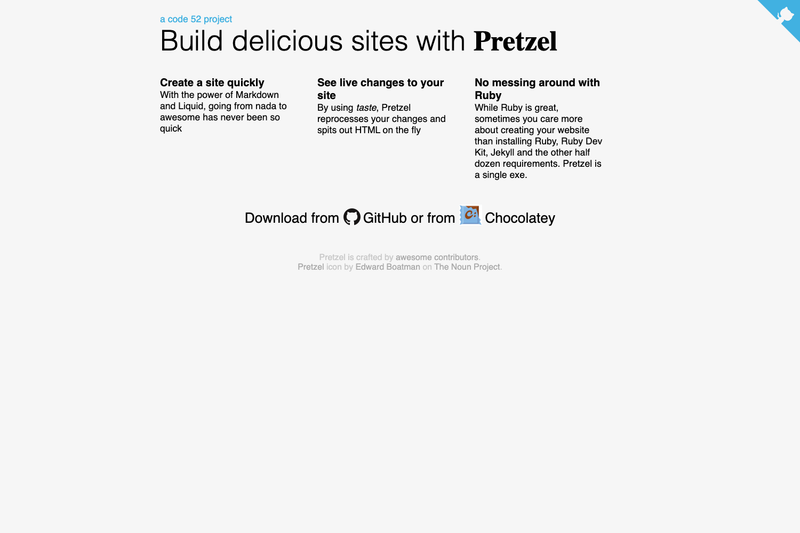
Pretzel is a static site generation tool for the .NET platform that follows Jekyll conventions, enabling Windows users to build Jekyll-compatible websites without installing Ruby.
Archived by its Code52 maintainers, the tool provides create, bake, and taste commands for scaffolding, generating, and locally previewing sites.
What is Pretzel?
Pretzel is an open-source, pluggable site generator written for .NET, designed to be compatible with basic Jekyll websites. It takes a folder of site content — Markdown posts, pages, and layout templates organized per Jekyll's structure — and produces a static HTML site ready for deployment. The project lives under the Code52 organization on GitHub, and it can be installed as a Chocolatey package or a NuGet library (Pretzel.Logic). Because the repository is archived, active development has stopped; the maintainers point users to Wyam, Statiq.Web, Jekyll on Windows, or any other static site generator.
What makes Pretzel stand out?
- Jekyll compatibility — Pretzel follows the same conventions as Jekyll, so a basic Jekyll website's folder structure and content should work without modification.
- Three core commands —
pretzel createscaffolds a new site folder structure,pretzel bakegenerates the static site from the current or specified folder, andpretzel tasteserves the site locally for testing. - Live regeneration — The
tastecommand watches for file changes and regenerates the page automatically, with a default port of 4000 and an option to change the port via--port. - Plugin support — Pretzel has a plugin system documented on its wiki, allowing users to extend its processing pipeline.
- Input inference — When running
bake, Pretzel scans the folder to detect content types automatically; you can also explicitly set the engine (for example,--engine liquid). - .NET distribution — It ships as a Chocolatey package (
pretzel) and as thePretzel.LogicNuGet package, making installation straightforward on Windows.
Who should use Pretzel?
- .NET developers who want to generate static sites using tools they already know, instead of installing the Ruby-based Jekyll toolchain.
- Windows users who need a Jekyll-compatible generator that runs natively on .NET; Mono support was planned but not implemented, so Windows is the primary target.
- Jekyll users who want a .NET-based alternative for local generation or CI integration while keeping the same content layout conventions.
- Teams migrating from Jekyll who need a drop-in generator for simple sites and can tolerate the project's archived status.
What can you do with Pretzel?
- Create a new blog or documentation site: Run
pretzel create C:\path\to\folderto generate the initial folder structure, then add content in Markdown. - Generate a deployable static site: Use
pretzel bakeon a folder with posts and pages; Pretzel outputs plain HTML that can be hosted on any static file server. - Preview changes locally: Start
pretzel taste --port 5000to serve the site on a custom port and have it rebuild automatically as files change; pressqto stop the server.
How does Pretzel work?
Pretzel's workflow mirrors Jekyll's: you organize content in the expected folder structure (posts, layouts, includes), optionally configure plugins, and then run the generate command. The bake command scans the target folder, processes content through the selected engine (Liquid by default), and writes the resulting static files. For local development, taste runs the same generation logic and serves the output over HTTP, regenerating whenever source files are modified.
Alternatives to Pretzel
- Jekyll — the original Ruby-based generator that defines the conventions Pretzel follows, still actively maintained.
- Wyam — a .NET static site generator mentioned in Pretzel's archived README as an alternative.
- Statiq.Web — the successor to Wyam, also a .NET static site generator, listed in the README's recommendations.
- Other static site generators — the README links to staticgen.com for a broader directory of options.
FAQ
Is Pretzel free?
Yes. Pretzel is open source and distributed through Chocolatey and NuGet at no cost. The source code is available on GitHub under the Code52 organization.
Is Pretzel still maintained?
No. The project's README states it has been archived because the maintainers lost time and will to continue. Anyone is welcome to fork it or use the recommended alternatives such as Statiq.Web.
What commands does Pretzel provide?
Pretzel has three principal commands: create (scaffolds a new site), bake (generates the static output), and taste (serves the site locally with auto-regeneration). Each command accepts optional parameters like a target folder or port.
Does Pretzel support Mono or Linux?
Mono support was "planned I think" according to the README, but it was not completed before the project was archived. The tool is primarily aimed at Windows and .NET developers.
What is the default port for pretzel taste?
The default port is 4000, and you can override it with the --port option, for example pretzel taste --port 5000. Press q to stop the server.