Newsletter
Join the Community
Subscribe to our newsletter for the latest news and updates

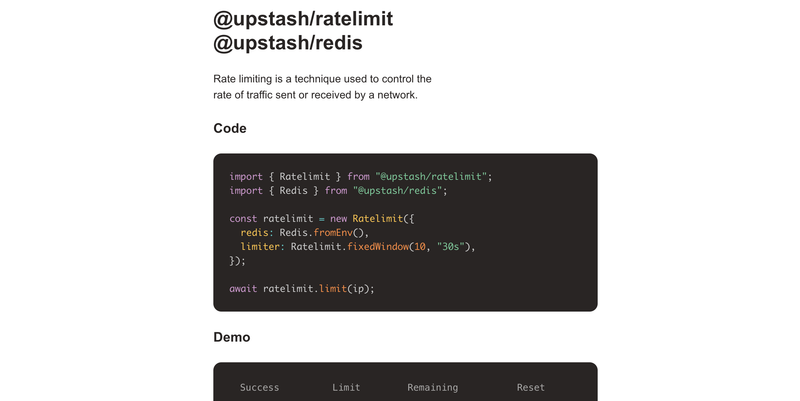
Example app wiring @upstash/ratelimit to Upstash Redis, with npm local dev and one-command Vercel deployment.

Open-source Next.js starter kit from Astria for building an AI headshot generator SaaS, with Supabase auth, Stripe billing and Vercel deploy.

Example Next.js marketing site whose pages are assembled from Drupal Landing page nodes and paragraphs served over JSON:API.

Next.js 15 starter from PaddleHQ that adds a pricing page and a Paddle Billing web checkout openable from iOS apps, with Apple Pay support.
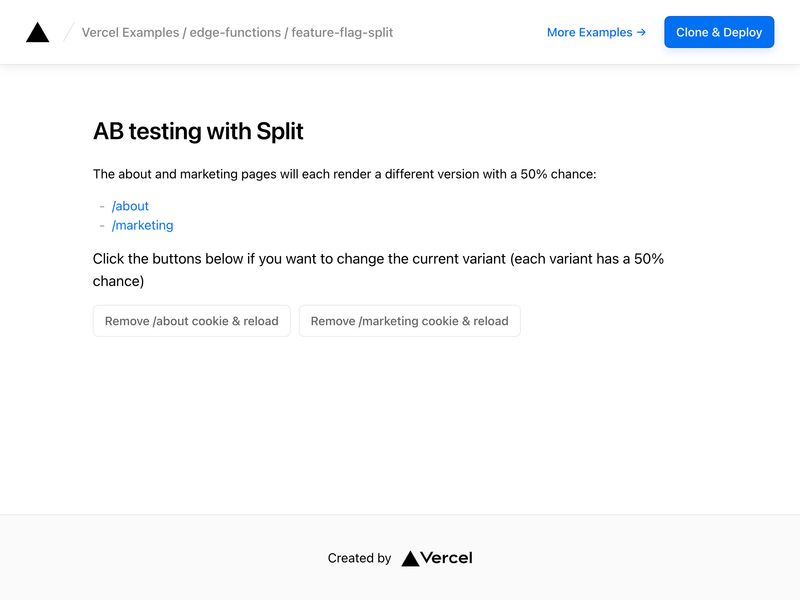
Next.js Edge Middleware example that uses Split feature flags to A/B test a marketing page and an about page, styled with Tailwind CSS.

A minimal Hugo static-site boilerplate from Vercel's examples repository that deploys to Vercel with zero configuration.

Minimal Flask example that runs a WSGI Python API on Vercel Serverless Functions using the Python Runtime.
@upstash/ratelimit & @upstash/redis example is a small server-side reference project from the Upstash examples repository that connects the @upstash/ratelimit library to an Upstash Redis instance, runs locally through npm scripts, and deploys to Vercel with the Vercel CLI.
This example demonstrates using @upstash/ratelimit together with @upstash/redis, the two npm packages it pairs. You supply Upstash Redis credentials as environment variables, and the application uses them at runtime to enforce rate limits through the @upstash/ratelimit library. It lives in the Upstash examples repository (about 42 stars), whose stated description is "Examples how to use Upstash with various tech", so it is one entry in a collection rather than a standalone product.
Running the example takes five steps: copy the example env file with cp .env.local.example .env.local, create an Upstash Redis instance, set the environment variables in the new file using the instance's credentials, install dependencies with npm install, and start the app with npm run dev. Deployment from the same directory is a single vercel command through the Vercel CLI.
@upstash/ratelimit package, applied against a Redis backend rather than in-memory state..env.local.example is copied to .env.local, which is where the Upstash Redis connection values are pasted.npm install installs dependencies and npm run dev starts the local development server.vercel from the project directory builds and deploys the app to Vercel.@upstash/ratelimit to an existing API route or handler instead of writing the Redis wiring from scratch.vercel CLI path, including the note that a newly created project may need its environment variables set and a redeploy.@upstash/ratelimit and @upstash/redis fit together before committing an app to the stack.npm run dev locally against a free-to-create Upstash Redis instance to validate the limiting behavior, then push the same configuration to Vercel.Yes. The application reads Upstash Redis credentials from the environment, so you must create an Upstash Redis instance, copy .env.local.example to .env.local, and place the credentials there before npm run dev will work.
Run the vercel command from the project directory. The README notes that if you create a new project during that step, you may need to set the environment variables on the project and redeploy the app for the Redis connection to work.
No. It covers environment setup, local development with npm, and Vercel deployment only. Specific algorithms, time windows, and request thresholds are configured by you in the code rather than described on the page.
It is a minimal example whose stated purpose is demonstrating @upstash/ratelimit with Upstash Redis. There is no documented UI, database schema, or feature list beyond the setup and deploy instructions.