Resume is an MIT-licensed LaTeX resume template for producing elegant single-page Chinese and English CVs, compiled with XeLaTeX and forked from the popular billryan/resume project. It takes resume content written in simple LaTeX macros and outputs a professionally typeset PDF with full Unicode and Chinese font support, making it a practical choice for job seekers who want a clean, customizable one-page CV.
What is Resume?
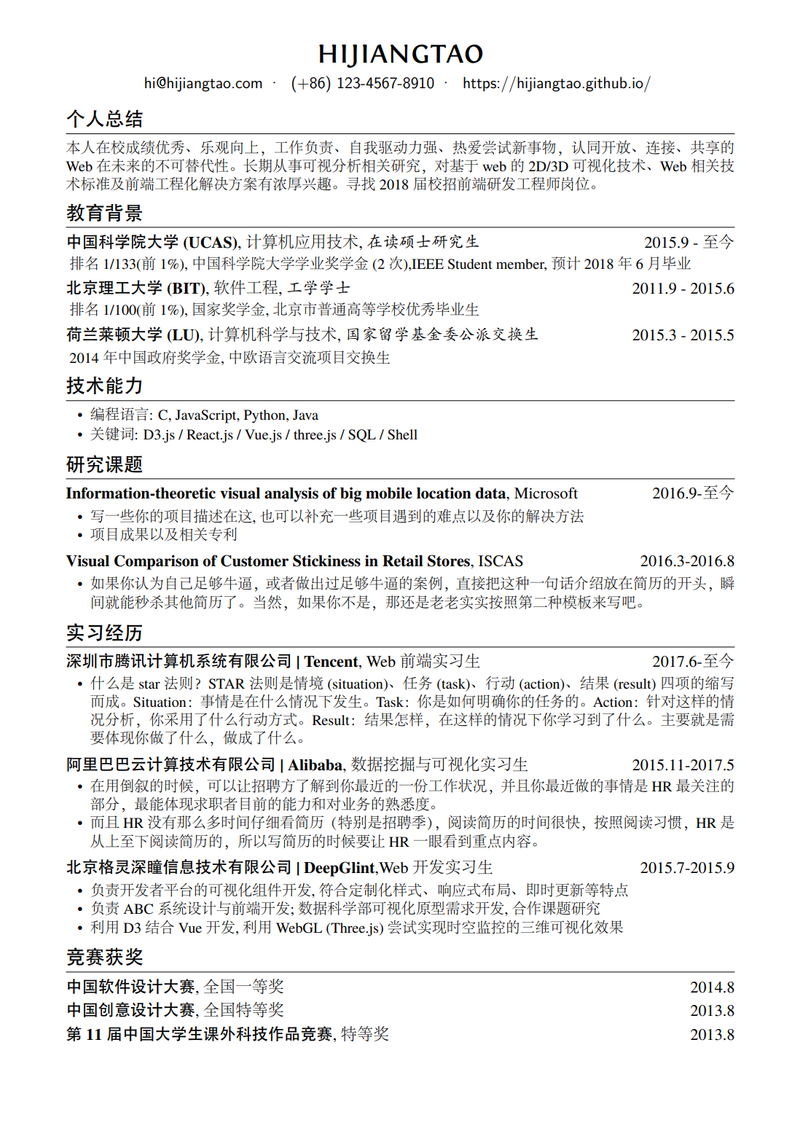
Resume is a LaTeX class and example document created by hijiangtao, based on the billryan/resume repository. Its main entry file is resume-zh_CN.tex, and it is compiled with the XeLaTeX engine because it uses the fontspec package for font management. The template accepts structured resume data through macros such as \name, \contactInfo, \section, and \datedsubsection, and produces a PDF ready for submission. A preview of the rendered result is included in the repository as a PNG file.
Key Features
- XeLaTeX compilation — Relies on
fontspecto load system fonts, enabling correct Unicode and Chinese character rendering that older LaTeX engines cannot handle. - Chinese font support — The master branch bundles Adobe Song, Kai, Hei, and Fang font families (roughly 37 MB), and an external variant (
zh_CN-Adobefonts_external) uses system-installed Adobe fonts instead. - Simple macro system — Custom commands like
\name,\contactInfo,\section,\datedsubsection, and\itemizelet you structure a resume without writing raw layout code. - FontAwesome 4.3.0 icons — Icons for email, phone, and social links can be inserted by copying the relevant macro from
fontawesome.sty; aliases are not yet supported. - One-page friendly design — The layout is intentionally compact, suited to the traditional single-page resume format rather than multi-page CVs.
- Online compilation ready — You can zip the source and upload it to ShareLaTeX/Overleaf for cloud-based compilation, with a dedicated package option for that environment.
- MIT licensed — The template code is freely reusable and modifiable; bundled Adobe fonts remain copyrighted and are excluded from the license.
Who is it for?
- Job seekers — Build a professional one-page Chinese resume by filling in the provided macros and compiling to PDF in minutes.
- Internship applicants — Use the dated subsection macro to list education, research projects, and part-time roles with right-aligned time ranges.
- LaTeX users tired of old CV templates — Switch from
resormoderncvto a template that offers modern Unicode support and easier customization.
What can you do with Resume?
- Create a Chinese resume — Edit
resume-zh_CN.texwith your details and compile with XeLaTeX to get a PDF with proper Chinese typography and fonts. - Add icons to contact lines — Search the Font Awesome icon list, find the matching command in
fontawesome.sty, and place it in your contact info for a visual touch. - Compile online without installing LaTeX — Package the entire folder into a zip, upload to ShareLaTeX, and choose the external fonts package to generate your PDF in the browser.
How does Resume work?
Start by cloning the repository: git clone https://github.com/hijiangtao/resume.git --branch master --depth 1 --single-branch <folder>. Then edit resume-zh_CN.tex using the provided macros. Compile locally with XeLaTeX, or upload a zip of the source to ShareLaTeX/Overleaf and use the zh_CN-Adobefonts_external package. If you need only the Chinese version, the master branch includes the necessary Adobe fonts.
FAQ
Does Resume support Chinese?
Yes. The template is built for Chinese support, using XeLaTeX and the fontspec package to load Adobe fonts and handle Unicode. It includes four font families: Song, Kai, Hei, and Fang.
Can I compile Resume online?
Yes. The README recommends zipping the source and uploading it to ShareLaTeX (now Overleaf). Use the zh_CN-Adobefonts_external package on the online platform, since the bundled fonts are not installed there.
Is Resume free to use?
The template is released under the MIT License, so you can freely use and modify it. However, the Adobe fonts bundled in the repository are copyrighted and are not covered by that license.
What compiler is required?
You must use XeLaTeX. The template depends on the fontspec package, which is not supported by pdfLaTeX or standard LaTeX.
How do I customize the layout?
The template defines easy macros: \section for major sections, \datedsubsection for subsections with a right-aligned date, and \itemize for bullet lists. The README links to ShareLaTeX blog posts that explain the underlying class design.