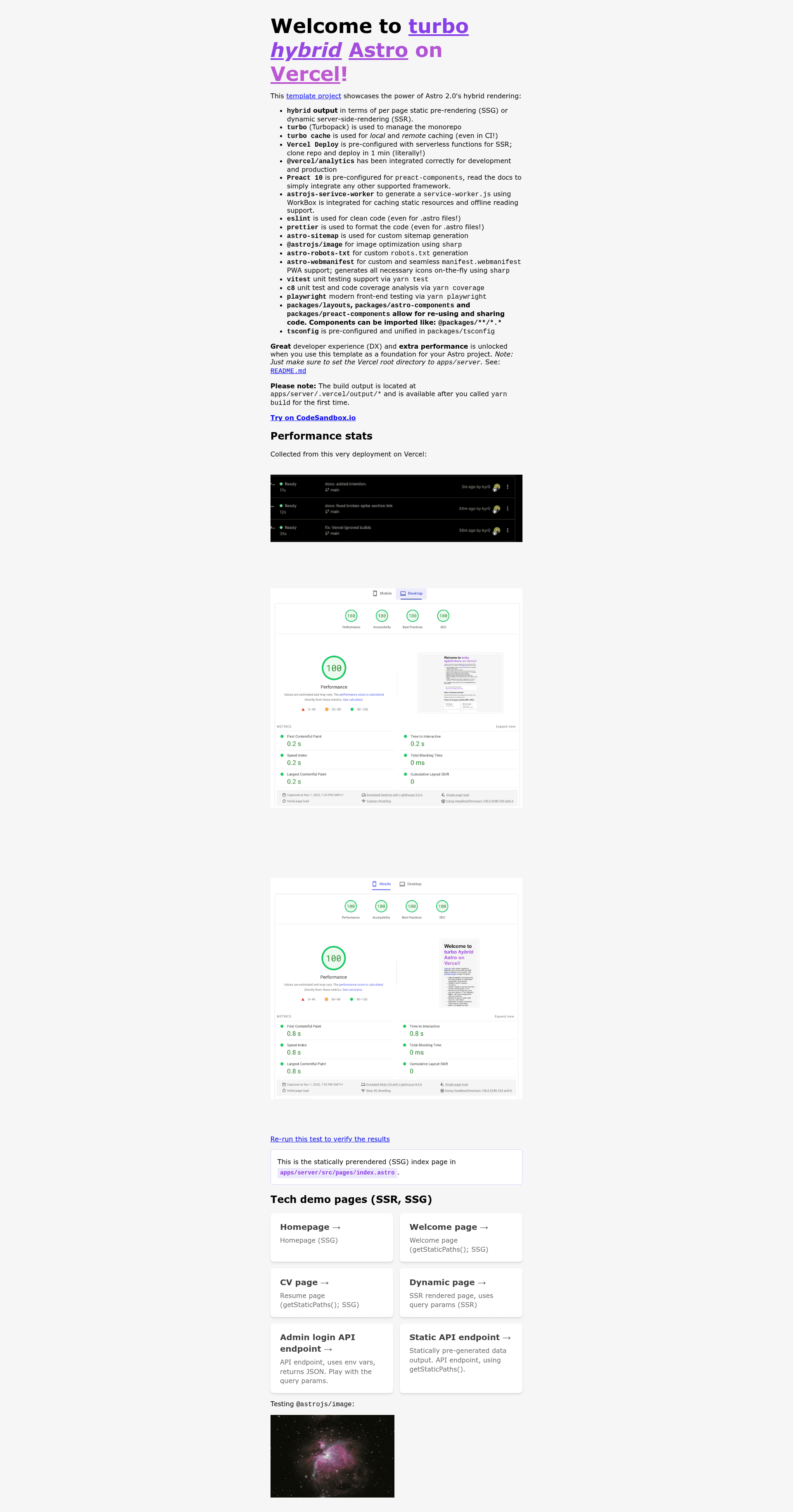
Turbo Hybrid Astro on Vercel is an Astro 2.0 boilerplate template that uses Astro's hybrid output to combine static site generation (SSG) and server-side rendering (SSR) in one project, with Turborepo handling the monorepo and Vercel as the deployment target.
What is Turbo Hybrid Astro on Vercel?
Turbo Hybrid Astro on Vercel is a public GitHub repository template that scaffolds an Astro 2.0 project with hybrid rendering enabled. It takes application code, pages, and API routes as input and produces a deployable Vercel project that supports both static pages and serverless or edge functions. The template includes a Turborepo setup with apps/server as the primary Astro deployment target, and it has been starred 55 times on GitHub.
Key Features
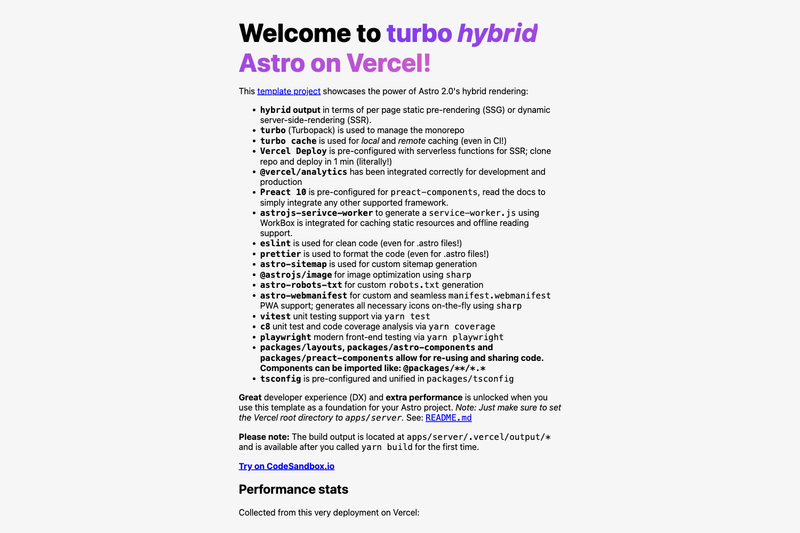
- Hybrid rendering with Astro 2.0 — Uses the new hybrid output mode to decide per-page whether to render statically or on the server, all within a single Astro app.
- Turborepo monorepo management — Orchestrates apps and packages with Turborepo, enabling local and remote build caching plus shared eslint, prettier, and tsconfig bases.
- Vercel-first deployment — Contains a vercel.json inside apps/server that forces turbo builds; you deploy by setting the root directory to apps/server.
- Pre-configured integrations — Ships with @vercel/analytics, preact, astrojs-service-worker, @astrojs/image, astro-robots-txt, astro-sitemap, and astro-webmanifest already wired in.
- Image optimization with sharp — Includes the sharp package pre-configured for local image processing; the README also gives a brew/vips troubleshooting workaround if sharp fails to install.
- Shared package structure — Reusable Astro components, layouts, and Preact components live in packages/*, alongside centralized tsconfig, prettier, and eslint configs.
- Measured build performance — The project reports a 40-second no-cache build and a 6-second cached full-turbo build on Vercel, and a 3.79-second full build locally on a 2021 Apple M1 Max.
Who should use Turbo Hybrid Astro on Vercel?
- Astro developers who need both SSG and SSR — They can create static content pages and dynamic, server-rendered routes or APIs without maintaining separate projects.
- Teams working in a monorepo — The layout separates apps and packages so multiple applications can reuse components and configuration through Turborepo.
- Developers deploying to Vercel — Those who want serverless/edge functions and remote caching can follow the documented deploy steps (set root directory to apps/server) and get a working pipeline.
- Prototypers wanting a batteries-included stack — Pre-installed analytics, sitemap, robots, manifest, service worker, and Preact support reduce setup time.
What can you do with this template?
- Build a hybrid marketing site: Combine fast static landing pages with dynamic SSR pages such as dashboards or personalized views.
- Expose API microservices: Add serverless or edge API routes within the Astro app and deploy them to Vercel alongside the site.
- Share components across apps: Use packages/astro-components and packages/preact-components to keep the UI consistent across multiple apps in the monorepo.
- Take advantage of remote caching: With Turborepo remote caching enabled, CI/CD builds can reuse cached artifacts, dropping the build time from 40 seconds to 6 seconds when nothing changed.