Newsletter
Join the Community
Subscribe to our newsletter for the latest news and updates

A Turborepo monorepo starter combining a Gatsby site, a Next.js docs app, and a shared React component library in TypeScript.
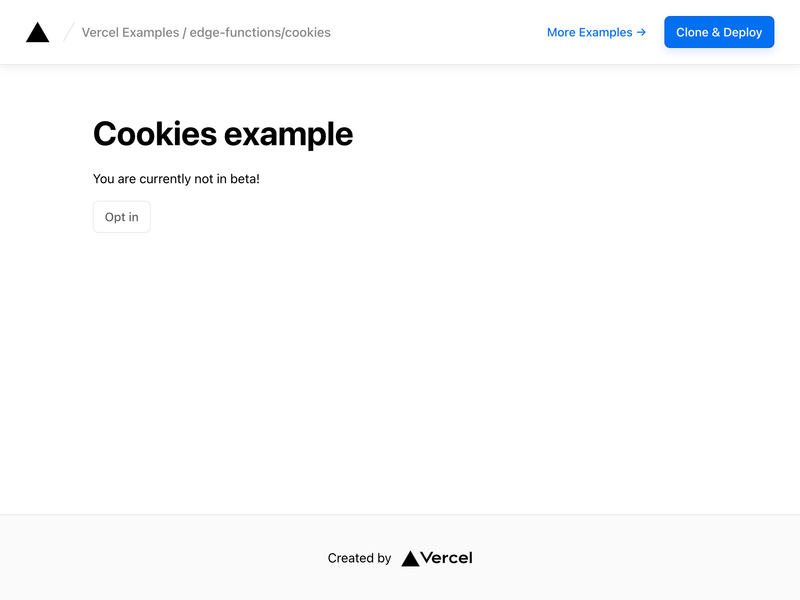
Next.js Edge Middleware example that reads a cookie at the edge and rewrites visitors to a statically generated page based on its value.

Open-source AI chatbot template built with Next.js, the AI SDK by Vercel, and Groq for streaming chat responses.
Minimal Shopify Hydrogen v2 headless storefront boilerplate built on Remix, ready to deploy to Vercel with zero configuration.
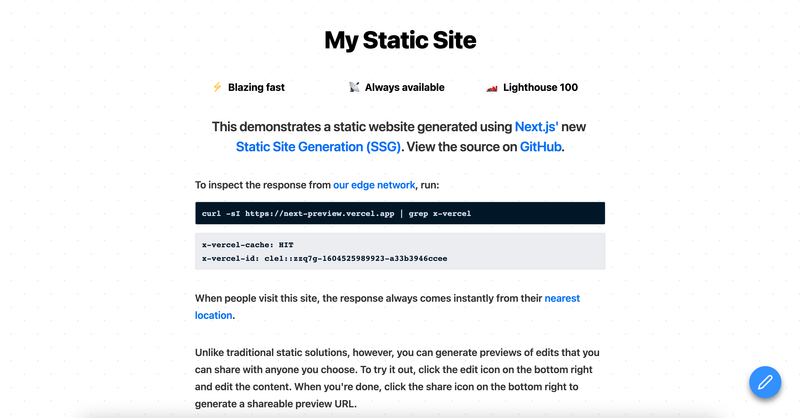
Next.js demo pairing static site generation via getStaticProps with Preview Mode, so authorized editors can view draft CMS content on demand.
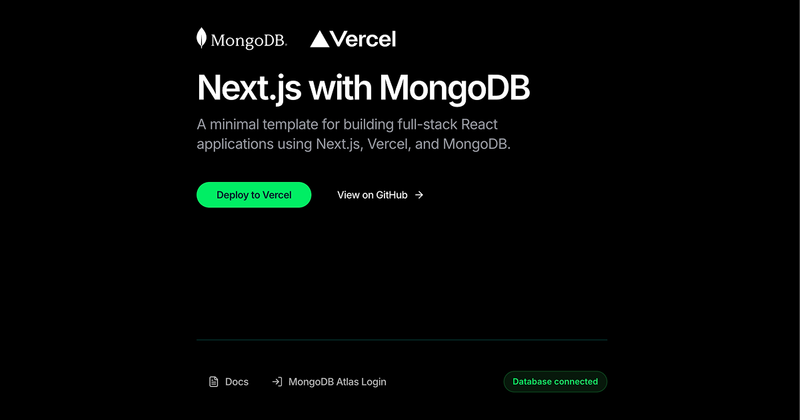
Minimal full-stack starter pairing the Next.js 16 App Router with MongoDB Atlas, TypeScript, Tailwind CSS, shadcn/ui and one-click Vercel deploy.

Starter that installs an Elysia API with Bun, previews it locally through the Vercel CLI on port 3000, and deploys it to Vercel.
The Turborepo Gatsby.js Starter is a community-maintained monorepo boilerplate that scaffolds a Gatsby site, a Next.js documentation app, and a shared React component library inside a single Turborepo workspace, generated with one command.
The Turborepo Gatsby.js Starter is a community-maintained example template that sets up a Turborepo monorepo containing two applications and three shared packages, all written in TypeScript. Running the command npx create-turbo@latest -e with-gatsby generates the workspace, after which pnpm run build builds every app and package and pnpm dev starts them in development mode. Turborepo itself is a Rust-written build system for JavaScript and TypeScript repositories, and this example is distributed as one of its official starter examples rather than as a standalone product.
web app is a Gatsby.js site while the docs app is a Next.js application, so both static-site and React server-rendered setups share one toolchain.@repo/ui is a stub React component library consumed by both web and docs, demonstrating cross-app component reuse.@repo/eslint-config centralizes lint rules, including eslint-config-next and eslint-config-prettier.@repo/typescript-config holds the tsconfig.json files used throughout the monorepo.turbo login and turbo link against a Vercel account.web Gatsby app sits beside a Next.js docs app, giving a reference for adding a second framework to the same pipeline.@repo/ui shows how to consume one component library from two different frameworks.web while authoring docs in the Next.js docs app, sharing components through @repo/ui.npx create-turbo@latest -e with-gatsby.pnpm run build to build all apps and packages, or pnpm dev for development.pnpm dlx turbo login and enable shared caching with pnpm dlx turbo link.The starter is free to generate and use, and Vercel Remote Cache is free on all Vercel plans according to the page. Turborepo itself is open source.
Nx, another JavaScript monorepo build tool, which centers on a plugin-driven project graph rather than Turborepo's pipeline configuration.
Yes. The example is free to scaffold with npx create-turbo@latest -e with-gatsby, and the page states that Vercel Remote Cache is free on all plans. Turborepo itself is open source software.
It contains a Gatsby.js web app, a Next.js docs app, a shared React component library named @repo/ui, an @repo/eslint-config package, and an @repo/typescript-config package. Every app and package is written in TypeScript.
Yes, but caching is local by default. To share cache artifacts across machines and CI pipelines you run pnpm dlx turbo login followed by pnpm dlx turbo link, and this requires a Vercel account.
It is a community-maintained example rather than an officially supported product. The page asks users who hit a problem to submit a pull request with a fix and notes that GitHub Issues will be closed.