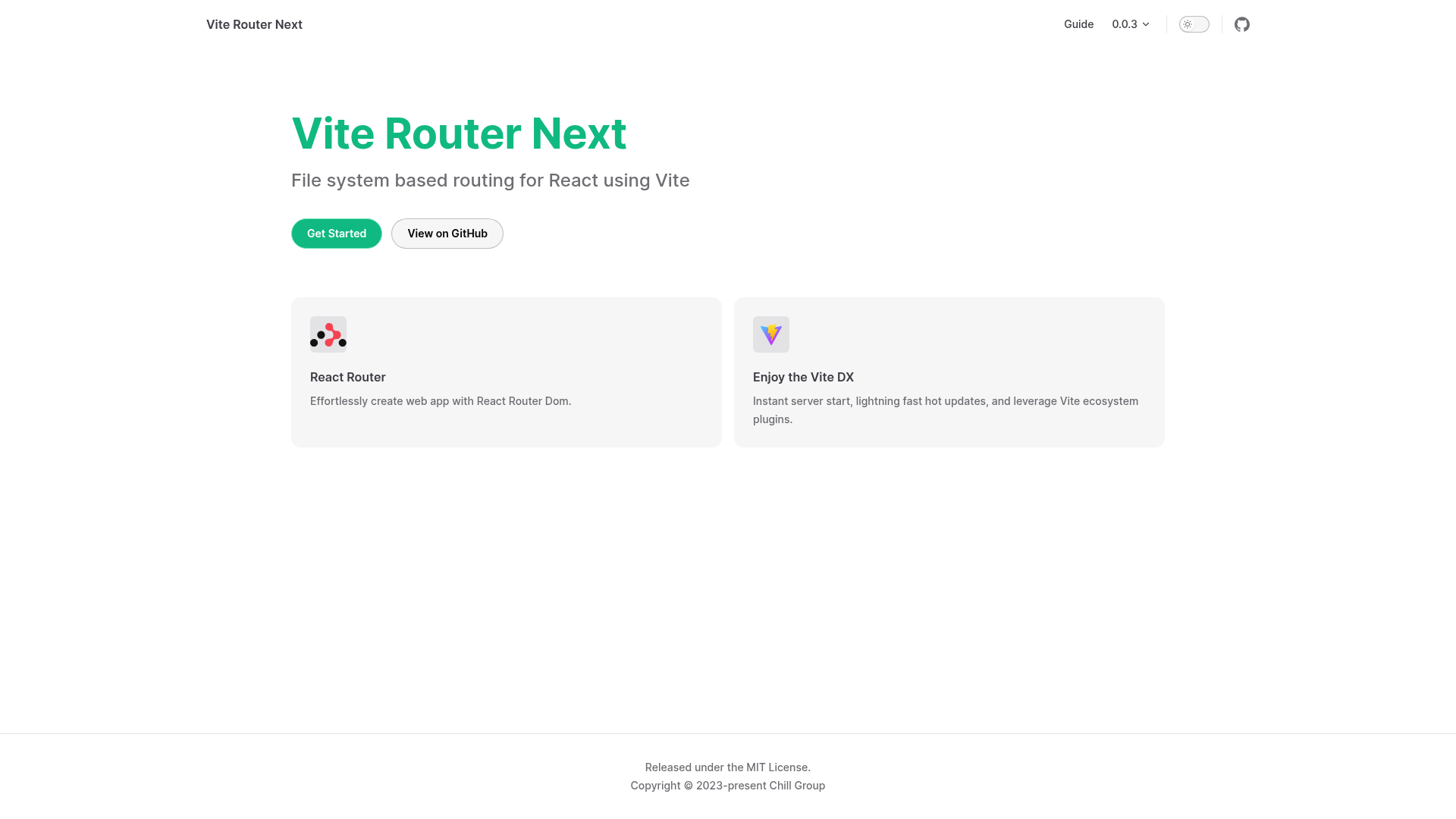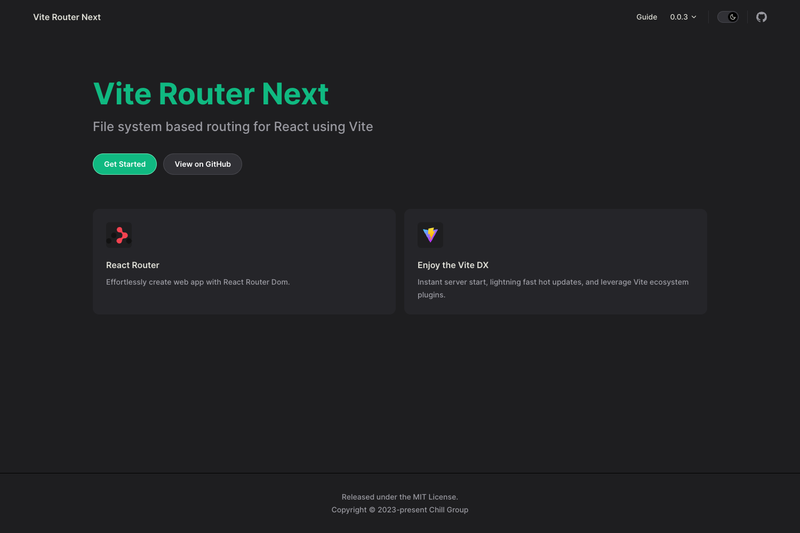
Vite Router Next is an open-source, file-system-based routing library for React applications using Vite, providing Next.js-style route conventions without requiring the Next.js framework.
What is Vite Router Next?
Vite Router Next is a routing library that lets React developers define routes as files and directories in their project instead of writing a central route configuration. It is built specifically for Vite-based React applications and is distributed under the MIT license, with official documentation available at https://chillgroup.github.io/vite-router-next/. The project integrates with the React Router ecosystem, as shown by its references to error boundaries, loaders, and deferred data loading.
Key Features
Vite Router Next includes a set of routing features that follow familiar file-system conventions:
- Route Groups — Group related routes in folders without adding extra URL segments, keeping your file tree organized.
- Dynamic Routing — Create routes with dynamic parameters by using segment placeholders in file names, enabling ID-based detail pages and similar patterns.
- Catch All Routing — Match arbitrary URL path lengths with a single catch-all route, useful for fallback or nested content.
- Loading UI — Attach loading states to routes for smoother transitions while data or code is being fetched.
- Error Boundary — Integrate React Router's error element to handle route-level errors gracefully instead of crashing the whole page.
- Loader and
useLoaderData— Load data before a route renders, with the loader's result exposed to the component throughuseLoaderData. defer— Defer slow data with React Router's defer, letting the page stream in early and update when data arrives.
These features cover the routing patterns most React applications need without hand-writing route resolver logic for each path.
Who is it for?
Vite Router Next is for React developers who want the ergonomics of file-based routing without adopting a full framework like Next.js. Teams running Vite as their build tool can use this library to replace manual route arrays with a simple folder structure. It is also suitable for developers already familiar with React Router APIs, since it builds on the same ecosystem of error boundaries, loaders, and deferred data.
What can you do with it?
- React developers on Vite — organize pages into folders and have route URLs generated automatically, cutting boilerplate from route configuration files.
- Teams migrating from Next.js — replicate the file-system routing mental model in a lighter Vite setup, keeping dynamic routes and loading patterns they already know.
- Open-source contributors — inspect the MIT-licensed source and contribute features like route groups and catch-all routing to the project.
FAQ
Is Vite Router Next free?
Yes, the project is open source and distributed under the MIT license, so you can use it in both personal and commercial projects without cost.
Does Vite Router Next work with React Router?
The feature list includes error boundary, loader, useLoaderData, and defer, all of which are React Router concepts. The README links to React Router documentation, indicating the library is built on or integrates with React Router's data APIs.
Where can I find the documentation?
Documentation is hosted on GitHub Pages at https://chillgroup.github.io/vite-router-next/.