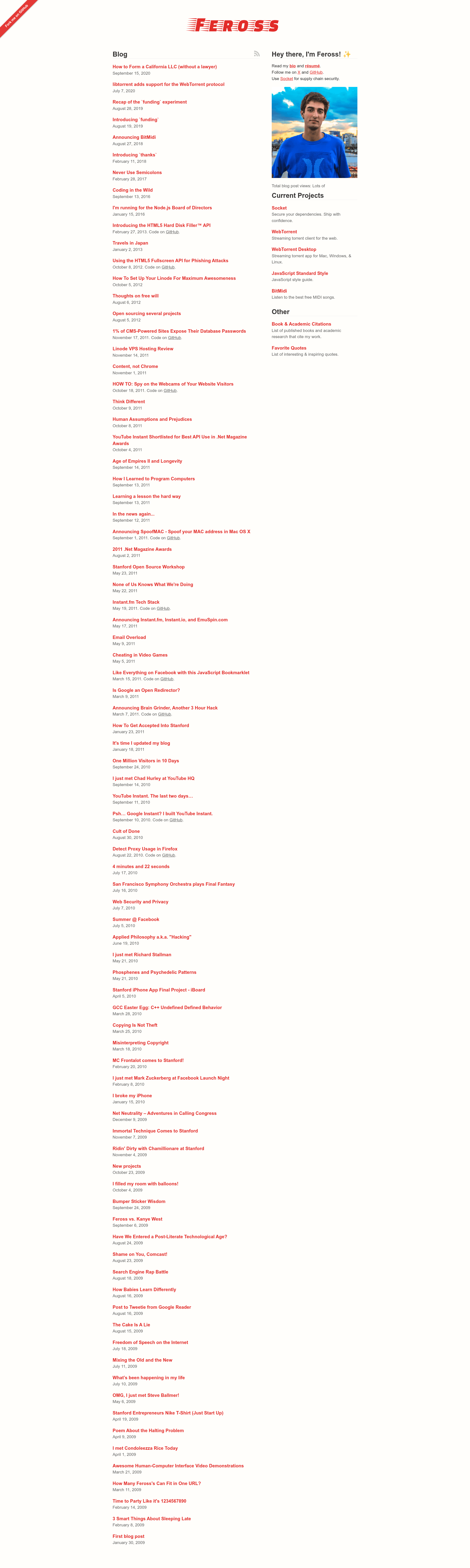
Feross.org is the open-source Jekyll blog template behind Feross Aboukhadijeh's personal site, converting Markdown posts into static HTML files with a Node.js page-view tracker.
What is Feross.org?
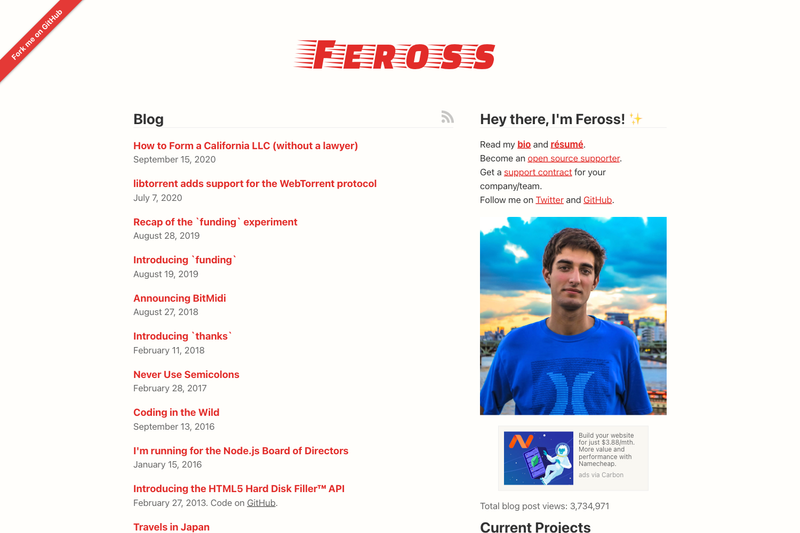
Feross.org is the source code repository for the blog at https://feross.org, created by Feross Aboukhadijeh. It is built with Jekyll, a static site generator that takes Markdown blog posts and converts them into flat HTML files. The project also includes a simple Node.js/MySQL application to track page views on each blog post. The author makes the source available for browsing and questions.
Key Features
- Jekyll static site generation — Converts Markdown posts into flat HTML files that can be served by almost any web server.
- Markdown authorship — All blog posts are written in Markdown, enabling easy version control and plain-text editing.
- Node.js page-view tracker — A basic Node.js/MySQL app counts how many views each post receives.
- Version-controlled content — The entire blog can be stored in a Git repository, simplifying backups and history.
- Low-maintenance publishing — Static output means no database-driven CMS or out-of-date WordPress installations.
- Self-hosting setup — The author hosts the site on his own server using nginx to serve the generated files and Supervisord to keep the Node.js app running.
- npm automation — Build, watch, test, and publish scripts are provided via package.json.
Who is it for?
- Developer bloggers — Who want a Jekyll-based blog they can self-host and customize to their own design.
- Jekyll learners — Who want a real-world example of a Jekyll project with a custom analytics component.
- Static-site enthusiasts — Who prefer version-controlled, low-maintenance publishing over dynamic CMS platforms.
What can you do with Feross.org?
- Publish a static blog — Write posts in Markdown, run
npm run buildto generate HTML, and serve the files from any web server. - Track per-post page views — Run the Node.js/MySQL app to monitor how many times each article is viewed.
- Study a production blog setup — Explore the source of a well-known developer's personal site to learn Jekyll conventions and a simple Node.js integration.
How does Feross.org work?
The workflow is straightforward: write a post in Markdown, then run npm run build to generate the static site with Jekyll. Use npm start to serve it locally, npm test for tests, and npm run publish to deploy. The Node.js page-view tracker runs as a separate process, managed by Supervisord on the server.
FAQ
Is Feross.org free to use?
Yes, the source code is available on GitHub, but it is copyrighted by Feross Aboukhadijeh; no specific open-source license is mentioned in the repository.
Can I fork this blog for my own site?
Yes, you can fork it, but the author explicitly asks that you create your own blog design rather than reusing his.
Does it work on GitHub Pages?
Not as configured. The author self-hosts because he uses a Jekyll plugin and a Node.js app, which GitHub Pages does not support.
What technology stack does it use?
The blog uses Jekyll, Markdown, Node.js, MySQL, npm, nginx, and Supervisord.