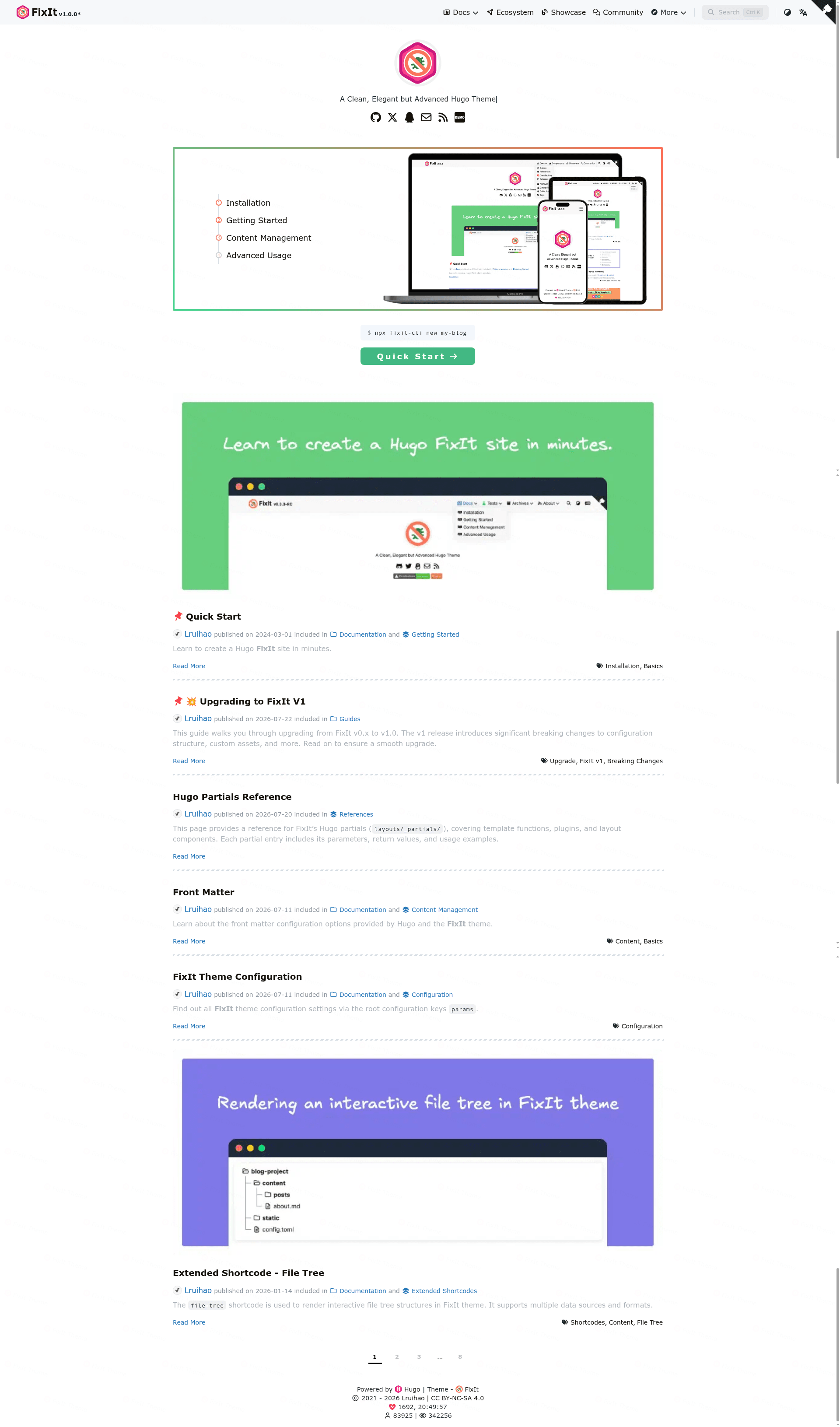
FixIt is an open-source blog theme for Hugo that produces static sites from Markdown content, created by Lruihao and maintained by the hugo-fixit organization under the MIT license. It is built on the foundations of the LoveIt, KeepIt, and LeaveIt themes and targets speed, multilingual support, and extensive third-party integrations.
What is FixIt?
FixIt is a clean, elegant, advanced blog theme for the Hugo static site generator. It accepts standard Hugo content files (Markdown, front matter, shortcodes) as input and outputs a fully static website with responsive layout, pagination, light/dark modes, and search. The theme is built by the hugo-fixit organization and author Lruihao, requires Hugo version ^0.161.0, and is licensed under MIT. Its documentation, demo, and test sites are live at fixit.lruihao.cn.
What makes FixIt stand out?
FixIt stands out among Hugo themes for the breadth of integrations it packs into a single theme: over a dozen comment systems, multiple search backends, analytics providers, and content shortcodes. Its tech stack is Hugo with UnoCSS, Font Awesome, Simple Icons, Twemoji, and Animate.css among its dependencies.
- Performance and SEO — reaches 99/100 mobile and 100/100 desktop scores in Google PageSpeed Insights, includes JSON-LD schema, and supports seven analytics backends (Google, Fathom, Baidu, Umami, Plausible, Cloudflare, Splitbee).
- Comment system coverage — supports up to 14 comment systems: Disqus, Gitalk, Valine, Waline, Facebook Comments, Telegram Comments, Commento, Utterances, Artalk, Twikoo, and giscus.
- Search options — integrates Algolia, Fuse.js, Pagefind, Google Custom Search Engine, and PostChat AI search.
- Rich content syntax — adds extended Markdown shortcodes for Font Awesome icons, ruby annotation, fractions, tabs, admonitions, mathematical formulas via KaTeX or MathJax, mermaid diagrams, ECharts, Mapbox GL, APlayer music, and Bilibili/Douyin video players.
- PWA and encryption — supports Progressive Web App installability, content encryption for pages and partials, and a web watermark via cell-watermark.
- Multilingual and i18n — ships with 16 languages including English, Simplified/Traditional Chinese, French, Russian, Japanese, Korean, and Hindi, with a community language contribution flow.
- Theme component ecosystem — provides 14 extra Hugo theme components (e.g., fixit-bundle bundles core plus components; cmpt-flyfish adds fish animation; component-projects displays GitHub projects).
- Starter tooling — offers a CLI wizard (
pnpx fixit-cli create my-blog) and four GitHub template repositories, including Hugo Modules and Git submodule setups, plus a multilingual docs template.
Who should use FixIt?
FixIt is for anyone who wants a self-hosted Hugo blog without giving up modern amenities like PWA, encryption, and AI search. It suits:
- Individual bloggers who want a fast, SEO-ready Hugo site without assembling dozens of integrations manually.
- Multilingual content teams that need one codebase to publish in up to 16 languages with i18n-ready templates.
- Developers and theme tinkerers who want to extend a Hugo theme through modular components, custom shortcodes, and the 14 available theme components.
- Open-source contributors interested in joining a community with discussions, WeChat/QQ groups, issue tracking, and contributing guidelines.
What can you do with FixIt?
FixIt can turn Markdown content into an interactive, multilingual static site with search, comments, PWA support, and embedded media. Use cases include:
- Bloggers: publish a Markdown-based blog with automatic code highlighting, copy-code buttons, image galleries via lightgallery, and a friends page template.
- Site owners: add a cookie consent banner, Chinese typesetting through pangu.js, typing animations via TypeIt, and custom styles or scripts per page.
- Developers: embed interactive content such as mermaid diagrams, ECharts charts, Mapbox maps, music players, and video players directly in posts.
- Docs maintainers: create a multilingual documentation site using the official docs template built with FixIt.
How does FixIt work?
FixIt works through Hugo's standard build pipeline: you scaffold a site, write Markdown, configure the theme, and build static files. You can create a new site in one command with pnpx fixit-cli create my-blog or by generating a repository from one of the starter templates (Hugo Modules or Git submodule). After installation, you add Markdown content under the content directory, configure theme parameters for analytics, comments, search, and PWA, then run Hugo to build the static site. The project also documents a v1 migration guide on the main branch, with version 1.0.0 planned for the first half of 2027.
Pricing
FixIt is free and open source under the MIT license. There are no paid tiers or licenses; community sponsors support development, and the project lists WeChat Pay and Alipay donation options.
Alternatives
For comparison, FixIt's direct predecessors are LoveIt, KeepIt, and LeaveIt; Hugo DoIt is another LoveIt-derived theme mentioned in the project's acknowledgements. These are all Hugo themes you might evaluate if you prefer a different balance of features.
FAQ
Is FixIt free?
Yes. FixIt is released under the MIT license, so you can use, modify, and redistribute it freely, including for commercial sites. No paid plans or feature gating are listed.
What Hugo version does FixIt require?
FixIt requires Hugo version ^0.161.0 or newer. The badge on the repository specifies Hugo ^0.161.0, so older Hugo versions may not support all theme features.
What comment systems does FixIt support?
FixIt integrates more than a dozen comment backends, including Disqus, Gitalk, Valine, Waline, Facebook Comments, Telegram Comments, Commento, Utterances, Artalk, Twikoo, and giscus. You enable the one you prefer in the theme configuration.
Does FixIt support AI features?
Yes. FixIt integrates PostChat for AI summary, AI search, and an AI chatbot, and it supports AI-driven search alongside Algolia, Fuse.js, Pagefind, and Google CSE.
How do I start a new blog with FixIt?
Run pnpx fixit-cli create my-blog to scaffold a project, or click the generate link on the hugo-fixit-starter or hugo-fixit-starter1 template repositories to create a new GitHub repository preconfigured with FixIt.