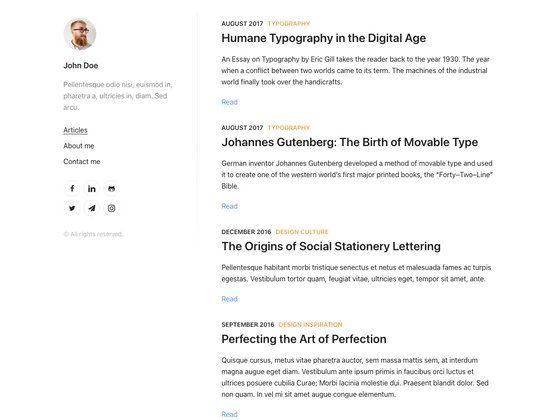
Gatsby Starter Lumen is an open-source static blog starter built on Gatsby, React, GraphQL, and TypeScript, designed to produce fast, mobile-first blogs with category/tag support and Sentry error tracking.
What is Gatsby Starter Lumen?
Gatsby Starter Lumen is a starter template for building static blogs using the Gatsby site generator. The starter provides a structured architecture for content-driven blogs, with Gatsby's build pipeline generating static pages for posts, categories, and tags. The project is maintained by Alex Shelepenok, is licensed under the MIT License, and has been continuously developed since 2016, with the repository description calling it "a constantly evolving and thoughtful architecture for creating static blogs."
Key Features
- Mobile-first development — The starter's layout is built with a mobile-first approach, so the blog is designed for small screens first and scales up to larger displays.
- Sentry error tracking — Built-in Sentry integration lets you monitor production errors and crashes directly from the blog.
- Category and tag support — Content can be organized into categories and tags, with the starter generating the corresponding archive pages.
- Modern tech stack — The starter is built with Gatsby (React), GraphQL for data querying, and TypeScript for type safety, and uses Bun as the package manager for installation and development scripts.
- Sponsor-backed — The project acknowledges BrowserStack and Sentry as sponsors, which support cross-browser testing and error monitoring respectively.
Who is it for?
- Static site developers — Developers who want a pre-configured Gatsby blog with a clean architecture can use Lumen as a starting point, then customize components, styles, and content.
- Technical bloggers — Writers who want a fast, SEO-friendly blog with organized categories and tags can publish posts without managing a content management system.
- Open-source contributors — Because the starter is MIT-licensed, anyone can fork, modify, and redistribute it, making it a flexible foundation for learning or building custom projects.
What can you do with Gatsby Starter Lumen?
- Launch a personal blog — Set up a personal blog with a minimal, reading-focused layout, add posts, and deploy the static output to any web host.
- Build a documentation site — Leverage the category and tag architecture to structure technical documentation into an easily navigable static site.
- Prototype a content site — Use the starter to quickly mock up a content-driven website with a modern React and GraphQL backend before swapping in a different content source.
How does Gatsby Starter Lumen work?
After cloning the repository, run bun install to install dependencies and bun run start to launch the development server. The starter uses Gatsby's build system to compile the site into static pages, which can then be deployed to services like Netlify, Vercel, or any static host.
Pricing
The template is free and open source under the MIT License. You can use it for personal or commercial projects without paying licensing fees.
FAQ
Is Gatsby Starter Lumen free?
Yes, it's released under the MIT License, which allows free use, modification, and distribution. Copyright is held by Alex Shelepenok and covers the years 2016 through 2026.
What tech stack does Gatsby Starter Lumen use?
It uses Gatsby as the static site generator, with React for the UI, GraphQL for querying data, TypeScript for type safety, and Bun as the package manager. The starter also integrates Sentry for error tracking.
Can I use Gatsby Starter Lumen for a commercial project?
Yes, the MIT License permits commercial use. You can build a blog for a business or product without paying royalties, as long as you retain the original copyright notice.
Does Gatsby Starter Lumen support categories and tags?
Yes, the starter includes support for organizing posts into categories and tags, allowing readers to browse content by topic.
What is the development environment for Gatsby Starter Lumen?
The quick start commands are bun install and bun run start, indicating Bun is the expected package manager and runtime for local development.