Go Web Examples is a free learning site and open-source Hugo project that provides copy-paste-ready Go snippets for web development, covering routing, templates, sessions, JSON, and websockets. The site is hosted at gowebexamples.com and its source repository is available on GitHub under the MIT license.
What is Go Web Examples?
Go Web Examples is a collection of tutorials and code examples for building web applications in Go (Golang). It takes a developer's question about a common web task and produces a runnable, minimal snippet with a short explanation. The site is generated with the Hugo static site generator, and the example source code lives in the content directory of the GitHub repository. The project was inspired by Go By Example, a popular introduction to Go fundamentals.
Key Features
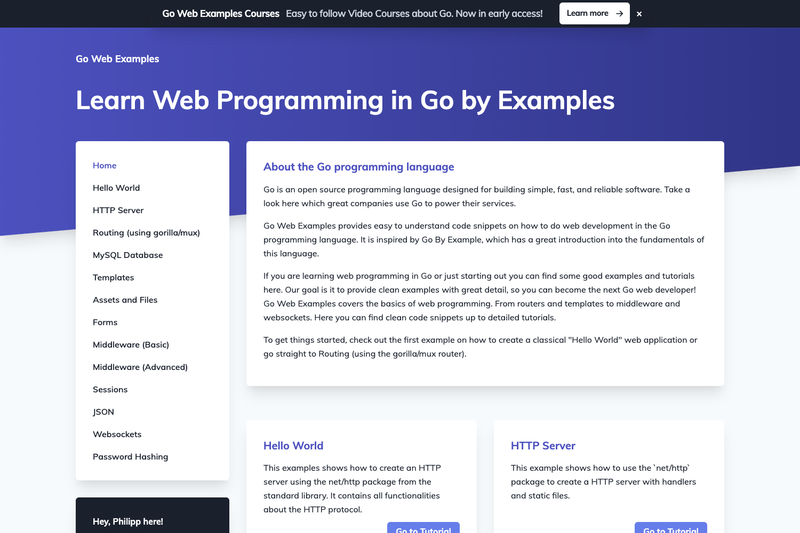
- Twelve example topics — Each topic has its own page: Hello World, HTTP Server, Routing with gorilla/mux, Templates, Requests and Forms, Assets and Files, Basic Middleware, Advanced Middleware, Sessions, JSON, Websockets, and Password Hashing with bcrypt.
- Runnable snippets — Every example is written as a small, self-contained Go program that demonstrates one concept, following the Go By Example style of learning by reading code.
- Hugo static site — The entire site is built from Markdown content using Hugo, producing the final HTML output in a
publicdirectory after running thehugocommand. - Open-source with MIT license — The complete source code, including all examples, is available on GitHub, so you can fork it, submit improvements, or reuse any snippet in your own projects.
- Practical middleware coverage — Separate basic and advanced middleware examples show how to wrap handlers with logging, recovery, and other cross-cutting concerns.
- Form and JSON handling — The examples show how to parse request forms, decode JSON payloads, and respond with JSON, which covers most API-building needs.
Who is it for?
- Go beginners — Developers who know basic Go syntax but want to see how to set up an HTTP server, handle routes, and render templates without reading long documentation.
- Working web developers — Engineers who need a quick reference for a specific task such as adding sessions, implementing password hashing with bcrypt, or writing middleware.
- Open-source contributors — People who want to improve the learning material or extend the site with new topics. Since the project is on GitHub, they can add examples or fix issues directly.
- Educators — Instructors teaching Go web development can use the examples as assignments or classroom exercises, relying on the MIT license for reuse.
What can you do with Go Web Examples?
- Implement user authentication — Use the password hashing example with bcrypt to store and verify user passwords in your Go applications.
- Build JSON APIs — The JSON example shows how to marshal structs into JSON responses and unmarshal request bodies, giving you a starting point for REST endpoints.
- Add real-time features — The websockets example demonstrates a basic WebSocket connection, which you can extend for chat or live updates.
- Create maintainable routes — The gorilla/mux routing example shows how to define path variables and method-based routing, beyond the standard library's ServeMux.
How does Go Web Examples work?
The examples are stored as Markdown files in the content directory of the GitHub repository. To build the site yourself, you need Hugo and Python with pygments installed, then clone the repository and run the hugo command, which outputs the static site into the public folder. The live site at gowebexamples.com is the result of this build, with each topic accessible at a dedicated URL.