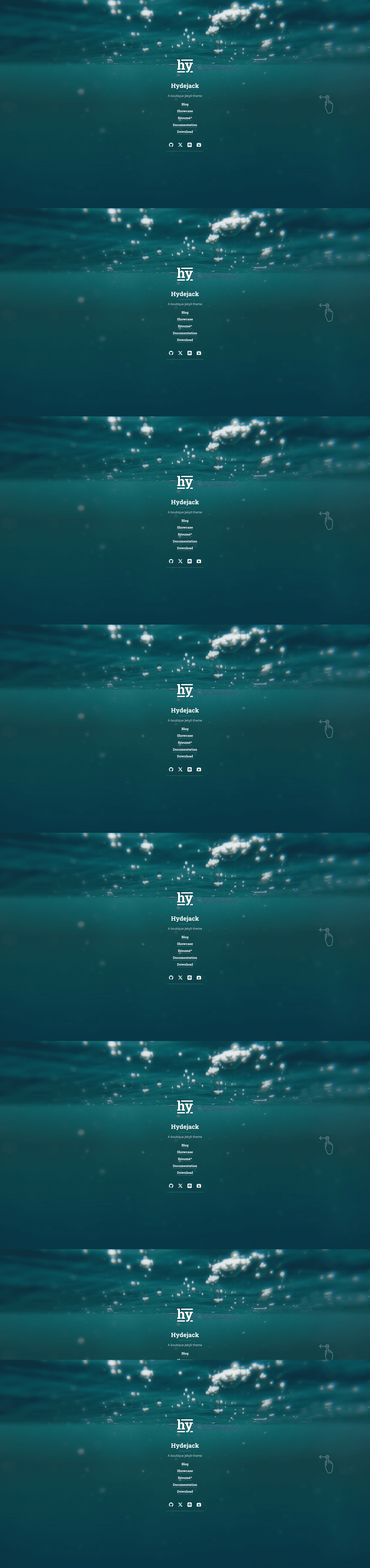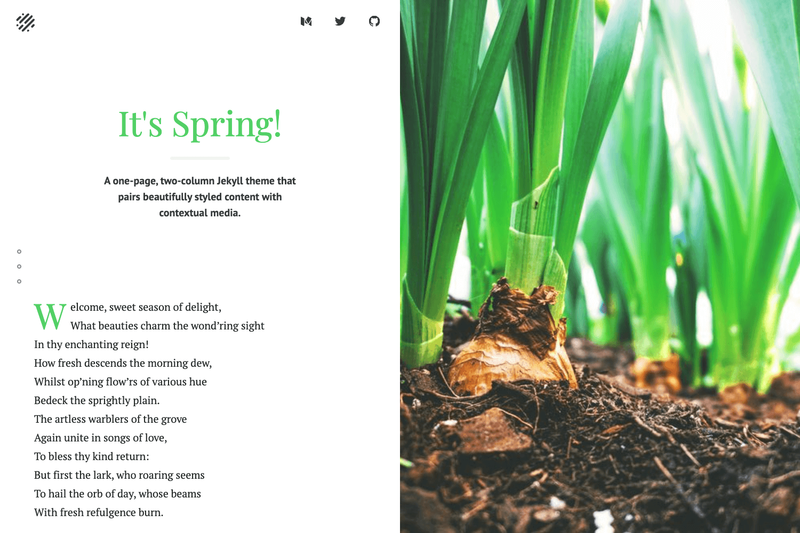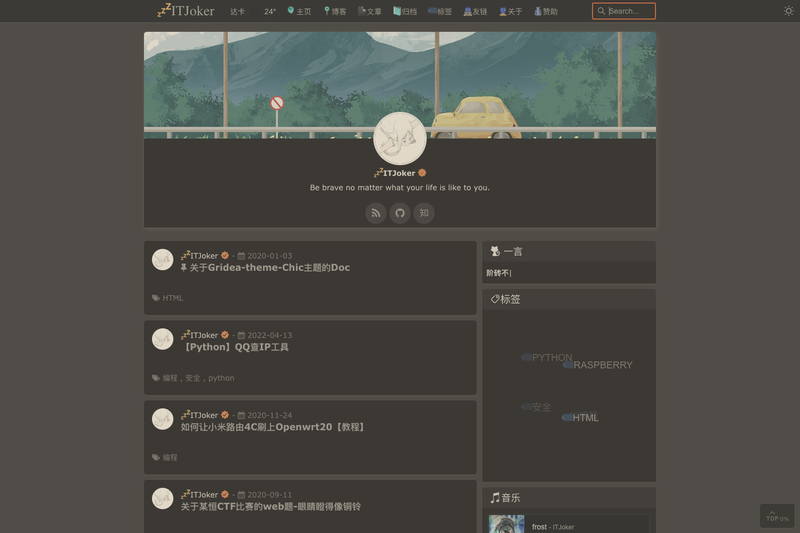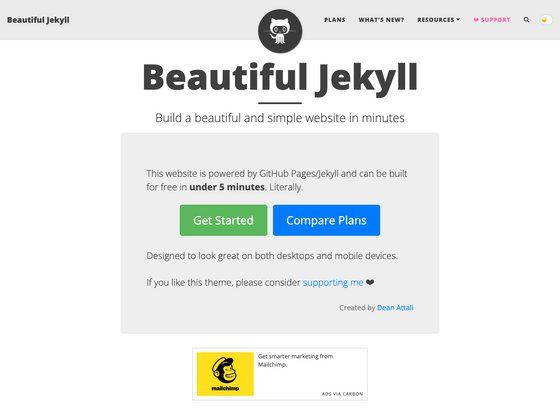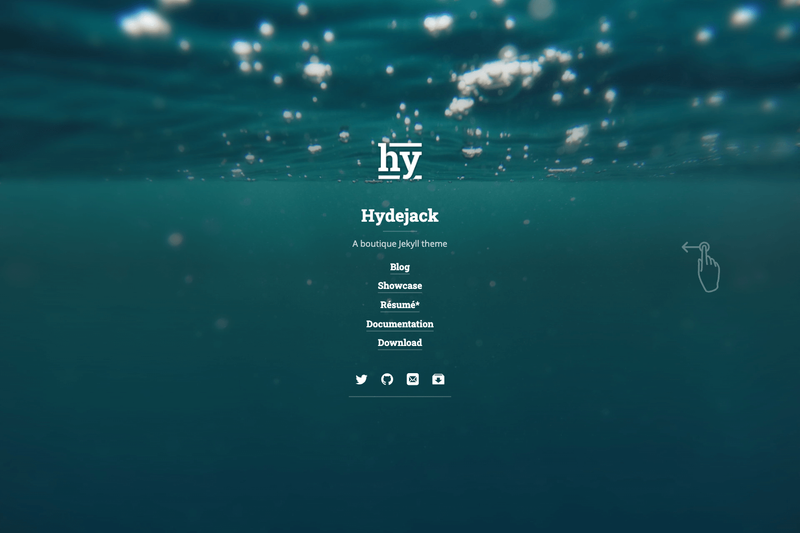
Hydejack is a boutique Jekyll theme for hackers, nerds, and academics, centered on personal sites designed to impress. It generates a fully static website—plain HTML—that runs on any web server and works out of the box with GitHub Pages. The theme bundles a blog suitable for prose and technical documentation, a portfolio for showcasing projects, and a resume template that prints consistently on screen and paper.
What is Hydejack?
Hydejack is a Jekyll theme that turns Markdown content into a static personal website. You write posts, projects, and resume data in Markdown; Jekyll builds it into HTML pages with a responsive layout, a sidebar, and built-in icons for social networks. Hydejack is developed by the hydecorp project and is open source under GPL-3.0 for the free version, with parts of the PRO version proprietary.
Key Features
- Responsive design — The layout adapts with unique design features for every screen size, from mobile to desktop.
- Cover Pages — Add a full-width cover image or gradient to give your homepage a strong first impression.
- Dynamic page loading — Uses Single Page App-style navigation with FLIP animations, while remaining a plain web page that works without JavaScript.
- Syntax highlighting — Code blocks are highlighted with Rouge and can display a filename and caption.
- Math rendering — Write LaTeX math blocks and render them with either KaTeX or MathJax; GitHub Pages limits you to MathJax.
- Soft-coded labels — Change wording or translate the whole theme by editing a single file.
- Content organization — Supports categories and tags, an author section with multiple authors, and structured data for SEO.
- Blog + Portfolio + Resume — The blog handles prose and technical docs, the portfolio presents projects, and the resume prints to PDF.
Who is it for?
- Developers and hackers — Build a personal site that documents projects and experiments with code-focused features like syntax highlighting and math.
- Academics — Use the resume template and blog to present papers, talks, and a curriculum vitae in print or PDF.
- Designers and freelancers — Showcase a portfolio of work and keep a blog to share behind-the-scenes content.
- Privacy-minded users — Host the static HTML on any server or GitHub Pages without needing a database or dynamic backend.
What can you do with Hydejack?
- Publish a technical blog — Write posts in Markdown with code and math blocks, and categorize them with tags.
- Display a project portfolio — Add projects to the portfolio grid, which is included in the PRO version.
- Generate a printable resume — Create a resume that looks the same on the web and in print, with a PDF export available.
- Run a personal site with zero maintenance — Deploy static files anywhere and rely on GitHub Pages for free hosting.
Pricing
Hydejack offers a Free version (GPL-3.0) with blogging, the core features, and Dark Mode. The PRO version costs a one-time $99 payment and adds the portfolio, printable resume, built-in search, custom forms, grid layout, offline support, table of contents, cookie banner, and removes Hydejack branding. Discounts may apply via Gumroad.
FAQ
Is Hydejack free?
Yes, the Free version is available on GitHub under the GPL-3.0 license. It includes the blog, features, documentation, and Dark Mode. The PRO version is a one-time purchase and uses a separate license.
Does Hydejack work with GitHub Pages?
Hydejack works with GitHub Pages out of the box. One limitation is that math blocks must use MathJax instead of KaTeX when hosted there.
What is included in the PRO version?
PRO adds the portfolio, a printable resume, built-in search, custom forms, a grid layout, offline support, a table of contents for large screens, a cookie banner, and removes Hydejack branding.
Can I translate Hydejack?
Yes. The theme uses soft-coded labels, so you can change all wording or translate it to another language by editing a single file.
Do I need a server to run Hydejack?
No. Hydejack outputs plain HTML that you can serve from any static file host, including GitHub Pages, Netlify, or your own web server.