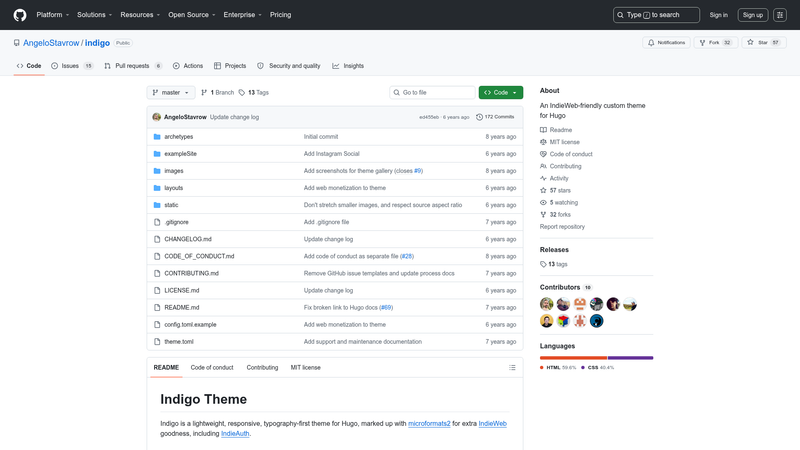
Indy Academy Hugo Theme is a Hugo static-site theme for building blogs and content-focused websites, packaged with a webpack-based asset build system. It is published on GitHub with the description "The Indie Academy hugo theme" and topics including blog-engine, CMS, and static-site-generator.
What is Indy Academy Hugo Theme?
Indy Academy Hugo Theme is a theme for the Hugo static site generator. As a theme, its input is Hugo content files (typically Markdown) plus the theme's templates, and its output is a static HTML website that can be deployed anywhere. The theme runs on the Hugo platform, which requires no server-side runtime for the generated pages. The repository is hosted on GitHub, and its development toolchain requires Node.js and Yarn, as documented in the README.
Key Features
- Hugo static site generation — the theme is built for Hugo, so content is authored in Markdown and compiled to plain HTML, making sites fast and easy to host.
- Webpack asset bundling — uses webpack with extract-text-webpack-plugin, css-loader, file-loader, and style-loader to bundle CSS and other static assets during development.
- PostCSS processing — includes postcss, postcss-loader, postcss-cssnext, and postcss-import, enabling modern CSS syntax and import inlining in the build.
- Flexboxgrid layout system — includes flexboxgrid, a responsive grid library, in the dependency list.
- normalize.css — includes normalize.css to minimize cross-browser styling differences.
- Moment.js dependency — includes moment, a JavaScript date library, as part of the installed packages.
- Node/Builder workflow — the README documents installing with Yarn and building with
npm run build, giving a familiar JavaScript build pipeline on top of Hugo.
Who is it for?
Hugo site developers — the theme provides a pre-configured webpack and postcss setup that can be extended for custom CSS and asset workflows. Independent bloggers — the blog-engine metadata and static output make it a direct starting point for a personal blog. Developers new to static-site asset pipelines — the minimal documentation shows the exact commands to install dependencies and build the theme, which is useful for learning a Node-based Hugo workflow.
What can you do with it?
- Bloggers: set up a Hugo-based static blog with this theme, using the documented build commands to generate their site.
- Developers: customize the webpack and postcss pipeline through the documented
yarn addsteps andnpm run build, adding their own CSS and JavaScript assets. - Site owners: produce static HTML files via Hugo that can be hosted on any static hosting service.
How does the build process work?
The README describes a straightforward development setup. First, install Node.js and Yarn with Homebrew using brew install node and brew install yarn. Next, add the build dependencies by running the suggested yarn add commands for webpack, PostCSS-related packages, and the vendor libraries (flexboxgrid, moment, normalize.css). Finally, run npm run build to bundle assets.