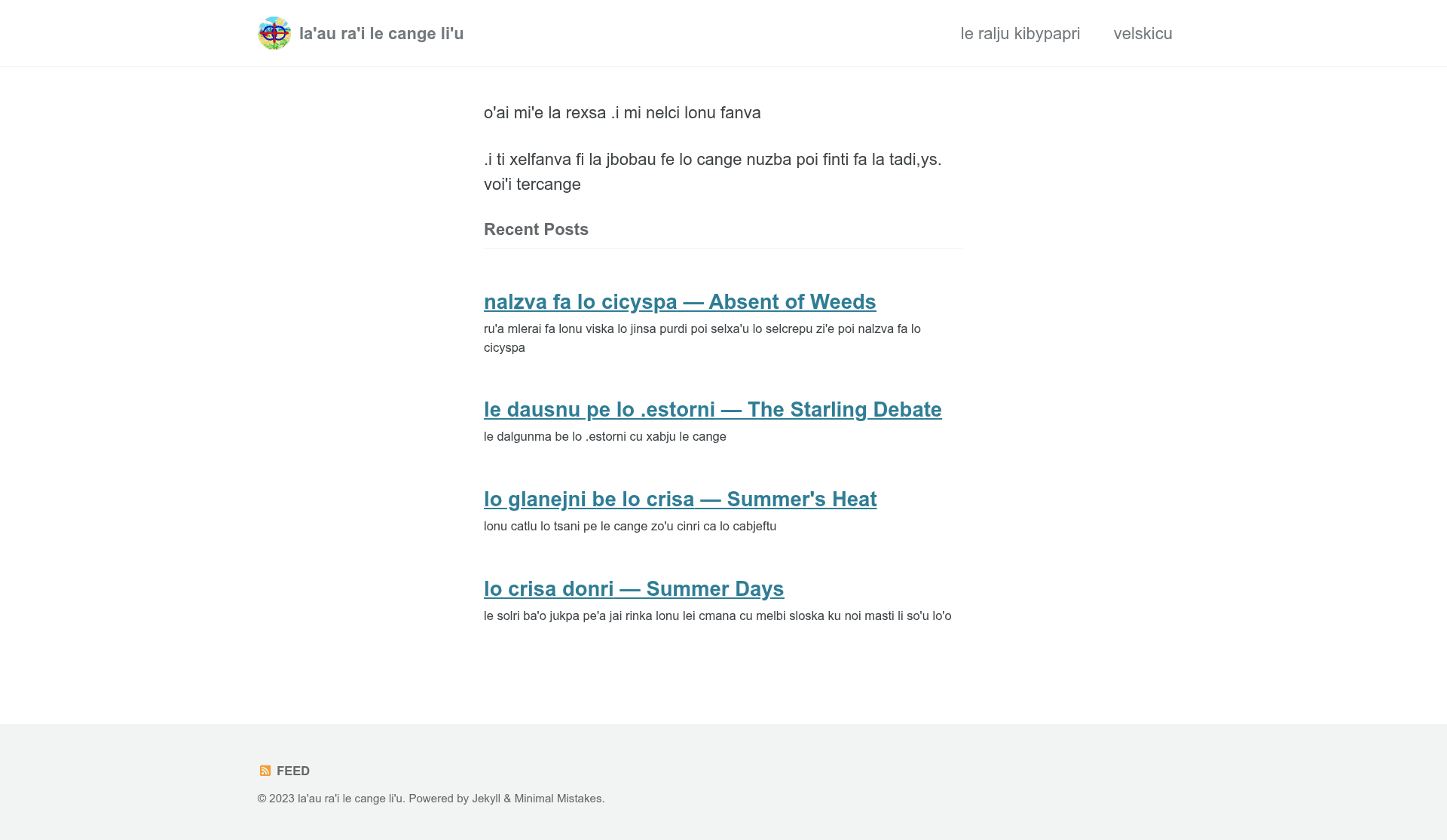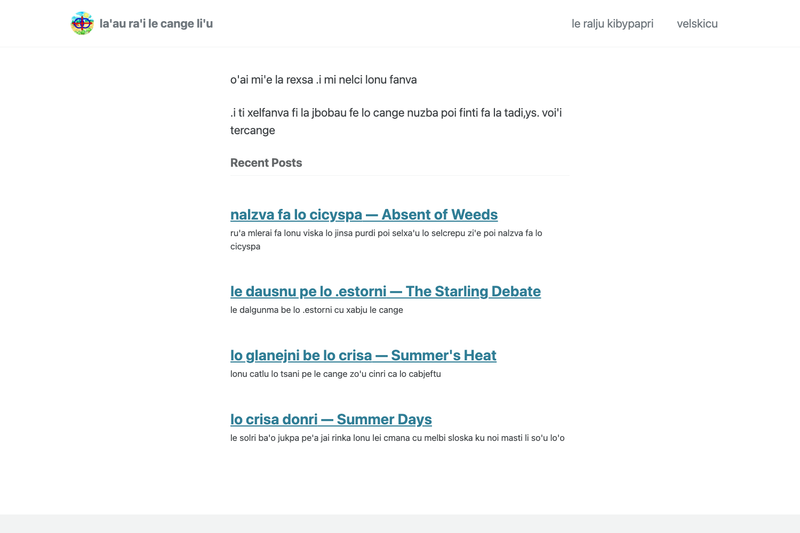
Lahau Rahi Le Cange Lihu is a Jekyll blog template that publishes Markdown articles containing Lojban interpretations of farm updates from Instagram's Farmer Thaddeus as a static GitHub Pages site.
What is Lahau Rahi Le Cange Lihu?
Lahau Rahi Le Cange Lihu is an unofficial, open-source blog project maintained by @alxndr, who translated (with substantial help) the updates that Farmer Thaddeus posts for Farm Fresh to You. The repository is primarily Markdown files that Jekyll compiles into a static website. The live site is hosted at alxndr.github.io/lahau-rahi-le-cange-lihu, and content is written entirely in Lojban, a constructed language. The project runs on a standard Jekyll setup: Ruby (version 2.5.0 or newer, up to 3.x), Bundler, and GitHub Pages for automatic deployment.
What makes this template stand out?
- Lojban content niche — The template is purpose-built for publishing Lojban-language articles, which is a rare use case among Jekyll blogs.
- GitHub Pages integration — Every push to the main branch triggers GitHub Pages to compile and host the static files automatically.
- Drafts workflow — Authors can preview unpublished posts locally by running
bundle exec jekyll serve --drafts, which is useful for reviewing translations before publishing. - Markdown-based authoring — All content lives in Markdown, making it easy to write and version-control posts without a database or CMS.
- Simple local setup — Only three steps are needed to start: install Ruby, install Bundler, and run
bundle install. - Tools and references included — The repo links to Lojban tools (jbofi'e for parsing, la sutysisku for lookup) and the CLL (Complete Lojban Language) reference, so editors can verify translations.
- Minimal dependencies — The locked gemfile keeps the project stable; upgrades are handled with
bundle updateandbundle update --bundler.
Who should use Lahau Rahi Le Cange Lihu?
- Lojban learners — People studying Lojban can read real-world farm updates translated into the language to build vocabulary and reading comprehension.
- Fans of Farm Fresh to You — Followers of Farmer Thaddeus who also know Lojban (or want to learn) can enjoy the updates in translated form.
- Jekyll developers — Anyone looking for a minimal, no-frills Jekyll blog template with a clear Markdown workflow and GitHub Pages deployment will find this repo a useful starting point, even if they replace the content with their own language or topic.
What can you do with this template?
- Publish a Lojban blog — Create and host a static blog focused on Lojban content without paying for hosting, using GitHub's free Pages service.
- Practice local previews — Draft and review translations locally with the drafts flag, then push to publish.
- Customize for your own language — Because the content is just Markdown, you can easily swap the Lojban posts for any other language or subject and keep the same Jekyll structure.
How does the template work?
The setup requires a standard Ruby environment: install Ruby (2.5.0–3.x), install Bundler, then run bundle install in the repository root. After that, bundle exec jekyll serve runs a local development server, and adding --drafts shows draft posts. When changes are committed to the main branch, GitHub Pages automatically rebuilds and deploys the site. Updating the tools is done through bundle update or bundle update --bundler.
FAQ
Is Lahau Rahi Le Cange Lihu free to use?
Yes, the project is open-source and hosted on GitHub. You can clone the repository, run it locally, and publish your own version through GitHub Pages at no cost.
What does the template do?
It transforms Markdown files written in Lojban into a static blog using Jekyll. The primary use case is showing Lojban interpretations of Farm Fresh to You updates from Instagram.
Do I need to know Lojban to use the template?
Not necessarily for the technical setup — you could replace the content with anything. However, the repository's existing content and linked tools are specifically for Lojban translation work, so some familiarity with the language helps if you intend to add similar posts.
What versions of Ruby are supported?
The repo specifies Ruby 2.5.0 or newer, up to 3.x. You should also have Bundler installed and use bundle install to manage the Jekyll dependencies.