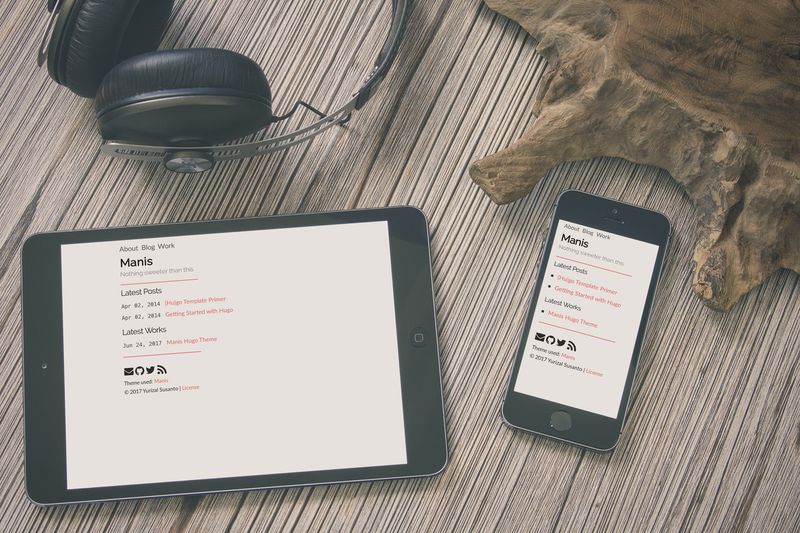
Manis is a minimalist and responsive Hugo theme for personal websites and blogs, created by yursan9 and named after the Indonesian word for "sweet". It takes Hugo's Markdown content organized into sections such as blog and work, and outputs a static site with configurable colors, dark mode, Disqus and Utterances comment support, and social icon links.
What is Manis Hugo Theme?
Manis Hugo Theme is a free, MIT-licensed theme for the Hugo Static Site Generator. The theme runs entirely on Hugo's build system, requiring no JavaScript framework or CSS grid library. You give it standard Hugo content directories (at minimum a blog section and a work section), and it generates a multi-page personal website. The project is maintained on GitHub by yursan9 and has 117 stars, with an exampleSite folder that includes a ready-made config.toml and sample content.
Key Features
- Configurable color — The theme's color scheme is adjustable, though the README does not document the exact configuration key; custom CSS is the officially documented way to change appearance.
- Code highlighting with HighlightJS — Syntax highlighting is included out of the box for code blocks in posts.
- Print.css for single posts — A dedicated print stylesheet makes individual blog posts print cleanly.
- Responsive layout — The design adapts to mobile and desktop screens without a grid framework.
- Social icon links — Footer icons are built in and their size can be changed via custom CSS.
- Disqus support — Enable comments by setting disqusShortname and listing comment-enabled sections under params.disqusSections.
- Utterances support — An alternative comment system powered by GitHub issues is also supported.
- Translatable interface — English and Bahasa Indonesia translations are included, and you can add your own language via the i18n files.
- Dark mode support — A built-in dark mode toggle uses Font Awesome's Moon and Sun icons (licensed CC BY 4.0).
Who is it for?
Manis suits personal bloggers and developers who want a clean, fast site without a heavyweight theme. The required content structure of blog and work sections makes it a natural fit for someone who wants to publish articles and showcase projects on the same site. Because the theme is intentionally minimal and skips grids, developers comfortable with CSS can quickly restyle it by dropping a custom CSS file into static/css.
What can you do with Manis Hugo Theme?
- Personal bloggers — Write posts in Markdown under content/blog, and Manis renders them as the site's Latest Posts section; you can rename this section using mainSections.
- Portfolio owners — Put project write-ups under content/work and configure workSections to surface them as Latest Works.
- Multilingual authors — Use the built-in translations or add your own by editing YAML files in the i18n directory and updating config.toml with your language code.
- Self-hosted commenters — Pick either Disqus or Utterances to add a comment system without building your own backend.
How does Manis Hugo Theme work?
The README's quick start asks you to clone the theme into themes/manis, copy the exampleSite config.toml, and run hugo new blog/hello.md to start a post. You then edit the config file to set your menu, sections, and comment preferences. The theme expects at least content/blog/_index.md and content/work/_index.md to exist for it to show the blog and work areas.
FAQ
Is Manis Hugo Theme free?
Yes. Manis is released under the MIT License, so it is free to use, modify, and redistribute. The repo's license file is included in the project root.
How do I change which posts appear under "Latest Posts"?
Set the mainSections parameter in your config.toml to a list of section names, for example ["blog", "post"]. The workSections parameter does the same for the Latest Works area, and it is optional.
Does Manis support comments?
Yes, two options are built in: Disqus and Utterances. For Disqus, add your disqusShortname and list the sections that should show comments under params.disqusSections. Utterances is enabled by the same configuration body.
Can I use Manis in a language other than English?
Yes. The theme ships with English and Bahasa Indonesia translations. To add your own, create a new i18n YAML file following the pattern in en.yaml or in.yaml, then set defaultContentLanguage and the language block in config.toml.
How do I customize the look without forking the theme?
Add your own CSS file by listing it in params.customCSS in config.toml, then create the corresponding file under static/css. This lets you change fonts, image sizes, or icon dimensions without modifying the theme's source.