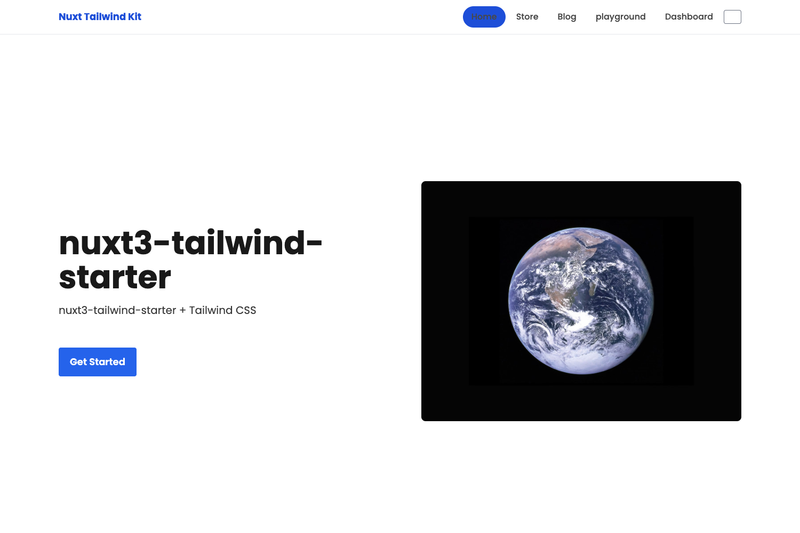
Nuxt 3 Tailwind Starter is a zero-config boilerplate for Nuxt 3 applications that bundles Tailwind CSS, Nuxt Content v2, Pinia, vee-validate, and @nuxtjs/i18n, with automated Vercel deployment and GitHub Pages publishing already configured.
What is Nuxt 3 Tailwind Starter?
Nuxt 3 Tailwind Starter is a GitHub template that scaffolds a production-ready Nuxt 3 project with a preconfigured tech stack. It takes a new or cloned repository as input and outputs a runnable Nuxt application with dependencies for styling, content management, state management, form validation, and internationalization already installed. The template is published under the Createitv account on GitHub and is also available as a one-click repository generator. The repository includes an online demo at nuxt3-tailwind-start.vercel.app and a Stackblitz entry point for instant browser testing.
Key Features
- Nuxt 3 framework — The starter pins Nuxt 3.0.0, giving you the latest Vue-based meta-framework with file-based routing, server endpoints, and auto-imports.
- Tailwind CSS 3.1.8 — Utility-first styling is preconfigured, and an automatic Prettier plugin keeps Tailwind class order consistent.
- Nuxt Content v2 — Content authoring is built in, allowing you to write Markdown files and query them at build time or runtime.
- Pinia 2.0.24 — State management is ready to use, and a custom authentication store is provided at
stores/auth.ts. - vee-validate 4.5.4 — Form validation is wired up with the v4 API, including validators and error handling components.
- @nuxtjs/i18n 9.2.2 — Multi-language support is preconfigured, so you can add locale files and switch languages out of the box.
- Nuxt Icon 0.1.5 — Icon rendering is handled via the Nuxt Icon module, letting you use icon sets as components.
- Automated CI/CD — Commitlint generates a CHANGELOG.md automatically, and pushing to the main branch triggers a Vercel deployment plus a GitHub Pages publish.
Who is Nuxt 3 Tailwind Starter for?
Nuxt developers starting a new project use the template to skip repetitive configuration and get a working Nuxt 3 app with Tailwind, Pinia, forms, and i18n in one command.
Content-focused teams can build documentation sites or blogs immediately because Nuxt Content v2 is already integrated, letting them author pages in Markdown.
Developers who need multilingual apps benefit from the preinstalled @nuxtjs/i18n module, which reduces setup time for locale routing and translations.
Indie hackers and agencies can use the built-in GitHub Actions workflow to automatically deploy to Vercel and GitHub Pages from the main branch, simplifying release management.
What can you do with Nuxt 3 Tailwind Starter?
Prototype a new Nuxt app quickly: Open the Stackblitz link or generate a repo from the GitHub template, then run pnpm install --shamefully-hoist or npm install followed by npm run dev to start developing on localhost:3000.
Build a content-driven site: Use Nuxt Content v2 to write Markdown files for blog posts or documentation and query them with content collections inside your pages.
Add authentication to your app: The included useAuthStore Pinia store gives you a starting point for tracking user state, which you can extend to call your own auth endpoints.
Ship to production without extra config: After pushing to the main branch, the template's GitHub Actions automatically deploys to Vercel and publishes to GitHub Pages, so you don't need to set up hosting manually.
How does Nuxt 3 Tailwind Starter work?
To use the template locally, you clone the repository with git clone https://github.com/Createitv/nuxt3-tailwind-starter my-app, change into the directory, and install dependencies with pnpm install --shamefully-hoist or npm install. Run npm run dev to start the development server on http://localhost:3000, or npm run build for a production build. The auto-deploy workflow triggers when you push to the main branch.
Pricing
Nuxt 3 Tailwind Starter is free to use. The repository is public on GitHub, and the template can be reused under the terms of the original project's license; no license file is shown in the README, so check the repository for licensing details.
FAQ
Is Nuxt 3 Tailwind Starter free?
Yes. It is a public GitHub template, and the README does not mention any paid tiers. You can create a repository from the template without cost.
What versions are included in the starter?
The badges list Nuxt.js 3.0.0, Tailwind CSS 3.1.8, Nuxt Content v2.0.1, Nuxt Icon 0.1.5, Pinia 2.0.24, vee-validate 4.5.4, @nuxtjs/i18n 9.2.2, Vercel 28.5.6, and pnpm 7.17.0.
Can I try the template before installing it?
Yes. There is a Stackblitz link that opens the template in a browser IDE, and the online demo is available at nuxt3-tailwind-start.vercel.app.
How do I deploy this starter to Vercel?
The template includes automation that auto-pushes to Vercel and GitHub Pages on the main branch. After you push your code, the GitHub Actions workflow runs the build and deploys.
Does the starter work with npm and pnpm?
The README lists both. The recommended command is pnpm install --shamefully-hoist, but npm install is supported, and the dev/build scripts are run with npm run dev and npm run build.