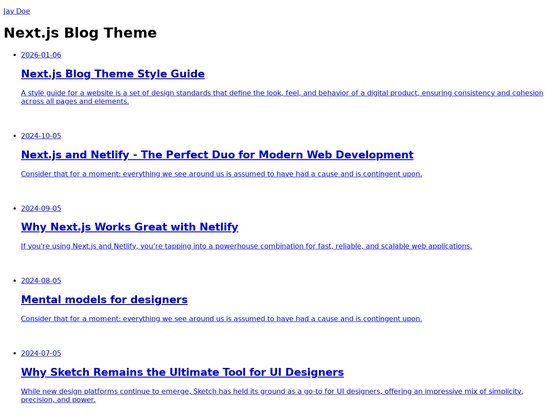
Retro Yellow is a minimal, light Jekyll blog theme built with a deliberately small amount of CSS, created by Sharad Raj Singh Maurya as a free open-source template for static sites.
What is Retro Yellow?
Retro Yellow is a Jekyll theme that renders a lightweight static website with a light color scheme and a small CSS footprint. It takes standard Jekyll inputs — Markdown posts and pages plus a _config.yml file — and outputs a static HTML site that runs locally or on GitHub Pages. The theme was created by Sharad Raj Singh Maurya and is distributed on GitHub, with a live demo at sharadcodes.github.io/jekyll-theme-retro-yellow and two stars on the repository.
Key Features
Retro Yellow ships as a single Jekyll theme with a deliberately small stylesheet and no extra UI libraries.
- Minimal CSS — The theme is built with minimal CSS, keeping the stylesheet footprint small for fast page loads.
- Light color scheme — Designed as a light theme with a retro yellow accent for a distinctive look without extra UI libraries.
- Jekyll + GitHub Pages ready — Built on Jekyll, the static site generator that GitHub Pages supports directly, so deployment is a matter of pushing the repository.
- Bundler-based install — Installation runs through
bundle installandbundle exec jekyll serve, the standard Jekyll workflow. - Single config file — Site settings are edited in
_config.yml, so changing the configuration happens in one place. - Live demo included — A working demo is hosted at sharadcodes.github.io/jekyll-theme-retro-yellow so you can preview the rendered look before installing.
Who is it for?
Retro Yellow suits anyone who wants a plain, fast Jekyll site without a heavy front-end stack.
- Jekyll users — Anyone already using Jekyll who wants a drop-in theme with a light, minimal aesthetic.
- GitHub Pages hosts — Developers who want a personal blog or project site hosted free on GitHub Pages without a separate CMS.
- Minimal-design fans — People who prefer a clean, lightweight page without JavaScript-heavy frameworks or CSS frameworks.
What can you do with Retro Yellow?
The theme supports the standard Jekyll content workflow — writing Markdown, editing the config file, and deploying the static output anywhere.
- Personal bloggers: write posts in Markdown and publish a static blog with no database.
- GitHub project authors: build a simple landing or documentation page hosted on GitHub Pages for a repository.
- Developers evaluating themes: clone the repo and run
bundle exec jekyll serveto preview the theme locally before adopting it.
How does Retro Yellow work?
Setup follows the standard Jekyll workflow.
- Clone or download the repository from GitHub.
- Run
bundle installto install the Jekyll dependencies. - Run
bundle exec jekyll serveto start a local server. - Edit
_config.ymlto change site settings. - Upload the files to a repository to publish the site.
Pricing
Retro Yellow is free, released as an open-source theme on GitHub.
FAQ
Is Retro Yellow free?
Yes, Retro Yellow is an open-source Jekyll theme hosted on GitHub, so it is free to download, use, and modify.
How do I install Retro Yellow?
Clone the repository with git clone, run bundle install to install dependencies, then run bundle exec jekyll serve to start the site locally. After editing _config.yml, upload the files to a repository to publish the site.
Does Retro Yellow work with GitHub Pages?
Yes, because it is a standard Jekyll theme, it can be hosted on GitHub Pages by uploading the repository files. The live demo is itself hosted at sharadcodes.github.io/jekyll-theme-retro-yellow, which confirms compatibility.
How do I customize Retro Yellow?
Site-level settings live in _config.yml, which you edit to match your own information. Content is added in the standard Jekyll way — posts and pages written in Markdown.