Newsletter
Join the Community
Subscribe to our newsletter for the latest news and updates

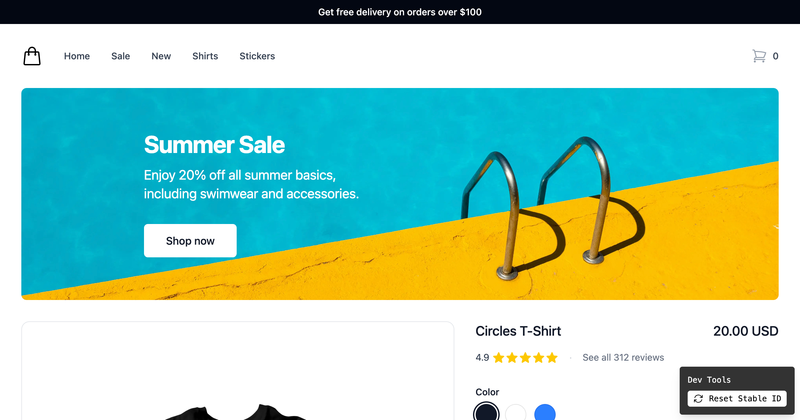
Next.js ecommerce demo by Vercel that toggles two promotional banners with code-defined Flags SDK feature flags, Flags Explorer, and Vercel Analytics.
A Turborepo monorepo starter pairing an Expo React Native app with a Next.js web app that share one React Native component library.
Vercel example wiring OpenFeature providers into the Flags SDK, with two 50/50 banner flags and Flags Explorer overrides.
MIT-licensed NestJS TypeScript starter repository that scaffolds a Node.js server-side application with pnpm build, watch, production, and test scripts.
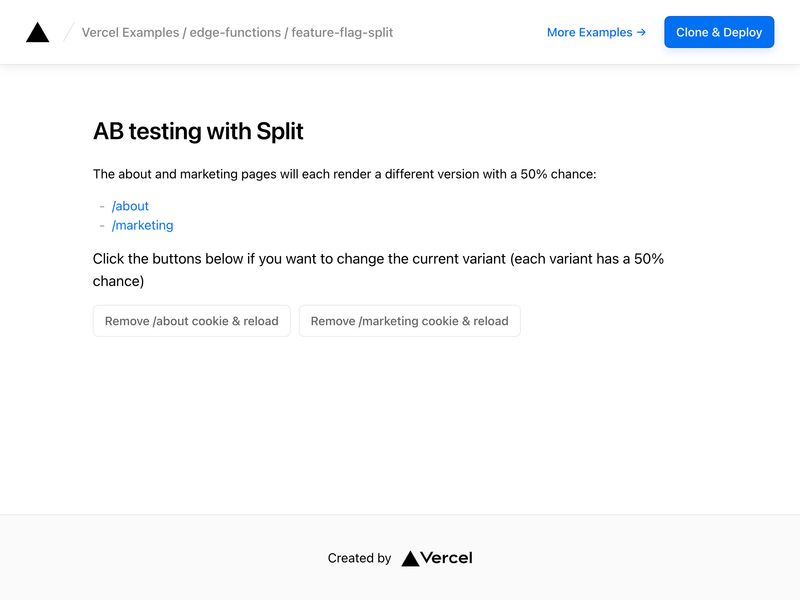
Next.js Edge Middleware example that uses Split feature flags to A/B test a marketing page and an about page, styled with Tailwind CSS.
Minimal Flask example that runs a WSGI Python API on Vercel Serverless Functions using the Python Runtime.
Vercel example boilerplate that runs an AI SDK backend on a Hono server and deploys with the Vercel CLI.
Shirt Shop Flags SDK Example is a Vercel-maintained Next.js storefront demo that uses the Flags SDK to control two promotional banners with feature flags, with the Flags Explorer toolbar and Vercel Analytics wired in.
The Shirt Shop Flags SDK Example is a Next.js ecommerce template published by Vercel that shows feature-flag-driven UI on a product page. Two feature flags declared in code decide whether each of two promotional banners is rendered, and the app also records analytics events through @vercel/analytics. A hosted demo runs at shirt-shop.labs.vercel.dev, and the source sits in the vercel/flags repository under examples/shirt-shop.
@vercel/analytics package.To run it locally you deploy the template (or clone it), then link the project with vercel link so the Flags Explorer can reach it. You pull environment variables with vercel env pull, install dependencies with npm install, and start the dev server with npm run dev. Visiting the page shows the current banner variation, which stays stable for that visitor until the stable id is reset.
It shows two feature flags defined in code, each controlling whether one promotional banner appears on the product page. Flags are set to a 50% split, and the same stable id keeps the visitor's variation consistent. It also sends events to Vercel Analytics.
Yes, if you want the Flags Explorer to overwrite flags. The variable must be 32 random bytes, base64-encoded. You can accept the generated value at deploy time or set your own, then retrieve it locally with vercel env pull.
Use the Dev Tools panel at the bottom of the page to reset the stable id and reload, which re-buckets the visitor. On a linked deployment you can instead create overrides in the Flags Explorer toolbar to force a specific variation.
It is a Next.js app that imports the Flags SDK for flag definitions and reads them on the server, with the Vercel toolbar providing the Flags Explorer overrides UI. It is published by Vercel in the Flags SDK examples folder.
It is an example template, not a production store. There is no cart, checkout, payment provider, or product backend in the documentation; the shirt shop framing exists to host the two banners that the feature flags control.