
Template details
Structured Object Generation Array Mode
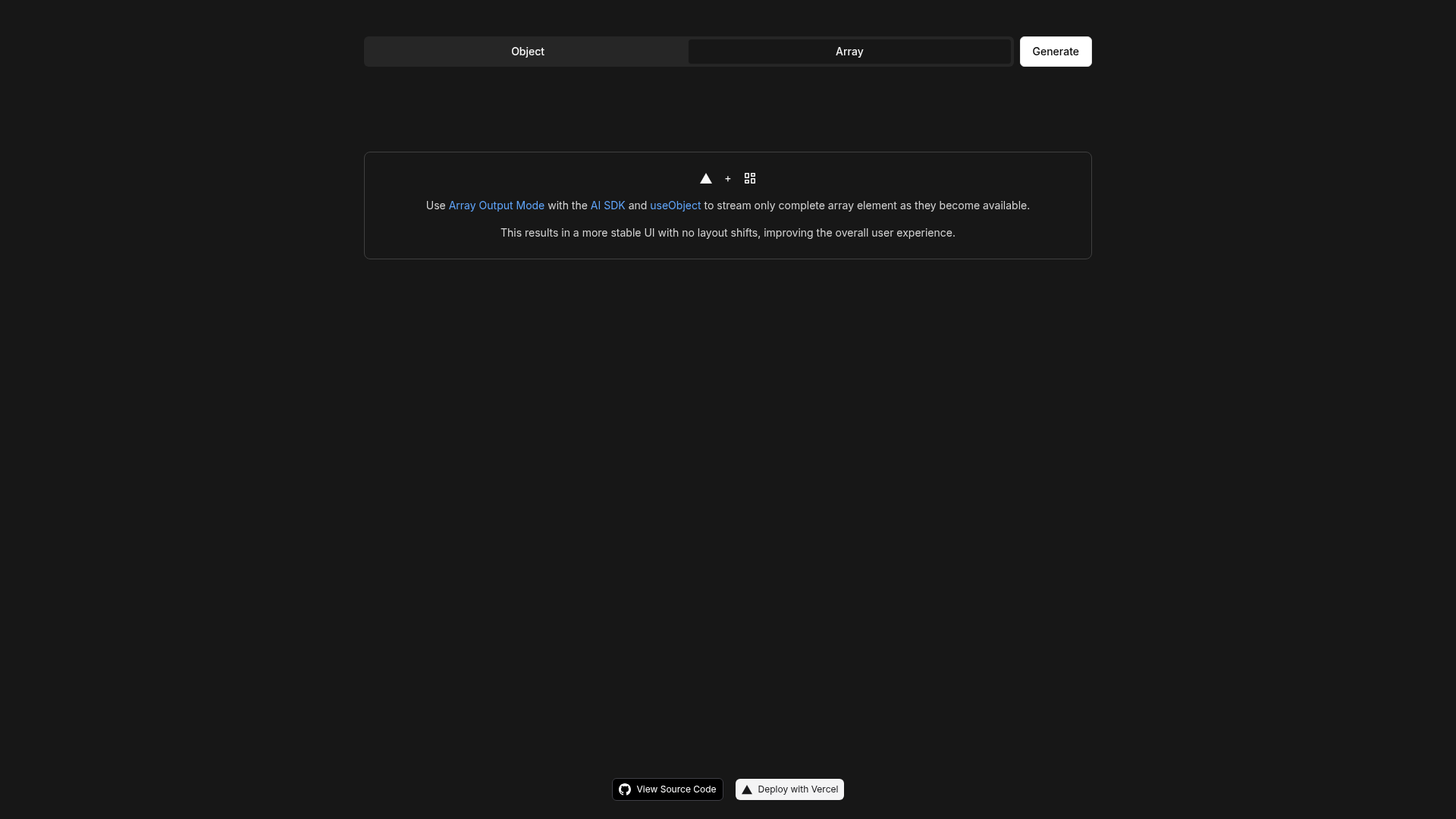
Next.js starter from Vercel Labs that streams structured objects one complete object at a time using the AI SDK streamObject array mode.
About this template
Structured Object Generation Array Mode is a Next.js starter project published by Vercel Labs that streams structured objects out of a language model one complete object at a time instead of token by token, using the streamObject function from the Vercel AI SDK with its array output mode.
What is Structured Object Generation Array Mode?
Structured Object Generation Array Mode is a Next.js application built by Vercel Labs that demonstrates the AI SDK's array output mode for streamObject, which delivers generated structured data as finished objects rather than partial token streams. It takes an OpenAI model call (configured through an OPENAI_API_KEY environment variable) as input and produces a stream of complete structured objects as output. The project runs locally on the Next.js development server at localhost:3000 and can be deployed directly to Vercel through the repository's deploy link.
What makes it stand out?
- Array output mode — the project showcases the output strategy documented by the AI SDK as "array", which streams structured objects by complete object instead of by token.
- Layout shift fix — because whole objects arrive at once, the render no longer reflows as individual tokens land, which is the layout shift problem this repo was created to address.
streamObjectintegration — the core generation call is thestreamObjectfunction from the Vercel AI SDK, notgenerateObjector a raw chat completion.- Next.js project structure — a standard Next.js app with a development server started through
pnpm devand reachable at http://localhost:3000. - pnpm tooling — dependencies are installed with
pnpm installafter cloning the repository from GitHub. - OpenAI key configuration — the app reads an
OPENAI_API_KEYvalue that you copy from the example env file into.env.localbefore starting the server. - One-click Vercel deploy — the README ships a Vercel deploy link that pre-fills the repository URL and the
OPENAI_API_KEYenvironment variable.
Who should use this template?
- Next.js developers building AI interfaces — anyone rendering model-generated lists or cards who needs objects to appear whole instead of being painted token by token.
- Engineers evaluating AI SDK output modes — developers comparing the array output strategy against the default streaming behavior of
streamObject. - Teams debugging layout shift — front-end engineers who need a minimal, runnable reference for why streamed structured data causes reflow and how the array mode avoids it.
- Prototypers — developers who want a working Next.js plus OpenAI starting point they can clone, run, and extend in a few commands.
What can you do with Structured Object Generation Array Mode?
- Build streaming list UIs: render model-generated items where each entry mounts complete, so the surrounding layout does not jump as the response streams in.
- Compare output strategies: run the same generation through the array output mode and observe how completion-by-object differs from token-by-token delivery.
- Start a new AI app: clone the repository, replace the OpenAI call with your own prompt and schema, and deploy it to Vercel with the same environment variable wiring.
How does it work?
- Clone the repository from GitHub and run
pnpm install. - Copy
.env.exampleto.env.localand setOPENAI_API_KEYto a valid OpenAI key. - Start the server with
pnpm devand open http://localhost:3000 in a browser.
FAQ
What is array output mode in the Vercel AI SDK?
Array output mode is a strategy for streamObject that streams a structured response by complete object rather than by token. The AI SDK documents it as the array output strategy, and this project is a runnable Next.js example of it.
Does Structured Object Generation Array Mode require an OpenAI API key?
Yes. The project reads the OPENAI_API_KEY environment variable, which you place in .env.local after copying the example env file. Without that key the model call cannot run.
What problem does the array output mode solve?
It removes the layout shift that appears when structured objects are streamed token by token. Because each object only renders once it is complete, list and card layouts stay stable while the model is still generating.
What stack does the project use?
It is a Next.js application that depends on the Vercel AI SDK for its streamObject call, uses pnpm as its package manager, and talks to an OpenAI model for generation.