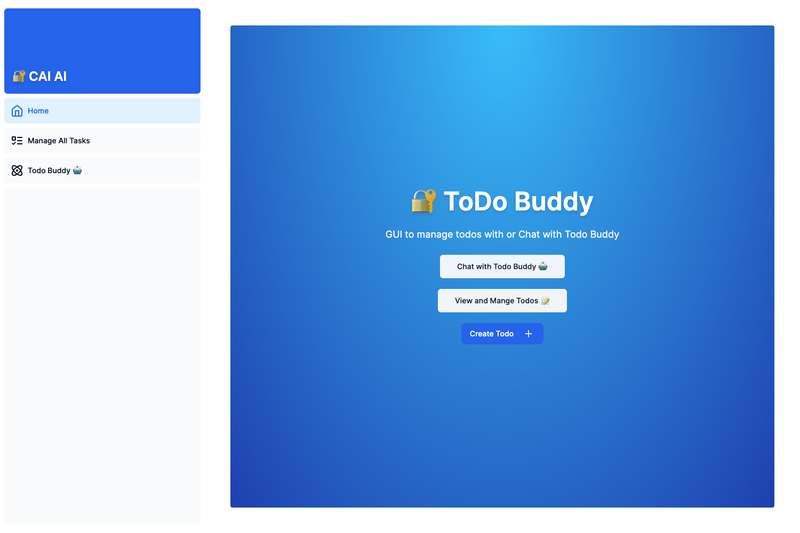
Todo Buddy is an open-source boilerplate that connects a Custom GPT conversational interface to a Next.js 14 web app, both performing CRUD operations on the same todo list through a FastAPI microservice deployed on Vercel.
What is Todo Buddy?
Todo Buddy is a starter project showing how to build a Custom GPT that syncs with a real web application. It takes a todo item as input—entered either through chat or the web dashboard—and stores, updates, or deletes it via a REST API exposed by a FastAPI microservice. The project uses SQLAlchemy ORM for database access and Alembic for migrations, and the frontend is a Next.js 14 app with a dashboard at /dashboard/manage. It is developed by mjunaidca and published as an open-source GitHub repository.
Key Features
- Custom GPT with Actions — Todo Buddy is available as a GPT at chat.openai.com/g/g-LsLmvsnKo-todo-buddy that can view all todos, add new tasks, update, and delete them through conversational prompts.
- Next.js 14 Dashboard — The web interface at https://cax-gpt-todo.vercel.app/dashboard/manage lets users manage todos directly; it's styled with Tailwind CSS (per repo topics) and uses PostCSS for processing.
- FastAPI Microservice — The backend runs on FastAPI and is deployed on Vercel alongside the Next.js app, exposing endpoints defined in an OpenAPI spec (gpt-openaispec.json) that is fed to the GPT builder.
- SQLAlchemy ORM + Alembic Migrations — Any database URL can be used; the guide recommends Vercel Postgres or Neon serverless Postgres. Migrations are generated with
alembic revision --autogenerateand applied withalembic upgrade head. - Single-User First, Multi-User Ready — The project notes it's built for a single user but can be extended to a multi-user web app.
- Vercel Deployment Guide — The README includes steps to link the project with
vercel link, set environment variables, and deploy withvercel --prod. - GPT Builder Integration — To create the custom GPT, you copy gpt-openaispec.json into the OpenAPI schema field in the GPT builder's Create Action step.
Who is it for?
- Full-stack developers who want a working example of connecting a Custom GPT to a web application with a real database.
- GPT builders who need a tested pattern for adding Actions to their custom GPTs, including the OpenAPI spec setup.
- Next.js developers looking for a todo-app boilerplate with a FastAPI backend and serverless deployment on Vercel.
- Indie hackers who want to ship a personal AI assistant that can manage tasks through both chat and a dashboard.
What can you do with it?
- Create a task-managing AI: Set up Todo Buddy’s Custom GPT in the GPT builder, then ask it to add, update, or list todos by speaking in natural language.
- Build a full-stack CRUD starter: Use the Next.js dashboard and FastAPI API as a base for other data-driven apps, swapping the Todo model for your own.
- Learn GPT Actions: Follow the included guide—from cloning the repo to pasting the OpenAPI spec—to see exactly how a GPT can call external APIs.
- Prototype a multi-user app: Extend the single-user task list to support teams by adding authentication and per-user data scoping, as the repo hints is possible.
How does Todo Buddy work?
The workflow starts with the user interacting with either the Custom GPT chat interface or the Next.js dashboard. Both send HTTP requests to the FastAPI service, which uses SQLAlchemy to read or write todos in the connected database. To make the GPT work, you clone the repo, set the environment variables (database URL and the local or production web URL for CORS), run Alembic migrations to create the Todos table, then paste the included OpenAPI spec into GPT builder under Create Action.