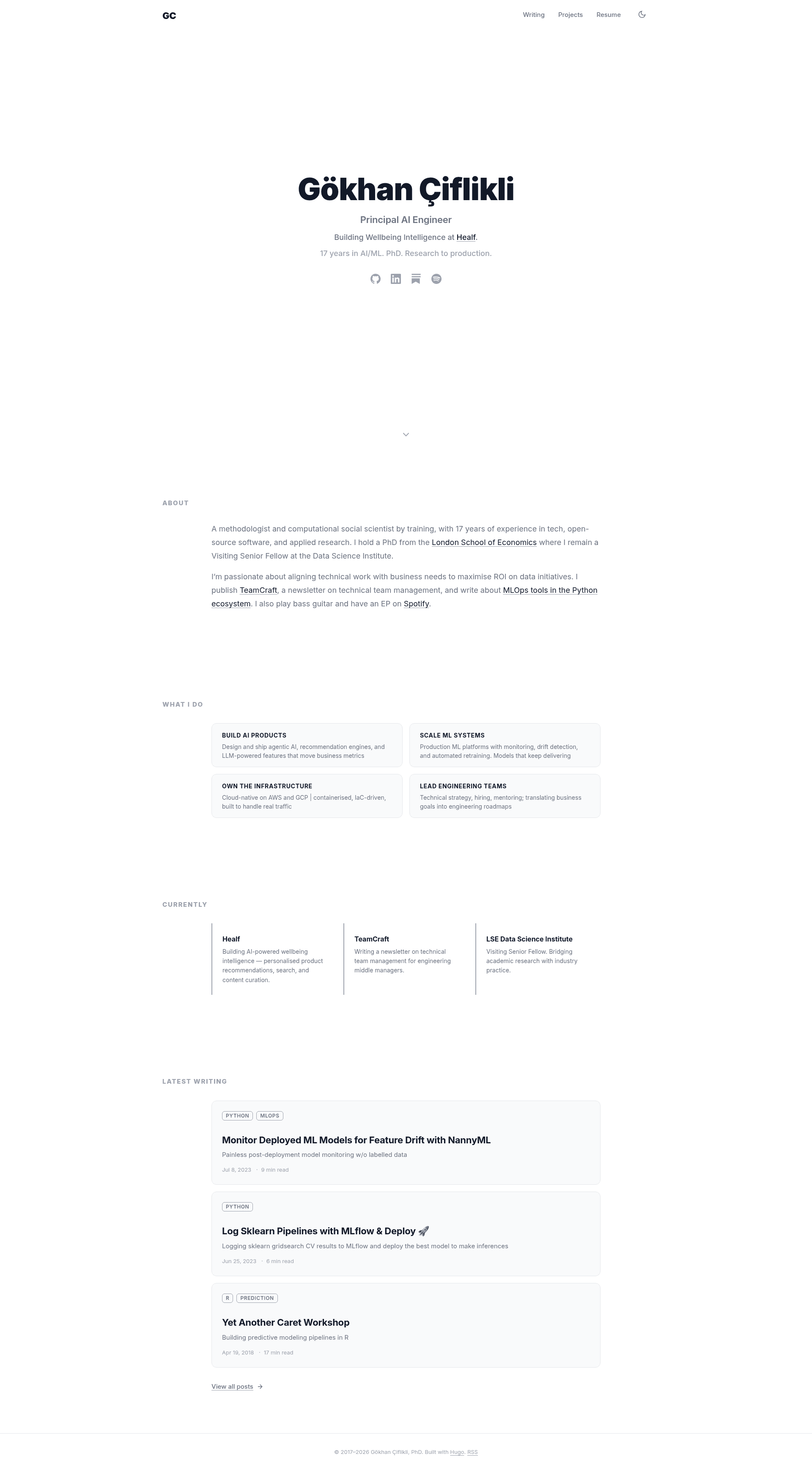
Personal Website is a blogdown-powered static site repository that generates gokhan.io, using the Hugo framework with R for data science, visualization, and forecasting content.
What is the Personal Website?
The repository contains the full source code behind gokhan.io, a personal website built with blogdown — an R package that combines R Markdown authoring with the Hugo static site generator. The site takes R Markdown and data files as inputs and produces a static HTML website that can be hosted on any static host, such as GitHub Pages or Netlify. The repository's topics list data-science, data-visualization, forecasting, r, and rstats, indicating the content focuses on data analysis presented through reproducible R workflows.
Key Features
- Blogdown integration — Uses the R package blogdown to write posts in R Markdown and render them through Hugo.
- Hugo static generation — Leverages Hugo's fast build times and flexible theming for a static output site.
- Custom CSS — Includes hand-written CSS to style pages, layouts, and visual elements without a UI framework.
- R & Rstats pipeline — Embeds R code chunks so every plot and analysis is regenerated on each build.
- Data science focus — Repository topics cover data-science, data-visualization, and forecasting as core content themes.
- Open-source reference — Public GitHub repository with 21 stars, useful as a template for building a personal blogdown site.
Who is it for?
- R users and data scientists — Who want a personal website where posts are written in R Markdown and include live code, charts, and statistical analyses.
- Researchers and academics — Who need a reproducible platform for publishing data-driven articles, preprints, and visualizations.
- Static site users — Who appreciate Hugo's performance and want to integrate R's analytical power directly into their site's content pipeline.
What can you do with the Personal Website template?
- Publish data analysis posts — Write R Markdown documents that execute R code at build time, generating plots and tables in the final HTML.
- Share forecasting models — Present forecasting results with reproducible charts and output tables embedded in blog posts.
- Learn blogdown setup — Study the repository structure to see how a real blogdown site is organized and configured.